![PortStrategy[GreenPort]](https://www.portstrategy.com/wp-content/uploads/2026/09/PortStrategyGreenPort.svg)



Smarter, stronger, greener
A new generation of mobile cranes is fast emerging with distinct smarter, stronger and greener characteristics
SECTOR ANALYSIS: MHCs: ECO POWER TO DATA DRIVE SOLUTIONS
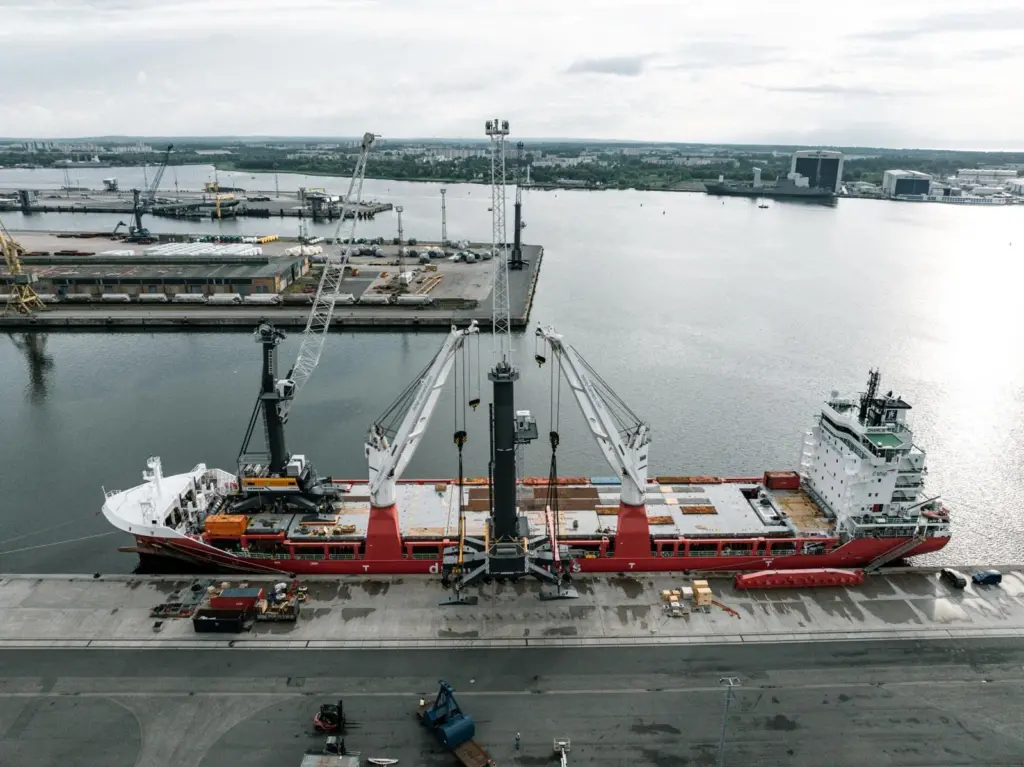
Electric power, analytics and customisation are major drivers for the port mobile harbour crane (MHC) market. According to DataM Intelligence’s Mobile Harbour Cranes Market Size, Share, Growth Trends and Forecast 2024-2031 report, this market is expected to grow at a CAGR of 25.1% during the forecast period. There is a greater demand for cranes that have higher lifting capacity to cope with the larger vessels entering service. The report highlights market themes: “Manufacturers are launching next-generation cranes equipped with advanced energy recovery systems and digital monitoring platforms for real-time performance analytics. Strategic collaborations between crane manufacturers and port operators are being formed to develop customised solutions tailored to specific terminal requirements.” The businesses cases below highlight these themes. Indeed, Liebherr, at the fiftieth anniversary of Its MHC division underlined its vision for the future includes more data-driven logistics. The large shift towards electric and hybrid power, driven by tightening emissions regulations, is also highlighted by the report, and seen in the latest MHC solutions reported by manufacturers.
DATA ANALYSIS: NEW ORDERS, ECO POWER & DIGITAL INNOVATION
GENMA: GENMA’s third generation MHC has boosted efficiency by 20% compared to its predecessors. The China-headquartered company reports that this is to a significant extent due to a smarter loading and unloading system which can choose the optimal path of operation and carry out the planned action in an optimal way. With improved anti-sway technology, container operations are smoother and more stable. This, according to GENMA, means that more time is saved, efficiency is improved and operator fatigue is reduced. In dry bulk operations mode, Intelligent Grabbing Technology means that the grab can adapt to a variety of materials, but at the same time each grab action is optimised. On the environmental front, GENMA provides a shore power option for customers which facilitates switching between diesel engines and shore power. Furthermore, the hydraulic accumulator can store energy and make use of it. Other features include a product life analysis system, which highlights the equipment condition and optimises maintenance, and a Multi Machine Cooperative Operating System, allowing the operator to command two cranes simultaneously.
Recent uptake: GENMA has announced that it has delivered three MHCs to an unnamed Latin American client. It includes one 210 tonne capacity GENMA MHC and two 150 tonne capacity GENMA MHC, both of which are customised according to the operational requirement. The 210 tonne unit has an intelligent hybrid power system, which utilises energy recovery technology in conjunction with diesel engines via accumulators to reduce energy consumption and carbon emissions.
Konecranes: Konecranes has won a clutch of recent MHC contracts, highlighting the move to electrified operations. Port of Manaus operator Super Terminais has placed a repeat order for three Konecranes Gottwald ESP.10 pedestal-mounted cranes to expand its Amazon River operations. Due to be delivered in Q3 2026. Super Terminais is repeating its 2021 purchase of the first three Konecranes Gottwald ESP.10 mobile harbour cranes ever produced. With a maximum reach of 64m and a strong lifting capacity curve, the pedestal-mounted cranes can handle containers and general cargo from vessels as large as super-post-Panamax class. The cranes can be connected to an onshore electricity supply to minimise emissions. Elsewhere, Dutch Combined Cargo Terminals (CCT) has ordered a Konecranes Gottwald ESP.7 MHC with external power supply for its terminal in Moerdijk. The crane is CCT’s response to growing freight volumes and meeting its own CO2 reduction targets. Delivery is scheduled for the third quarter of 2025. With a working radius of 51m, it is designed to increase handling performance. The external power supply for connection to the port network is intended to reduce fuel consumption and local emissions. The order is part of Finland headquartered Konecranes’ Ecolifting initiative. With this initiative, the company aims to continuously reduce the carbon footprint. Ecolifting also underpins Konecranes’ latest Generation 6 MHCs, a portfolio of six models. These are equipped with smart functions for automation and connectivity. They have a lifting capacity of up to 200 tonnes (400 tonnes in tandem lift with two cranes). Designed to use external power sources as well as to operate independently of the grid with consumption-optimised diesel-generator sets and modern hybrid drives, the crane range can also operate in conjunction with renewable energies such as wind and solar power as well as from the on-shore grid.
Liebherr: Liebherr has introduced Its LiSIM move mobile simulator, which is designed for rapid deployment and enables “realistic” training for Liebherr MHCs, specifically the LHM 550 and LHM 800. The system includes original Liebherr controls, a lifelike VR environment, and a user-friendly instructor interface. The simulator supports a wide range of training scenarios, from basic manoeuvres to complex operational challenges. Operators can practise 16 container handling exercises, five bulk handling tasks, and six breakbulk operations, each based on real-life port conditions. Adjustable settings such as ship draught and lighting conditions allow for tailored instruction, while built-in performance tracking ensures measurable progress. The Germany-headquartered company says that the LiSIM move saves approx. 99% of CO2 emissions compared to those generated in actual crane training.
Recent uptake: Green Energy Resources has invested in two electric LHM 550 cranes – a first-time collaboration between the Indian cargo company and Liebherr. The two cranes, with four-rope configuration, 124 tonne SWL, electric drive and overpressure units are being delivered fully assembled for immediate deployment at Green Energy Resources’ berth EQ1A in Visakhapatnam, India. Also notable, the Port of Dover has added a new Liebherr LHM 550 crane, which has a 54m outreach and 104 tonne lifting capacity. The unit is built as a high-rise version with a 4.8m tower extension, providing a more elevated crane operator perspective to support efficient cargo handling. It offers a capacity of up to 32 cycles per hour in container handling operations. The new LHM 550 runs on Hydrotreated Vegetable Oil (HVO). Liebherr has additionally delivered a new LHM 550 crane to BLG Logistics at its Bremerhaven car terminal. The crane is equipped with a 4.8m tower extension to accommodate ship heights and has a reach of 54m. With 10 drive axles, it can be used flexibly on site and operated with shore power.
Mantsinen: The UK’s Shoreham Port has announced its latest major investment with the purchase of a new Mantsinen 140M Hybrilift crane. The Mantsinen 140M has a maximum reach of 30 metres and a handling capacity of up to 900 tonnes per hour. Thanks to its Hybrilift energy recovery system, the crane offers greater fuel efficiency, enhanced reliability, and smarter energy use. Capturing and storing energy when the main boom is lowered, the system then reuses it when lifting – providing the equivalent of up to 210kW of additional power. Combined with closed loop swing hydraulics, on-demand hydraulic flow, and temperature-compensated performance, the crane operates efficiently in all weather conditions; using less fuel, reducing emissions, and keeping noise levels to a minimum. In line with other plant across the port, the crane will run on ISCC certified HVO (Hydrotreated Vegetable Oil), enabling an 80–90% reduction in CO2e emissions compared to traditional fossil fuels. The Finnish company says that its Mantsinen 140 is characterised by its energy efficiency and agility. “The 140 brings together the benefits of the smaller and nimble 120, as well as the big and fast 160, when cost per operated tonne makes the difference,” it states.
SENNEBOGEN: SENNEBOGEN offers what it claims is the largest material handler in the world and has also recently increased its port portfolio with a new model, as well as launching a new crane cabin. At the 2020 BAUMA trade show, the Germany headquartered company introduced its 885 G Hybrid MHC, with a 320 tonne operating weight and 38m reach. The crane can be optimised to meet individual needs. There is a choice of diesel or electric drive, the undercarriage can be designed as a tracked, mobile or rail-mounted version, and the flexibly adjustable skylift cab elevations can also be designed to suit the site and application. Elsewhere, in 2023, the company launched its new, completely redesigned Portcab large-capacity cabin. Its large glass areas to the front and sides, as well as floor panes made of safety glass, provide an unobstructed view across the entire work area and into the ship. The operator is also supported by cameras when monitoring the safety zones. The company additionally offers what it says is the largest material handler in the world, the SENNEBOGEN 895 E, with an operating weight of 420 tonnes and a reach of 40 metres. In November 2023, this model was delivered to the Gateway Terminal in Connecticut, USA. With cycle times of less than one minute, the 895 E enables faster loading processes. Its special skip pans, which are lighter than the original ones, have proven to be low-maintenance, resulting in cost savings. SENNEBOGEN’s Green Energy recovery system is claimed to be able to save up to 50% in operating costs via one or more additional hydraulic cylinders on the boom and a nitrogen accumulator in the rear. This enables the machine to store the energy generated when the boom is lowered and release it again when it is subsequently raised.
Related Articles
 TERMINAL OPERATIONS
 DIGITAL
 DIGITAL