





Lighting is vital in ports to ensure the safety and security of operations. However, new government schemes mean that lighting has to become more energy efficient, putting pressure on port authorities to review their lighting systems, says Michael McDonnell, business development director, Harvard Engineering.
Lighting performance levels at ports not only need to comply with dock regulations, but also need to deliver good night visibility to ensure staff security and the safe handling of goods. However, lighting a huge area, like a port, is complex and the introduction of new European legislation means that ports have to identify ways to lower energy consumption and carbon emissions.
The challenging economic climate also means that value for money is a major consideration, with long life lighting systems that can exceed requirements being looked on favourably. This includes lighting systems that can not only deliver energy saving solutions and a good return on investment, but environmental benefits as well. Not to mention lighting systems that can help reduce the problem of light pollution - which is very noticeable at ports.
Lighting technologies
Many, if not all of these requirements, can be met with the introduction of revolutionary dimmable lighting technologies. Installed alongside new or existing lighting systems, wireless control and monitoring solutions such as LeafNut are becoming an increasingly popular way to reduce carbon emissions, save energy and make cost savings.
Current lighting systems used in ports generally use old style copper or iron ballasts. Whilst these are reliable, they waste a lot of energy by running hot, as well as becoming increasingly inefficient throughout their seven to 10 year lifecycle. New electronic ballasts are equally reliable and are easily retrofitted to existing lighting by a ports own lighting maintenance team. The main advantage with using these technologies though, is that they have a power factor close to unity meaning there is little or no wasted energy, providing up to 25% of savings when compared to a copper or iron ballast.
LeafNut system
Using these electronic ballasts, lighting controls specialist Harvard Engineering, has developed a revolutionary system which allows total monitoring and control of port lighting. LeafNut is a wireless, web-based management system linking directly to the microprocessor of the electronic ballast to allow remote management and dimming of individual or groups of external lights.
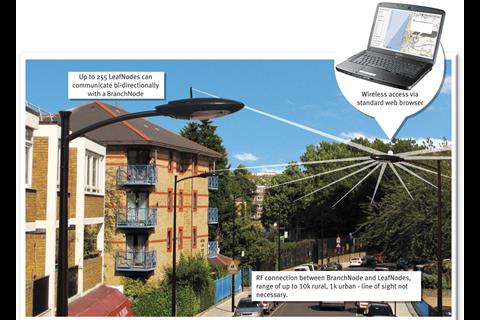
LeafNut works through a central web-based server called the TrunkNode, accessed by differential passwords allowing different access rights over a web browser on a computer, laptop, or android tablet or phone – a key operating feature of the system. The TrunkNode communicates via GPRS modem with BranchNodes, not unlike a mobile phone.
BranchNodes are cluster control units mounted on lights which are in continuous control of up to 256 LeafNodes, within a radius of up to 10km. Each LeafNode has a small wireless antenna linking directly to the microprocessor in the electronic ballast, which is how the remote monitoring, switching and dimming is achieved. As the number of BranchNodes is unlimited this also means the system is completely scalable, able to control from 24 light points to over 100,000 making it suitable for every size of port.
Using the central web server lights, can be pre-programmed to switch off or dim in periods of low use, and brought back to full power at the touch of a button, should this be needed. This ensures lighting is only provided when it is necessary and required, helping to save energy by up to 25% - in addition to the savings gained by using electronic ballasts - whilst also minimising light pollution and over illumination.
LeafNut is able to handle many different switching and dimming time profiles, making it flexible for use in a number of locations across the port, from car and freight parks, to terminals, loading areas and access routes. For example, between sundown and midnight, lights can be dimmed to 75%, between midnight and 5am 50% and between 5am and sunrise 75%. However, if a ship were to come in to port or leave port, this could be raised to 100% to ensure the safety and security of passengers, personnel and goods. In addition to this, police and emergency services can have log in details so should a safety or security issue occur, lights can be turned on to 100% intensity.
System securitry
As security is an important aspect within ports, if someone were to break in to the lighting system then the whole port could be compromised, the LeafNut system has a number of measures built in to ensure breaches do not occur.
The wireless network constantly and randomly hops between frequency channels in order to prevent jamming or any unauthorised access. In addition, all data is transmitted in an encrypted form, similar by that used by banks to deter hacking, and if any BranchNode fails, either mechanically or through vandalism or other damage, the LeafNodes it controls will continue to operate as previously programmed until the system is restored.
The system also provides nightly diagnostic reports, including operational efficiency, predicted lamp failure, ballast condition, fault finding and energy consumption which also allows maintenance periods to be extended and minimises the need for expensive night scouting and failed lamp checks which saves additional costs.
The simplicity of the system means that it can also be easily retrofitted in situ, with engineers only needing access to the lantern to change the old copper or iron ballast to an electronic version. The LeafNodes are mounted in the lantern and use power from the ballast, meaning no additional wires are needed. When all the BranchNodes and LeafNodes are installed, LeafNut is then simply activated through the website managed by Harvard.
Maximise savings
LeafNut can also be installed alongside new lighting schemes, such as LEDs, using relevant technologies. LED drivers would be used instead of ballasts to maximise energy savings although, the initial cost would be more than the cost of a simple retrofit.
Working with a number of well established financial institutions, Harvard Engineering also recently introduced a finance package which allows LeafNut users to buy the system without making a capital investment. The money saved through the reduced energy consumption is then used to pay for the system.
The installation of a wireless control system, such as LeafNut, allows the performance of each and every light to be maximised and the environmental responsibilities of a port to be achieved, whilst also saving money , a 'win-win' situation for all concerned.

