




Cold ironing has come a long way in the last five years, but it’s now ready to make a technological leap that will open up new horizons, writes Stevie Knight.
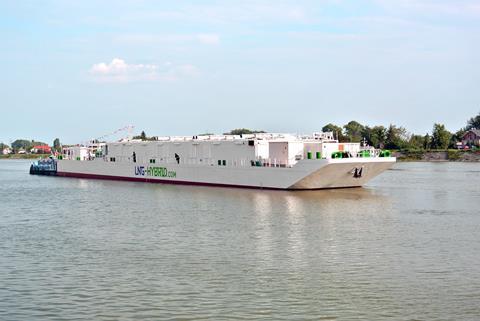
One novel concept sprang from very mundane origins. “Our initial idea was simply to support cruise ship arrivals by providing a general provisions barge - so the very first design included a small genset. When they saw it the cruise lines told us, 'this is really what we need, this power is what we want',” explains Christian Becker of (coincidentally) Becker Marine Systems.
But you can't just take a cable and plug it to a cruise ship - there's a lot of technical challenges to overcome. “First there's a very large power draw, it’s about the same as 20,000 or 30,000 households – while a big place like Hamburg has enough capacity to cope, a smaller city just doesn't have the power.”
Then there is the frequency issue – European domestic electricity is supplied 50Hz, while most vessels run on 60Hz. Last but not least, the cruise ships are seasonal stopovers, and certainly in Hamburg there is only need to provide shore power for around 700 hours per year. Therefore many cities may not think it worthwhile adding a burden of this scale to the infrastructure to cope with intermittent demand, especially as lines can come and go as they please.
The time was obviously ripe for an alternative. So, Becker Marine, supported by Aida Cruises, has designed and built a 'power barge' with five LNG engines to provide 7.5 megawatts of power - supplied at the right frequency - to welcome Aida ships on their Hamburg visits. “Zero emissions of particulates and SO2 are what make LNG engines. In addition, very low levels of nitrogen oxides are released and CO2 emissions are 20% lower than conventional marine diesel engines,” says Mr Becker. The barge is futureproof in more ways than one – in response to the scaling up of the cruise industry it has two extra slots ready and waiting to take another pair of engines, providing a total of 10MW of power. Further, as Mr Becker points out, a barge producing power can be moved, whereas a shoreside connection is very limited in its mobility.
However, development has had its challenges - the first idea was to bring the barge alongside the visiting cruise ship and simply pull an electricity link directly from one vessel to another. This wasn't a popular choice, worrying a number of people who didn't want a large LNG tank that close to cruise passengers for safety reasons: “There were questions about passengers flicking lit cigarette ends over the side towards the barge,” he said. The final plan settled on building a local grid with four connection points on the quayside, separating the cruise ship and the barge by a couple of hundred metres.
Secondly, it remains an expensive system and the cruise ships only come in for a total of around 700 hours per year – concentrated in the summer season. So what to do with the power for the other six months of the year?
“Things also get more complicated because there is a lot of fear about having 30 tonnes of LNG sitting so close to the city”, says Mr Becker. “With two 17 tonne LNG containers we can produce the power for three arrivals, but for safety we have to move the barge after every arrival, so it has to be taken on the 20 minute journey to what is considered a safe area.”
Also making life just a little more complicated is the nature of the barge – it isn't self-propelled as adding propulsion would have raised the class requirement complexity of an already intense project. Unfortunately, moving the barge by tugboat is very expensive says Mr Becker, adding that there are ongoing discussions with the port authority to find other solutions.
The concerns about handling LNG also impact the general operation including the refuelling pattern. “We have to take the LNG containers by truck to Rotterdam or Antwerp where they get refilled, and then we switch them over for the empty ones on the barge,” says Mr Becker.
Given all this, the whole investment needed to be clever in order to pay for its keep.
So, after the big cruise ships leave for the winter the power barge gets relocated to a more industrial site in Hamburg, and helps balance the budget by providing an alternative source of power for a manufacturing client that can use the power seven days a week. Further, at this industrial site the power barge will not necessarily be running from its own on-board LNG tanks, but may well be plugged into the wider gas grid, which is after all a cheaper solution.
However, what really adds to the attractiveness of the investment is that there is also a thermal distribution network so is not just power, it is also heat that is fed back into a local grid.
“This is very important for the harbours who may want to invest in alternative power connections, as it means a better business case if you can get a return on investment even outside cruise ship demand,” concludes Mr Becker.
Fuel cell alternative
The idea of putting a power source onto a barge has occurred to a number of people but LNG isn't the only candidate, there's also hydrogen.
In fact hydrogen fuel cells have a lot to offer – especially as there are some difficult questions to answer about the real environmental impact of a number of cold ironing power sources – shore power often has its origins in less than eco-friendly power stations and LNG, despite its recently raised profile in the greening of the maritime industry, is not, in fact a renewable energy and there can be considerable issues with regards to its extraction.
In the US an in-depth study by Sandia National laboratories has borne fruit: US based Young Brothers are stepping up to the mark by "seeing if everyone can get comfortable with using fuel cells to power reefer containers” says Joe Pratt, one of Sandia's researchers.
After reaching Young Brother's Honolulu facility it's normal for reefers to sit around on the quay for half a day but keeping them chilled means running a diesel genset which then gets transferred (along with the reefers) onto the barge transport. Mr Pratt explains that the alternative is to construct a containerised fuel cell and hydrogen tank combination that would be placed directly onto the barge – this could run a number of reefers and then continue keeping them cold for the onward journey.
The first build, modelled to provide a maximum 100kW of power using approximately 70kg of stored hydrogen, is underway and should reach the water mid 2015.
The reason for the investment is a potentially large fuel saving somewhere down the line. Sandia has put together some projections which show that “if the price of diesel is at $4 per gallon, and hydrogen is $5 per kg, and Young Brothers replace six 300kW diesel gensets - or about a third of their fleet - then they are looking at $200,000 of fuel savings per year...”
However, Mr Pratt is realistic and says this first prototype - like most - isn't itself going to be that economic when build costs are accounted for and further there's some pretty big assumptions about the shape of the fuel markets: “A large stumbling block is the lack of predictability on the price of hydrogen,” he adds.
The design is inevitably tied up with this concern – the barge being built for Young Brothers uses a Proton Exchange Membrane (PEM) cell (supplied by Hydrogenics Corp) which is still probably the most flexible, tried and trusted option but the downside is that a pure hydrogen source is necessary in order not to 'poision' the cell. Though it's possible to reform hydrogen from another gas, “you need to purify the hydrogen downstream and that adds to the bulkiness and cost of the installation” says Mr Pratt.
Even given this, hydrogen is a development worth keeping an eye on.

