Digitalisation in ports continues to expand and Port Management Information Systems are a growing area of investment. Phoebe Davison examines recent market trends and activity
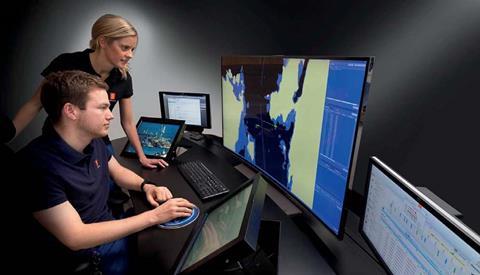
Digitalisation and the growth of new digital products supporting the shipping and ports industry continues to see tremendous growth with a wide range of different companies offering diverse solutions, and notably in the fast growing area of Port Management Information Systems (PMIS).
Information provider, Data&, estimates that at the start of 2022 the global maritime digital products and services market was worth in excess of US$150 billion and within 10 years this total could surpass US$350 billion annually. Big numbers.
PMIS are a key component of this sector and are being welcomed by many ports, as confirmed by the United States Environmental Protection Agency (US EPA): “The European Union has prioritised implementation of PMIS at its major ports….the Port of Rotterdam is well-known for its large-scale use of PMIS, and the Ports of Valencia and Hamburg have also developed advanced PMIS. In Asia, the ports of Singapore, Hong Kong, and Busan are prominent users of PMIS. Many major US ports have implemented PMIS, to varying extents, including the Port of Virginia, Port Authority of New York and New Jersey, Port of Oakland, the Port of Los Angeles and the Northwest Seaport Alliance.”
TAKING THE PLUNGE
There are a number of notable recent examples of ports taking the plunge and implementing PMIS, as the following examples confirm:
- The Port of Baku, Azerbaijan, is implementing a PMIS and expects the benefits to deliver optimised use of the port’s terminal operational areas, leading to lower operating costs and increased speed and efficiency of data exchange between all freight processing parties. Other supporting benefits include reduced paper usage, speeding up of interaction processes and increasing data accuracy
- Malaysia’s Port of Tanjung Pelepas has deployed Innovez One’s AI-powered PMIS, dubbed MarineM. The introduction of MarineM provides an interface where port agents can register vessels and order services to support ship arrivals (such as supplies and marine services), with machine- learning algorithms using a planning module to automatically manage schedules and ship resources. As opposed to manual planning, the AI-powered system is able to instantly reallocate resources if a vessel’s ETA changes, thereby limiting waiting times and making the Port of Tanjung Pelepas more resilient in the face of congestion.
- Brunei Darussalam, provider of pilotage and towage services for the port of Muara, Brunei, has also deployed MarineM to fully digitise and optimise all marine services for vessels arriving and departing the port. The digital platform replaces paper-based processes to capture job requests, track the progress of each job in real time, and generate invoices automatically.
- In the UK, Associated British Ports is continuing to introduce vessel traffic services and port management information systems across all 21 of its ports following a deal signed with Wärtsilä, through the Wärtsilä Voyage digital software arm. Due for delivery before April 2023, the Port of Southampton will be using wide-ranging software applications. These include just-in-time (JIT) arrival monitoring and scheduling, machine learning algorithms and artificial intelligence applications to support operational efficiencies.
- PORTIC, the port community system (PCS) of the Port Community of Barcelona, has released a new technological platform targeting both the capacity and speed of processing of operations and cybersecurity, in order to optimise performance, security and resilience. The project represents a US$5.3 million investment by the port to refurbish PORTIC’s technological infrastructure, after more than 10 years in use, with the aim of providing electronic document interchanges while including new AI technologies.
So, there is demand from the port industry for PMIS, but which companies are providing the products?
Table 1 highlights a cross section of the companies currently offering PMIS solutions to ports. While the list is not exhaustive, it nevertheless confirms that the requirement to supply PMIS is global, with the geographic range of companies located throughout Europe, Scandinavia, India, Asia and North America.
| Company | Headquarters/Key Location | PMIS Product(s) |
|---|---|---|
| Caribbean Software Solutions | St. Maarten, Caribbean | Port Management System |
| Data-Core | Philadelphia, USA | e-PIS |
| Empross | Athens, Greece | Integrated Port Management System |
| Envision | Hyderabad, India | iPortman |
| Experion Maritime | Mijnsheerenland, Netherlands | xPort® |
| GISGRO | Jyväskylä, Finland | Port Management & Digitalisation |
| Innovez Partners | Singapore | Port Management Insights (PMIn-sightsTM) |
| Irugasa | Hong Kong / Shanghai, China | Irugasa PMIS |
| Klein Systems Group Ltd | Burnaby (BC), Canada | Kleinport |
| Kongsberg | Kongsberg, Norway | C-Scope |
| Leonardo Company | Roma, Italy | I-Port |
| Marcom | Madrid, Spain | PORTCONTROL™ |
| NASH Maritime | Southampton, UK | SEE PANEL: TAILORED SOLUTIONS |
| Saab | Stockholm, Sweden | PortControl |
| Sercel Concept | Nantes, France | Marlin Smart |
| Transas | Mumbai, India | Transas PMIS |
“NOTHING IS PERMANENT EXCEPT CHANGE”
This well-known quotation from Greek philosopher Heraclitus is one that Experion Maritime quotes in relation to its port management information system. In a similar vein, Sercel Concept adopts an equally pertinent description of its Marlin Smart PMIS offering: “Automate the mundane so you can focus on the important.”
With more than 5000 commercial ports operating globally, according to Data&, there are a high number of opportunities for companies offering PMIS products, even allowing for removal of hype from reality regarding potential. The market is growing, but so is the need for these solutions.
Although probably better known as a former vehicle manufacturer and builder of fighter jets, Saab underlines why integrated solutions for maritime users on a global basis are needed in order to ensure efficiently run ports, to overcome current challenges: “At present 30 per cent of shipments are delayed, 25 per cent of trucks on the road are empty and each transaction in the supply-chain can involve up to 28 parties.”
Topics
- Busan Port
- Data&
- Digitalisation
- Equipment
- Northwest Seaport Alliance
- PMIS
- Port Authority of New York and New Jersey
- Port Management Information Systems
- Port of Hamburg
- Port of Hong Kong
- Port of Los Angeles
- Port of Oakland
- Port of Rotterdam
- Port of Singapore
- Port of Valencia
- Port of Virginia
- Products & Services
- United States Environmental Protection Agency