The terminal tractor supply sector is pushing on with work aimed at introducing new clean fuel designs.
SECTOR ANALYSIS: HYDROGEN FUEL CELL INTEREST BUILDS
The terminal tractor supply sector is pushing on with work aimed at introducing new clean fuel designs. Hydrogen fuel cell powered designs are clearly the flavour of the day with various prototypes now under test and US-based Capacity the latest manufacturer to introduce an entirely new design. The economies inherent to such designs and particularly extended operational times, low maintenance costs and, compared to electric powered units, the requirement for less expensive support systems for refuelling together with other attributes are all seen as appealing to users and as such are primary catalysts to development work. Adding fuel to the fire (excuse the pun) of R&D is the enlisted support of specialist environmental engineering consultancies for propulsion and energy solutions as well as fuel cell providers such as Nuvera, a specialist in the provision of zero emission hydrogen powered fuel cell engines. In addition to the work in the field of power source, there is also steadily growing interest in autonomous driving solutions – the most recent example being Hamburg terminal operator HHLA’s decision to invest in the Munich-based start-up Fernride, which is developing solutions in this field. The two companies are implementing a pilot project for highly automated and electric container logistics at the HHLA TK Estonia terminal in Tallin with terminal tractors central to this.
R&D, PROTOTYPE TRIALS, NEW PRODUCT LAUNCHES, DESIGN INNOVATION
Capacity
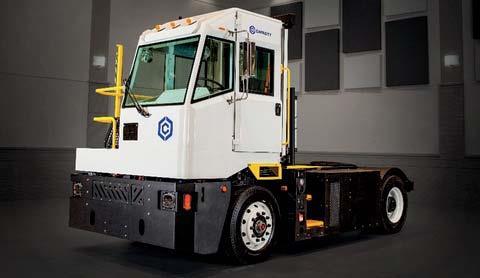
As PS goes to press, Capacity Trucks announces that its new Zero Emissions Hydrogen Fuel Cell Electric Terminal Truck will be formally launched at the Technology & Maintenance Council Annual Meeting, scheduled to take place in Orlando, Florida late February/early March. Capable of handling GCVWR of up to 180,000Ibs Capacity states the new unit is designed to operate for at least one full shift before refuelling and with this able to be completed within 15 minutes. A new generation terminal tractor design, the unit features a new look and redesigned cab as well as Capacity’s patented Dura-Ride air ride suspension.
In 2020 Capacity Trucks formed an alliance with the Hyster-YALE Group to jointly develop electric, hydrogen and automation-ready terminal tractors. Capacity states: “The collaboration leverages each company’s product expertise in the global material handling solutions market, bringing together Capacity’s robust terminal truck platform and Hyster-Yale Group’s vast experience in lift truck electric powertrain and hydrogen fuel cell technology developed by its subsidiary company, Nuvera.”
Gaussin
Prominent in Gaussin’s terminal tractor product range is its APM 75T autonomous tractor design which the company offers in electric and hydrogen powered versions. Simplicity of operation and low maintenance costs are highlighted by the company as key features together with the ability to achieve a ROI in just two years. The electric (FULL ELEC – BEV) and the FUEL CELL/HYDROGEN (FCEV) designs share a single modular vehicle architecture – a common platform thus enjoying the benefits of standardisation. Gaussin has pursued autonomous driving systems design since 2013, aiming to introduce its systems into the overall automation plans of terminal operators.
Also offered by Gaussin is the ATM 38T electric yard tractor purpose-built for trailer and semi-trailer movements as required for applications such as distribution centres, logistics hubs, container depots and other industrial applications.
Hyster
Under the Clean Port and Logistics Programme, a joint initiative of Hamburg-based container terminal operator HHLA and other European companies, Hyster has committed to supply HHLA with a hydrogen fuel cell powered terminal tractor and top pick container handler.
The terminal tractor was scheduled to arrive at HHLA in late 2022 and the container handler in early 2023. Both units will be powered by Nuvera fuel cells and run on hydrogen fuel produced locally at the HHLA Hamburg Green Hydrogen Hub. Specifically, the terminal tractor design incorporates a 45-kilowatt Nuvera fuel cell. The two units have also been configured to share many of the same components such as drive motor, battery modules, converters, hydrogen tanks and controls – the overall objective being to limit complexity, cost of design, manufacturing, service and maintenance.
The collaboration between Hyster and Capacity in the terminal tractor market – aimed at jointly developing electric, hydrogen, and automation-ready terminal tractors is highlighted in the Capacity entry above.
Kalmar
A part of the Cargotec Group, Kalmar announced at the beginning of this year that it is collaborating with Toyota Tsusho America Inc. and the global strategic environmental engineering consultancy Ricardo in a project to develop fuel cell powered terminal tractors. As part of this project, two fuel cell powered terminal tractors will be trialled with a USWC container terminal. Kalmar underlines that compared to battery powered solutions – which it also offers – fuel cell powered terminal tractors will deliver extended operational uptime and reduce the need for new investment in electric grid infrastructure. Speaking at the time of the announcement, Chris Dvorak, Director of Engineering, Kalmar said: “We are applying the learnings we have gained from our battery-electric platform to implement a modular fuel cell platform that will help customers meet increasingly strict emissions targets. This is in line with our terminal tractor roadmap and supports Cargotec’s 1.5°C climate ambition.”
The overall development programme is designed to demonstrate the feasibility of fuel cell and hydrogen technologies for terminal tractor applications.
Kalmar is also engaged in a US$20 million investment at its Ottawa, Kansas manufacturing plant which will realise a doubling of capacity, the conversion of the existing line to a high-speed line for ‘rapid build’ distribution terminal tractors and the addition of a new ‘flex line’ with state-of-the-art technology to enable high-volume production of Kalmar’s fully electric and high-end terminal tractor models. The anticipated benefits include significantly reduced lead times for the supply of new units.
The Kalmar-Ottawa electric terminal tractor range is described by the company as in its second generation and featuring a number of key improvements over the first generation – charge time cut in half, a direct drive solution, the ability to operate in extreme temperatures and of course zero carbon emission.
MAFI
The company added to its clean fuel tractor range in the second half of 2022 with the launch of a propane powered terminal tractor design. The unit incorporates PSI’s CARB-certified .02 NOx 8.8 litre propane engine which is claimed to produce fewer lifecycle emissions in comparison to an electric powered unit. Mafi further highlights the cost parameters of the new design stating a propane port tractor can be acquired at around one-third of the cost of an electric counterpart and with the added bonus of “refuelling infrastructure that cost significantly less than electric recharging infrastructure.”
This new design option follows on from Mafi’s introduction of an electric version of its popular T 230 diesel terminal tractor in early 2021. It is powered by a battery pack with a capacity of up to 177 kWh. Also available is the T 225 De electric distribution tractor, employed especially for moving semi-trailers in distribution and logistics centres. The long wheelbase of 3500mm allows for significantly more free space between the semi-trailer and the driver’s cab.
Terberg Taylor Americas Group
This Group is a joint venture between the Royal Terberg Group and the Taylor Group of companies and in January this year it broke ground on a new US$20 million manufacturing facility in Lowndes County, Mississippi, USA. The Group reports: “The Terberg Taylor relationship is the result of two privately-owned companies with very similar business models coming together to build the best terminal tractors for their customers.” The facility will be built as a scalable design so that it may continually meet production demands with the first terminal tractor expected to be produced in 2024. The Terberg Taylor alliance covers the USA as a whole.
Terberg
Outside of the USA, Terberg has also been busy in its own right. In December 2022 Terberg Tractors Malaysia Sdn Bhd (TTM), the joint venture between the Royal Terberg Group and Sime Darby Industrial, added to its tractor portfolio the fully battery-powered electric terminal tractor, model YT200EV. Terberg notes: “The YT200EV terminal tractor features 350 kWh Lithium Iron Phosphate (LFP) batteries that provide continuous operation for up to 10 hours (in container port operation) and can be fully charged within an hour. The vehicle also features a 240 kW asynchronous water-cooled motor drive, capable of sufficient torque to carry up to 90 tonnes payload, making it more efficient and cost effective compared with diesel tractors.”
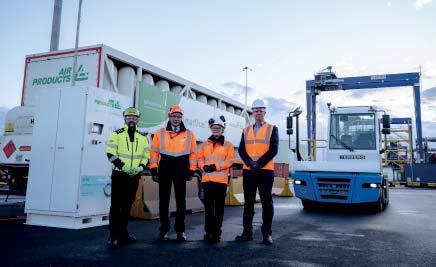
In Europe Terberg Special Vehicles commenced testing its concept Hydrogen Fuel Cell YT Terminal tractor in mainland Europe, first in the port of Rotterdam and then, in late 2022, in the port of Antwerp, and in January 2023 in conjunction with Associated British Ports (ABP) at its Immingham facility. The latter comprehensive pilot project has received funding from ORE Catapult through Innovate UK’s Hydrogen Innovation Initiative, following funding of initial feasibility from the UK’s Department of Transport Clean Maritime Demonstration Competition. For use in conjunction with the project Air Products has provided a mobile hydrogen filling station.