
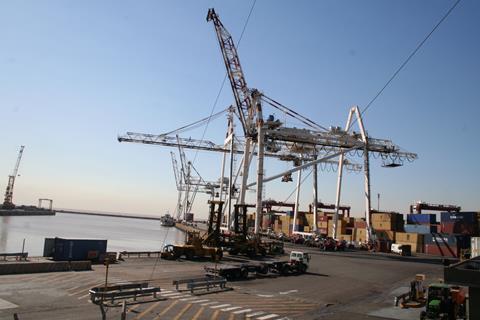
Ports on South America''s East Coast are vying for the undivided attention of the lines,as Rob Ward finds out
The burning issues on everyone's lips in recent months in East Coast of South America port circles have been dredging, "when will the bigger ships start calling?" and also where will they go?
Different from most trade lanes around the world - where contraction is the buzz-word - in Brazil, Uruguay and in Argentina for different reasons, provision is being made for larger, more cost-efficient vessels to start calling and for schedules to include fewer ports of call.
There will be a concomitant rise in cabotage and coastal services and a number of coastal operators - including Brazilian-owned Log-In and Brazilian-flagged (but Hamburg Sud and Maersk Line owned) Alianca and Mercosul Line - are champing at the bit as they lie in wait to service those requirements.
The hub and spoke system seems to be on its way. Already the 5,905 teu Rio class vessels of Hamburg Sud have started to call along ECSA ports. And pundits are saying that the next generation - the 7,000 teu capacity Santa class ships - might arrive in 2010, if world trade picks up a notch or two, although further delays could be in the pipeline if they don't.
In anticipation, Hamburg Sud is progressing its long-awaited Itapoa transhipment hub port project, and it should open sometime next year in time for Santa, and there are reports that some trial calls will be made before 2009 is out.
Henrik Simon, the director for reefer cargo for Hamburg Sud in the ECSA trades, tells Port Strategy: "Obviously the best natural hub ports are those with deep water so you have to include Rio Grande, Itapoa, Suape and Pecem. And of course Santos will have to be added to the list of future hub ports once the current dredging plan there is completed."
And to connect into the future of this Brave New New (sic) World of transhipment hubs several carriers have already introduced a number of feeder operations from the River Plate up to Itajai, in the south of Brazil.
Hamburg Sud itself is carrying more and more feeder boxes on its Brazilian flag Alianca operation between the River Plate and Brazil, and MSC has been running a regular feeder service from Rosario, on the Parana river, some 300 km northwest of Buenos Aires. The MSC service - using the 1,282 teu MSC Chelsea - operates up to the new Portonave box facility at Navegantes (facing Itajai across the River Itajai-Acu river), and Hapag Lloyd has just taken over the charter of the Pampero (514 teu capacity), from Zim to run a similar service.
For some years now other Plate operators - including Lineas Feeder, Vessel SA and barge operator Mercosur Shuttle Group (MSG) - have contemplated extending their networks to one key southern Brazilian port or another, with Rio Grande, Porto Alegre, Imbituba and Itajai top of the lists.
However, Vessel SA had some problems with one of its vessels - the 450 teu Transmodal which caught fire off the Brazilian coast - and had to abort its Brazil expansion plan, and the other independent operators have been gazumped by the dedicated feeders from the deep-sea carriers.
And Maruba, the sole surviving Argentine flag operation, has also been considering operating coastal services into Brazil, already having in place a container barge service up to Paraguay, with connections to Uruguay and Argentina. And maybe a feeder connection up the River plate to southern Brazil will be the next step, as Buenos Aires draught, of just 10 metres, struggles to keep up.
Claudio de Michelis, a key co-ordinator for liner services for Maruba, tells Port Strategy: "We have seriously considered the possibility of doing something similar to MSC, for example connecting the River Plate to Navegantes with a small feeder vessel."
So what effect will all this have on the ECSA port systems?
Quite a dramatic one, according to Mr de Michelis, who says: "Buenos Aires is very congested, and has no draught so, in my personal opinion, I think that in the future it will be served from a port in the south of Brazil, Rio Grande, or maybe even the new terminal of Portonave at Navegantes. Brazil is spending huge sums on dredging right now and this will give their ports the edge."
Mr de Michelis does not rate Montevideo either believing that it "lacks sufficient space to become a true regional hub port".
Already a number of ports are clamouring to become one of the three to five ECSA hub ports that will be nominated by the deep-sea carriers once their larger vessels (in the 7,000 to 8,000 teu range) are in place.
The main heavyweight contenders are Santos, Sepetiba, Suape or Pecem (in the northeast of Brazil) and Montevideo.
Then there are the ports of Rio Grande, Itajai/Navegantes, Paranagua who will compete to become the regional hub port for southern Brazil and the River Plate.
"There are exciting times ahead as to which box terminals will become the hub ports for Brazil and the ECSA," says Richard Klien, vice-chairman of Santos Brasil (South America's largest port operator) and also one of the owners of shipping line Transroll Navegacao.
And playing a crucial role in these "exciting times" is the current Reais1.6BN ($706m) dredging programme from the Brazilian government.
This is already underway and by paying to dredge certain ports down to levels at 14 m and deeper, this will pave the way for even more candidates to make a "legitimate bid" to become a hub port.
Several experts spoken to in researching this feature said that a case could be made for deep-sea vessels to journey no further south than Santos, and Santos Brasil's Mr Klien says he doesn't believe any viable candidates (for hub status) can exist further south than Imbituba - obviously cognisant of his vested interests in the self-same facility.
Mr Klien is also backing Santos Brasil's recently acquired operation in the south of Brazil - Tecon Imbituba - to become a hub port for southern Brazil and the River Plate.
Santos Brasil is spending some Reais283M ($125m) on Imbituba which will give it extra berthing length and dredging down to 11.5 m (Phase One) by the end of this year and eventually down to 15 m (in Phase Two). Tecon Imbituba says it could have a capacity of 1m teu per annum by the end of this year, or early next.
Mr Klien argues: "Carriers could make huge savings by turning vessels somewhere in the Imbituba (Santa Catarina) range. By cutting one days sailing - in comparison to a call at Rio Grande or Montevideo - some serious money can be saved.
"I think a lot more transhipment is coming to the ECSA sooner than we think. I believe that owners will soon start pulling vessels in the 7,000/8000 teu range from the East-West trades and dropping them into the north-south trades where volumes haven't fallen so much."
It certainly beats having these vessels laid up for a year or so.
A claim can be made for Imbituba and Itajai/Navegantes but it would be foolish to rule out the two deepwater ports already in place: Suape and Sepetiba (also known as Itaguai).
Sepetiba has long been talked about as a potential hub port for the ECSA and with some 40% to 50% of its boxes already being handled as transhipment cargo it is well on track to reach the hallowed status.
And Suape, with 14.5 m of natural draught, is also in a league of its own to become the regional hub for the northeast of Brazil, easily beating off Salvador, which has draught and space restrictions.
Many thought at one stage that Suape could become the port for all Brazil.
Being located at a point closest to Africa and Europe, some strategists - including the German consultant Hans Peters, a former advisor to the World Bank on transport issues - that one call (from Asia, Europe and the US) at Suape would suffice for the entire ECSA and then feeders could operate from there.
But the theory that Suape could become a one-stop shop for ECSA has been strongly debunked by others.
Neil Davidson, the director for ports for Drewry's Shipping Consultancy, says that Suape "certainly has the potential to become a hub port for the northeast of Brazil but I doubt that many vessels will be calling only at Suape when around 40% of all the cargo on board is destined for Santos.
"For me Santos is the Must Call port in the ECSA," he tells Port Strategy, "and therefore it makes a lot of sense to do any transhipment from where you are going to have to call anyway."
Mr Davidson and others add that, given the current economic climate, financial viability was also going to prove an important factor in ECSA port development over the next couple of years.
But as long as the dredging programme continues and the bigger 7,000/8,000 teu vessels get "cascaded" down to South America, a nascent hub port and spoke system is possibly only months away.