



The charge for shore power
There are still obstacles to overcome but the take-up of onshore power supply is rapidly gaining momentum supported by an innovative system supplier sector
SECTOR ANALYSIS: STANDARDISATION, REGULATION AND INVESTMENT CAPACITY
The use of shore power in ports has rapidly gained momentum, but challenges to overcome include global standardisation and investment.
While the IEC 80005 standard, established in 2012, is key, there is a need for more globally standardised practices to enable compatibility across ports and vessels.
Strategy for Shore Power in the Port of Rotterdam, this report highlights standardisation as a concern for complex shipping segments – such as liquid bulk and transshipment – where transition to shore power is more difficult and therefore in need of regularisation. The report says: “International collaboration and the establishment of a policy for standardisation are crucially important for developments in this area.”
But progress is being made, as the report notes the Port of Rotterdam is focusing on working with international partners to establish international technical standards.
Elsewhere Reducing Emissions from Shipping in Ports; Examining the Barriers to Shore Power a report by the British Ports Association (BPA) underlines that the primary barrier to adoption is capital cost. “A green maritime fund to support shore power in the UK is clearly needed to help meet prohibitive costs, particularly around energy networks and generation,” emphasises the BPA..
Regulation is also important – Europe is ahead of other areas, driven by regulation that states all main European Union ports must install shoreside electricity by 2030.
While, however, there are hurdles to overcome, the below shore power system supplier news highlights how progress is ongoing, with new projects, technical innovation, investments and overall solutions.
INSTALLATIONS, TRIALS, R&D, JOINT VENTURES AND NEW SOLUTIONS
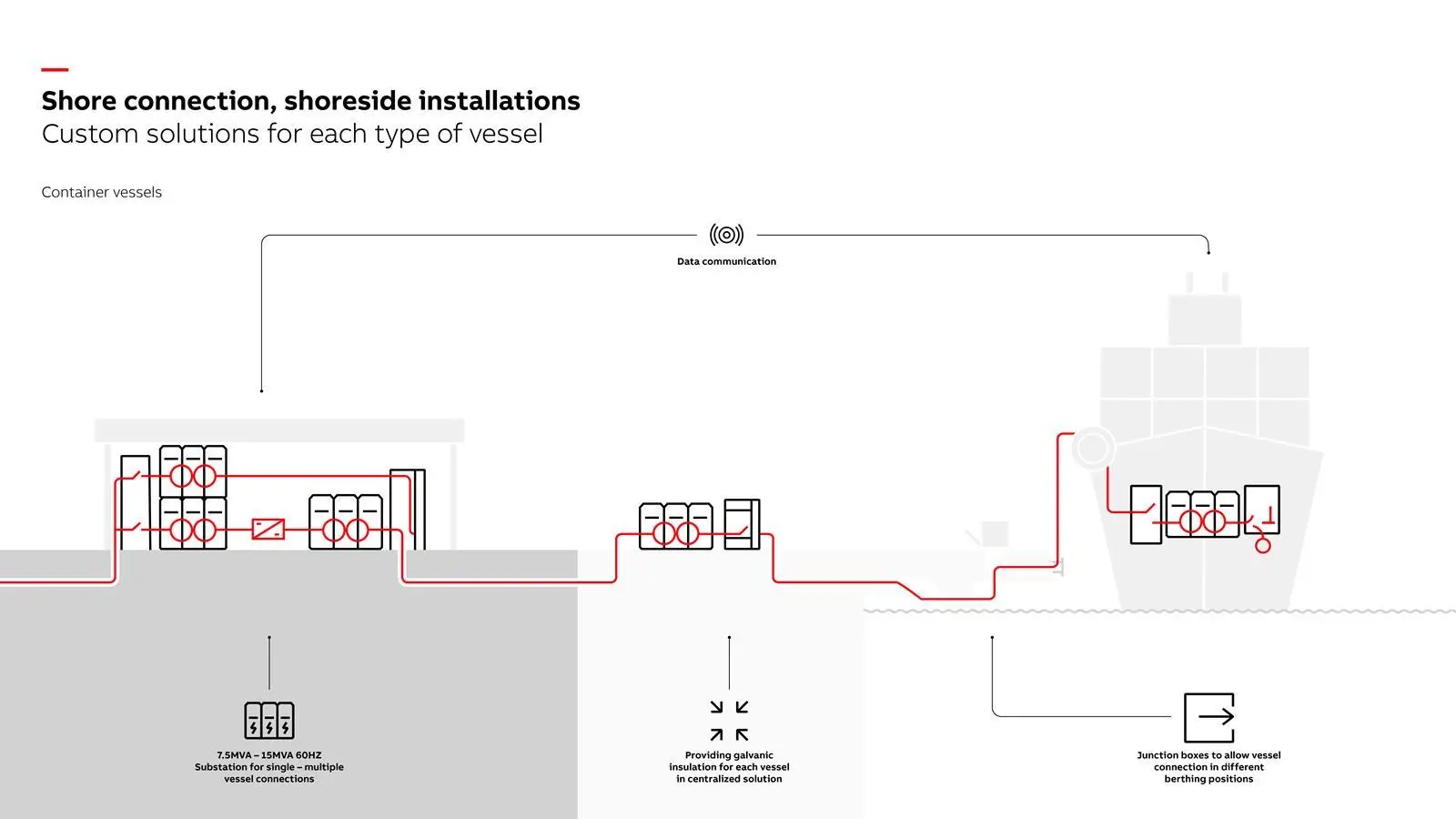
ABB: Switzerland-headquartered ABB has recently won a clutch of contracts that extend the use of its shore power connections. The company will supply Portsmouth International Port, UK with a shore connection solution for ferries and cruise ships. Part of the UK port’s Sea Change project to design, build and operate a shore power system across its three busiest berths, the installation will serve two ferry berths – each with five connection points – and an additional berth shared by ferries and cruise ships. The system is due for installation in the fourth quarter of 2024 and expected to be operational by the second quarter of 2025. ABB’s full scope of supply for the shore connection system comprises a 16-MVA ACS6080 drive with shunt filter, MV switchgear, power-factor compensation, transformers, e-houses, cable management systems, and automation. Also notable in March it was announced that ABB will install shore power to connect to DEME vessels calling at their base in Vlissingen’s (Netherlands) by the end of 2024. In December 2023 ABB introduced its CO2e Calculator to boost transparency of vessel operation emissions. For shore power connections, the tool calculates the estimated reduction in emissions that can be achieved by drawing from the shoreside utility grid instead of generating electric power using onboard generators.
Actemium Nederland: Dutch company Actemium Nederland has provided an on shore power (OPS) installation for Rotterdam Shore Power, a joint venture between energy company Eneco and the Port of Rotterdam Authority. The shore power installation was commissioned for DFDS JinLing ro ro vessels servicing a route to and from Immingham. Located at the DFDS terminal in Vlaardingen, the shore power facility consists of a converted 40-foot container containing electrical equipment that makes electricity from the public power grid suitable for use onboard the vessels. The shore power installation has a capacity of 1.8 MW and is expected to provide 3.5 GWh per year of electricity. Actemium provides flexible, containerised, moveable or static building shore power systems.
Blueday Technology: Provider of marine shore power and charging systems Blueday Technology has recently scooped contracts for the installation of its BluEco Shore Power system. It is being installed – as part of a turnkey contract awarded to Blueday – at the Port of Stavanger’s terminal in Risavika (Norway) and is scheduled to be completed this year. Additionally, in May last year the Norwegian headquartered company announced that it had been selected by Fjuel AS for a turnkey contract including its BluEco Shore Power system for both low and high voltage to the Port of Tromsø. This is slated to be finished by the second half of this year. Its system has also been selected by Fjord Base to be installed at two of their terminals in Florø, Norway. BluEco Shore Power system allows ships to be powered up with energy from onshore via a flexible cable management system.
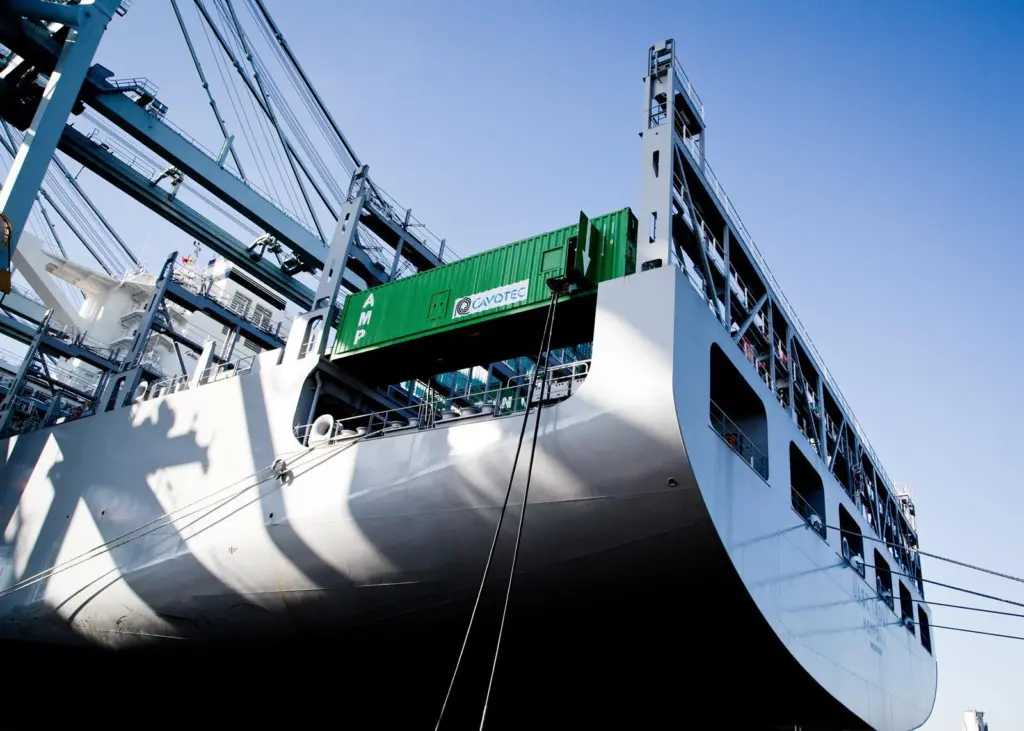
Cavotec: Switzerland-headquartered Cavotec has recently clinched several deals extending the reach of its shore power solutions. In April this year it revealed that it had signed a US$5 million shore power order with a global shipping company. The order includes a substantial number of PowerFit shore power units, with deliveries scheduled later this year. Cavotec’s PowerFit units offer containerised solutions for high voltage vessel connections and include all equipment for a high voltage shore connection, from its PowerAMPReel onboard cable management system, a high voltage switchboard, control panel to high/low voltage transformer and other auxiliary systems. Cavotec has also recently signed a two-year service agreement with APM Terminals at the Port of Tanger Med for all its MoorMaster NxG units and shore power solution Power Units at the port. Cavotec has so far installed seventeen Power Units at the port. By the completion of the third phase in Q1 2024, the amount of Power units is expected to increase to 31. Elsewhere, Cavotec has enabled Europe’s first shore power connection for a tanker vessel. The Swedish port of Gävle connected a tanker to a shoreside electricity system, provided by Cavotec and based on new standards drawn up in co-operation with other ports and operators. Cavotec says this is “set to pave the way for tanker berth operators to reduce emissions and accelerate progress towards decarbonised maritime and energy supply chains”. The test sequence, during which no electrical current was supplied to the Tern Fors vessel, was conducted last year. Following the trial, operator Tarntank and the Port of Gävle said they now planned to use the system to connect the Tern Fors to an electrical current.
Fjuel: Fjuel’s Shore Power Connect enables collection, analysis, and storage of crucial data from shore power installations and offers a total system integration that combines shore power units from different supplies into one complete control system. The company added a new payment solution last year that is designed to reduce the risk of price fluctuations and ensure stability. The solution means that ports now can charge different prices for load levels used by vessels, keeping expenses under control. The billing process is automatic, and the solution integrates with different ERPs or billing IT-systems, simplifying income and expense tracking. The solution creates data insights as its gathers information from shore power facilities, allowing ports and terminals to access information including consumption details, power loads and spot prices. The solution also allows pricing of different power load levels. Fjuel says: “By power load price differentiation, we push shipping companies to optimise their power demand, helping companies to save money, while ports can reduce their grid charges as well.” Norwegian startup Fjuel is owned by Trondheim Harbour, Bodø Harbour, Tromsø Harbour, Bodø Energi AS and Troms kraft AS.
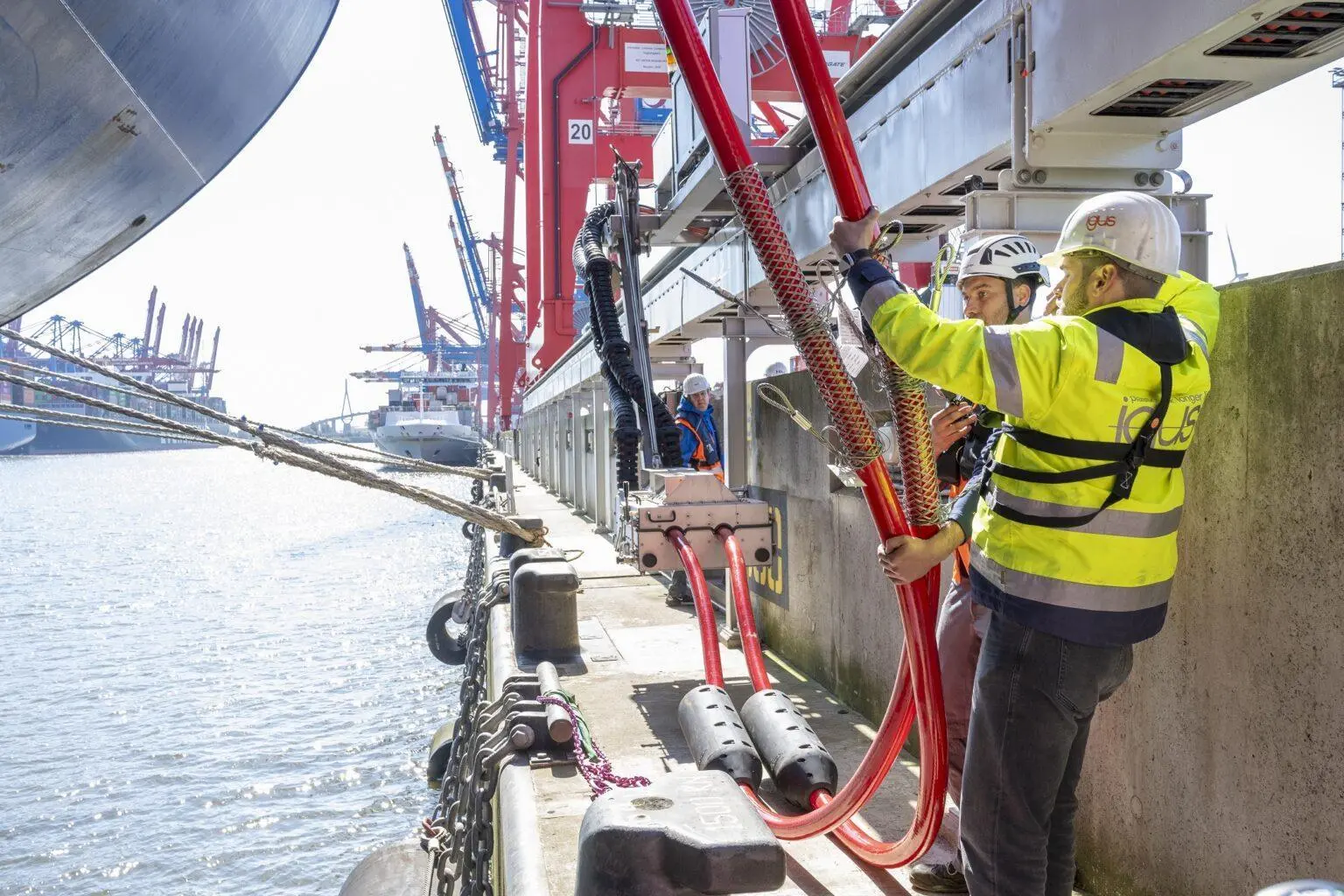
Igus: Germany’s motion plastics specialist Igus’ mobile shore power source readychain® iMSPO (Igus Mobile Shore Power Outlet) is a self-propelled socket for the shore power connection of container strips. The Port of Hamburg has installed iMSPO to solve what Igus says is the ‘connection dilemma’. The company explains that there is no fixed place where the vessel can be “plugged in” in container terminals as there are constantly changing ships of different sizes and berthing positions. The iMSPO system solves this problem as the combination of igus’ roller e-chain and chainflex® medium-voltage cables enable the system to travel within a range of up to 400 metres (which corresponds to the length of the largest container ships). The mobile socket is moved along the quay to exactly where the ship’s connection point is located and the ship cables are lowered and connected to the movable socket. The iMSPO is operated with remote control.
Nidec ASI: Nidec ASI, part of the Motion & Energy Division of Nidec Group, together with partners ICOP and Step Impianti was chosen by the Port Authority of the Eastern Adriatic Sea for the electrification projects of docks IV, V, VI in Monfalcone Port. The system planned for the docks will be able to supply power of 4 MVA at 11 kV distributed in two different connection points (2MVA each). Monfalcone is the ninth European dock electrification project to be awarded to Nidec ASI.
PowerCon: The Port of Barcelona’s first on shore power supply for container ships has arrived at its BEST terminal. The OPS substation comprises six modules assembled in Denmark by PowerCon, which was awarded the contract to install the system in turnkey format and will allow up to two container ships to be connected simultaneously. The aim is to start supplying ships with clean energy certified as 100% renewable as of July. Lluís Salvadó, President, Port of Barcelona, says that this is the “first system of this type in southern Europe”. PowerCon integrates its main components into standard shipping containers, enabling it to pre-manufacture, pre-assemble, and pre-test solutions before they are shipped to on-site, where the containers also ensure easy and fast installation.
SAMPOL Ingeniería y Obras S.A: Mallorca-founded engineering company Sampol has won a contract for the electrical connection to ships in the Port of Valencia’s Transversal de Costa-MSC dock. Expected to take 57 months, the project will provide two supply points with respective cable management systems. Each supply point will be capable of providing electricity to a ship of up to 7.5 MVA. However, if there are two ships simultaneously docked and demanding electricity, up to 5MVA will be supplied to each of them simultaneously. To meet this power demand, an on shore power substation will be installed at the Transversal de Costa dock. Sampol says that this “constitutes the heart of the system”. This project comes on the back of work by Sampol including the installation of electrical supply to ferries at the Paraires dock in the Port of Palma and to ships in the Muelle Grande in the Port of Las Palmas.
SP Mobility: The Maritime and Port Authority of Singapore (MPA) launched its first pilot trial for an electric harbour craft (e-HC) charging point in April this year. The charging point at Marine South Pier was awarded to a partnership between Singapore headquartered SP Mobility, Pyxis Energy and Pyxis Maritime. Under this pilot, the partnership has deployed a 150-kilowatt (kW) land-based Direct Current fast charger with a Combined Charging System 2 connector at MSP. MPA explains that the charger can charge an e-HC with an approximate battery capacity of 500 kWh in around three hours and enable an operating range of about 50 nautical miles, or about 90 km. Users of the e-HC charger will need to scan a QR code using the SP app and make the payment via the app, similar to users of electric vehicles. Dean Cher, Head (Mobility), Sustainable Energy Solutions, SP Group, notes, “This very first public marine charging point at Marina South Pier is a small but important step in providing the marine industry with decarbonisation options and our partnership with Pyxis will lead the way to wider e-HC adoption in Singapore.”
Related Articles
 PORT & TERMINAL NEWS
 PORT & TERMINAL NEWS
 PORT & TERMINAL NEWS