

The Port of Brisbane – A modern port
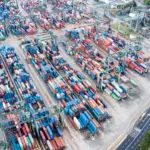
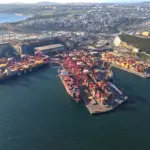
The Port of Brisbane is located in one of Australia’s fastest growing regions, South East Queensland, and is Queensland’s largest and most diverse multi cargo port. Handling over $50 billion worth of international trade each year, the Port of Brisbane is an engine for state economic growth, says Emily Griffiths from the Port of Brisbane Pty Ltd.
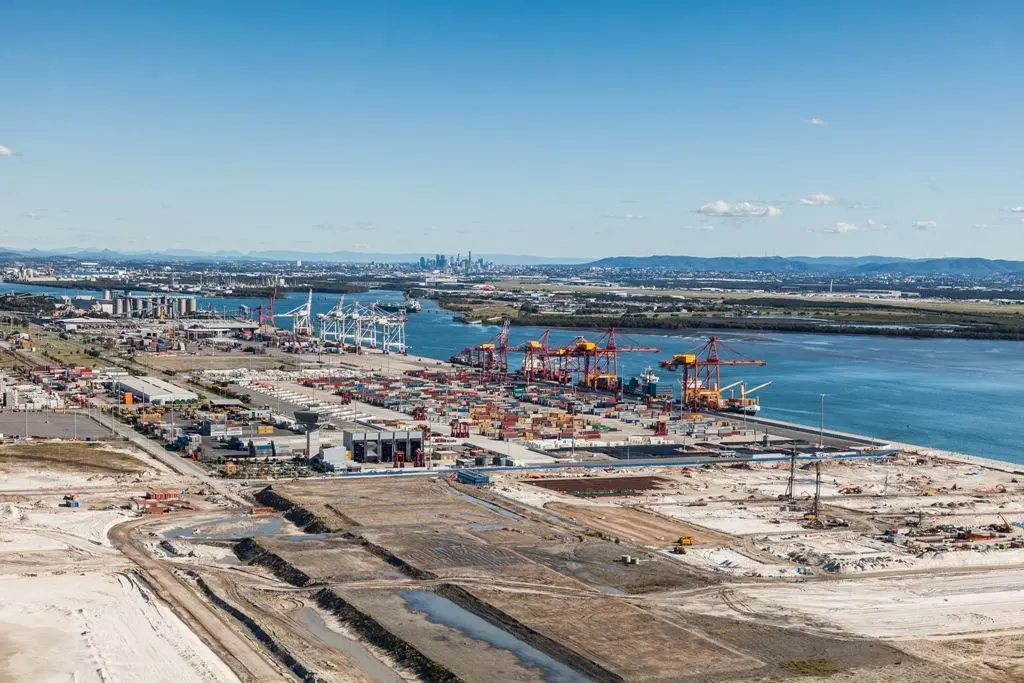
With the ongoing investments in infrastructure, by 2014, the Port of Brisbane will be the first port in Australia where all stevedores in operation – Patrick, DP World and Hutchison Port Holdings – will have automated container handling equipment.
This infrastructure supports logistics supply chain efficiencies and safety initiatives, which are critical to enhancing trade opportunities through the Port of Brisbane.
Patrick
Asciano’s Patrick Container Terminals at the Port of Brisbane is the only fully automated stevedore onsite following the introduction of its AutostradTM technology to its Brisbane terminal in 2005. Patrick’s Brisbane Terminal currently operates 27 AutostradsTM, an automatic straddle carrier system, and five ship-to-shore cranes. The 10 metre high, 60 tonne straddle carriers are capable of picking up, carrying and placing shipping containers (allowing movement of containers from landside vehicles to holding stacks and to ship-to-shore cranes and back), and can operate 24-hours a day in virtually any conditions. Fully laden, the AutostradTM can weigh up to 100 tonnes, yet boasts positional accuracy to within two centimetres.
Patrick’s Brisbane Manager Terminals Division, Matt Hollamby, said the company has invested more than $300 million in the Terminal since 2005¸developing a world-class facility with a design capacity in excess of one million TEUs containers. “Patrick’s Brisbane AutostradTM Terminal has been designed and built to take the facility well into the future, ensuring it will meet the long-term needs of the import and export container trade,” Mr Hollamby said. “The AutostradTM technology, developed in Australia by Patrick, currently exists nowhere else in the world.”
Automation uses radar and laser guidance technology to navigate the straddles around the yard. Unlike other technology which follows paths embedded in the terminal pavement, the AutostradTM moves freely on a virtual computer-generated grid of weigh points, which can be applied to most existing terminal facilities world-wide. These systems allow the machines to operate unmanned and to move and stack containers around the terminal with pinpoint accuracy. The technology has also delivered other significant benefits by extending the life of infrastructure and equipment as well as savings in energy consumption.
According to Mr Hollamby, the introduction of automated technology has directly contributed to Patrick’s excellent safety record. “In 2011 Patrick recorded only two lost time injuries, both of which occurred on a vessel. There were no lost time injuries reported in the terminal itself,” Mr Hollamby said.
DP World Brisbane
DP World is investing $250 million to automate its landside operations and introduce semi-automated technology to its waterside operations by the end of 2013. Landside DP World is initially developing a terminal comprising of eight modules, with seven modules to be equipped in the first phase. Each will be serviced by two fully automated automatic stacking cranes (ASC). The technology will improve the reliability and availability of existing equipment and provide greater flexibility to its application of picking and storing containers. On the waterside, 14 semi-automated manned shuttle carriers (MSC) will operate between the ASCs and the ship-to-shore cranes to transfer cargo between land and the vessels.
DP World will also be implementing the latest Navis Sparcs N4 Terminal Operating System (TOS), bringing Brisbane into line with our other terminal operating systems across the country which is critical to maintaining the highest customer service levels. DP World’s Director and General Manager, Mark Hulme, said the company’s technology incorporates leading safety practices, and is designed to meet or exceed Australian safety standards. “DP World’s commitment to safety is reinforced by our $1 million investment in the development of a state-of-the-art simulator – the first of its kind in Australia – to train employees in using the equipment ahead of implementing the new technology,” Mr Hulme said. “Employees operate the simulator in a virtual space, which also replicates a full range of weather scenarios and operating conditions on the wharves, reducing the chance of injury or damage to equipment. DP World’s investment in the world-leading technology will improve safety and ensure a highly efficient and competitive terminal.”
Automation technology will also deliver significant benefits to customers in the transport industry including:
- greater flexibility for the collection and drop off of containers
- improved IT systems to enable transport companies to locate the position of containers online, allowing for improved servicing and turnaround of trucks once inside the terminal
- improved access to vehicle booking systems.
Scheduled for completion by the end of 2013, the project will increase DP World’s terminal capacity from 600,000 TEUs to beyond 850,000 TEUs.
Hutchison Port Holdings
In 2013, the Port of Brisbane will welcome Hutchison Port Holdings (HPH) to the precinct following the completion of Berths 11 and 12, which are on target for HPH to occupy in 2013 and 2014 respectively. HPH Australasia and North Asia Managing Director, Raymond Law, says HPH is investing more than $250 million in the construction of the new terminal. “HPH is looking forward to commencing operations at the Port of Brisbane,” Mr Law said.
The signing of a 35 year lease to construct and operate Brisbane’s newest container terminal demonstrates our commitment to building modern container port facilities in Australia. HPH is introducing new technologies into Brisbane to increase port capacity and streamline the flow of containers and information through the terminal and the extended supply chain. “We will be introducing the iteration of the IT terminal management platform, nGen, initially developed by HPH for our Hong Kong terminals, which handle more than 10 million TEUs a year,” he added.
nGen will track and manage the movement of containers through the terminal. It will also operate the new Automatic Stacking Cranes and the automated processing of truck manifests at entry and exit gates. “Brisbane will be the first container port in Australia to see the introduction of Automated Stacking Cranes,” Mr Law said.
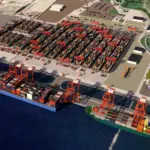
The automated cranes enable higher more densely packed container stacks without any manual handling. When complete, HPH’s Brisbane terminal will have a total area of 26 hectares, a total quay length of 660 metres and a depth alongside of 14 metres.
Related Articles
 AUSTRALASIA GREENPORT
 AUSTRALASIA GREENPORT
 AUSTRALASIA GREENPORT