

THREE SOLUTIONS FOR DRAYAGE
Adrian Weiler, Dr. Eva Savelsberg and Matthew Wittemeier of INFORM review threeof the common challenges seen in port and terminal drayage operations andoutline available optimisation solutions
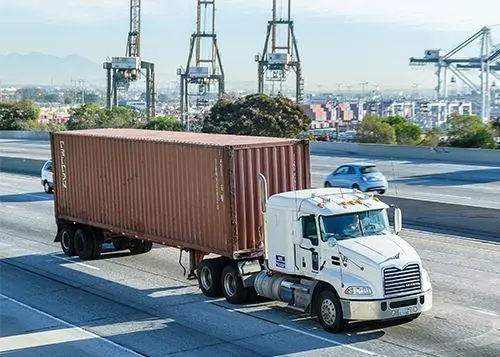
Real-time truck fl eet dispatch when supported by artifi cial intelligence (AI) can master challenges in port and terminal drayage operations while providing signifi cant effi ciency improvements, cost reductions and environmental improvements. This article assesses three key challenges and solutions for the industry.
LONG AND UNPREDICTABLE GATE QUEUING
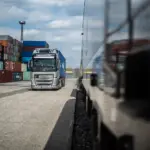
It is no secret in the maritime industry that long truck queue times are regularly encountered – manual gate processes and peak traffic at certain times of the day (e.g., morning queuing) are two of many factors that lead to long and unpredictable gate-queuing times.
In the Truck Drayage Productivity Guide, published by The National Academies Press, it notes that the average delay across the year at ports in the USA is 20 minutes, but during peak periods, such as morning queues, the delays can easily extend for hours.
It estimates that these delays cost ports between US$67-83 million (€55-68 million) nationwide annually. In addition, the sustainability impact from vehicles idling for, on average, 20 minutes per drayage call adds up quickly.
A study from the Journal of the Air & Waste Management Association finds that idle emissions from diesel engines averaged 4500g/hr. On the basis of an estimated 60 million drayage calls per year in the USA, an average delay of 20 minutes equates to 90,000 tons of CO2 produced annually that could be avoided.
Solution: Time Slot and Gate Management
Truck fleet dispatch systems come equipped with a comprehensive time slot management and gate management feature allowing dispatch planners to streamline drayage operations.
By considering the availability of personnel, load availability, loading equipment capacity restrictions, as well as other restrictions, the agile optimisation software produces an optimised time slot plan during both preliminary planning and real-time operations, considering ad-hoc bookings and other unforeseen circumstances, while adjusting as needed.
EXTRA DRAYAGE TRIPS, “DRY RUNS”
Poor communication between dispatchers, drivers and terminals leads to increased drayage moves within the port complex. While the time delays can vary substantially, setting a delay variable of two hours per error results in a cost of over US$1.2 million (€1.0 million) annually across the USA.
The flow-on effects include missed customer appointments and environmental impacts resulting from additional mileage driven and idling times. If an error rate of 0.1 per cent or one in every 1,000 drayage calls is assumed, this equals 540 tons of potentially avoidable CO2 production annually.
Solution: Automated Communication and Online Data Sharing
Interfacing with a port/terminal’s Terminal Operations System (TOS), the use of GPS telematics systems enables automated, efficient communication between drivers and the system, reducing pressure on the planner significantly. In addition, processed data can be presented via online portals that are accessible anywhere, anytime.
CHASSIS LOGISTICS DELAYS
Chassis availability, particularly in USA markets, is one of the most debated topics in drayage year-on-year and for a good reason. Congestion at chassis yards, delays due to maintenance, poor interchangeability and time lost due to locating and hooking-up chassis are major sources of pain for drayage and terminal operators alike.
It is estimated that, on average, 12 minutes per drayage call is wasted when a driver must obtain a chassis and this costs the industry between US$2-4 million (€1.6-3.3 million) annually nationwide.
Solution: Availability Checks on Booking and Preliminary Transport Capacity Planning
Even as orders are booked, the system takes demand and the availability of loading slots as well as transport capacities, such as chassis, into account. The plans, updated in realtime, enable dispatchers to negotiate a suitable delivery time while speaking to the customer.
Based on the known availability of drivers and vehicles, as well as existing orders, the software calculates an optimised delivery plan for the following days. Planners can make changes, assign priorities to orders, and choose whether the emphasis is to be on cost efficiency or service quality.
INFORM’S BIGGER PICTURE
With a broad range of standalone and add-on software modules, INFORM’s blend of algorithmic-based software expertise, industry experience and big world thinking targets delivery of value for customers. For example, Syncrotess, for truck fleet dispatch, optimises transport scheduling and time slot management.
This INFORM software product offers truck fleet dispatchers the capability to have the price and service quality factors work in their favour by providing effective support in preliminary tactical planning, availability checks, time slot management, real-time scheduling, and real-time optimisation. In each case, the system uses the best optimisation algorithms available for the area concerned.
INFORM believes that AI and optimisation software can streamline terminal drayage operations, saving money and reducing harmful emissions. Based in Aachen, Germany, the company has been in the optimisation business for over 50 years and serves a wide span of logistics industries, including ports, maritime, and intermodal terminals.
Related Articles
 EQUIPMENT
 EQUIPMENT
 OPERATIONS