


Carbon-neutral fleets run entirely on renewables are no longer a pipe dream but are already on the way, says Gavin Allwright, Secretary General of the International Windship Association.
The last 18 months have been quite transformational for the shipping industry as it struggles to get to grips with low carbon solutions for shipping.
April 2018 was something of a watershed, with the much-heralded IMO initial strategy of ‘at least’ 50% GHG reduction target. In September, that was boosted by the wake-up call from the IPCC 1.5C report.
Then at the tail end of 2018, Maersk stepped in front of the IMO pledge by declaring it will have a fully carbon neutral fleet by 2050. How attainable are these targets? What do these commitments mean for ports?
Do we have a basket of technologies to get us there and what are the implementation pathways for policy and regulation, future fuel costs and carbon price?
None of us have a crystal ball but one thing is certain: the vessels we are designing and building today will be operating in a net zero emissions environment before the end of their commercial life.
That is a huge challenge, compounded by the fact that this makes financing new vessels problematic when banks are anxious about investing in stranded fossil-fuel dependent assets. A basket of technologies will be required to propel the fleet; there is no silver bullet, no ‘one size fits all’.
The development of wind-powered and wind-assisted ships is making waves at the moment, as a critical part of an integrated 100% renewable-powered propulsion solution for the future.
With fuel savings of 5-20% for retrofit systems and the potential to reach 30% and then significantly higher savings when wind propulsion solutions are integrated into optimised newbuild designs, these savings can’t be ignored. In addition, reducing the need for bunkering makes primary renewable propulsion like wind attractive as it increases the utilisation of the asset and helps deliver improved long-term energy security.
This technology poses a number of questions for ports and could offer some immediate and longer-term sustainability benefits. On the emissions levels, a significant reduction of fuel use would naturally lead to immediate benefits for air quality and carbon footprint but what would a decrease of 30% in bunkering requirement mean for ports?
As the fuel requirement is reduced along with the associated OPEX, this could lead to new routes and trades becoming viable. However, the question would therefore be what size of vessels would we be seeing built and operated?
Will these be smaller, more versatile (primarily wind-powered) vessels visiting smaller entrepreneurial ports, closer to the point of product supply and delivery?
On port operations, how will wind-powered vessels affect stevedoring? Will there be knock-on concerns around safety? Or are these simply problems of image and perception? Regarding infrastructure, do we need to be factoring in increases of air draft, etc.?
The bigger picture
There are wider issues of sustainable development in the port, port city and surrounding region. New technology and installations can mean new business for regional shipbuilders, engineering companies and suppliers. Several of the wind propulsion systems under development are modular containerised systems that could lead to new business activity and opportunities in ports as these are leased or rented to ship operators.
The uptake of wind propulsion reduces the need for fuel, so potentially reducing the cost of alternative propulsion systems such as hydrogen, batteries etc. with less onboard storage and installed power required. This could make these systems more affordable, increase uptake and tie in with land-based renewable energy development.
Large industry players and cargo owners have already started embracing wind propulsion. Maersk and Viking lines have both fitted rotor sails to vessels recently and Scandlines will soon follow. Samsung and Hyundai Heavy Industries have both released designs for rotor-assisted VLCCs. Chantiers de l'Atlantique (formerly STX Europe) has a primary wind propulsion cruise vessel product range and Airbus spin-off, Airseas, has logged orders for its kite systems from Louis Dreyfus Armateurs and K-lines. Renault Group has signed a cargo agreement backing the build of two primary wind ro-ro vessels for cross-Atlantic car deliveries with the Nantes-based Neoline.
Meanwhile, MOL is leading a rigid wing sail project in Japan and Wallenius Marine announced in December it will build a primary wind propulsion car-carrier in 2021 in collaboration with Becker Marine in Germany.
Sizing up the market
So, what is the potential size of the market for these technologies? An EU-commissioned report studying the market potential of wind propulsion concluded: “Should some wind propulsion technologies reach marketability in 2020, the market potential for bulk carriers, tankers and container vessels is estimated to add up to around 3,700-10,700 installed systems until 2030.”
This level of market growth is forecast to continue, with the UK Government’s recent Clean Maritime Plan (July 2019), looking at the global market potential for wind propulsion systems growing from around £2 billion a year in the 2050s.
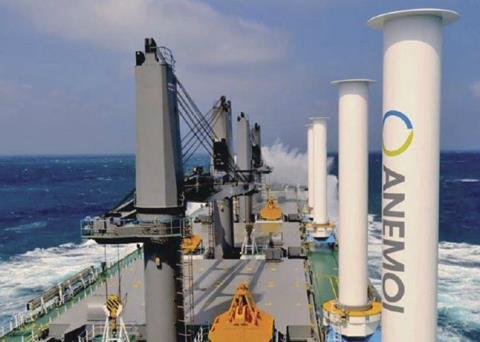
Flettner rotor wind propulsion systems are already entering the market with six vessels in operation and 14 rotors installed, including installations by Finland-based Norsepower on the Maersk Pelican, a 109,000 dwt LR2 product tanker, a ferry/cruise vessel and a ro-ro vessel. Two other general cargo vessels have been fitted with rotors and four Anemoi Marine Technologies’ Flettner Rotor systems have been installed on a geared bulk carrier, the 64,000 dwt MV Afros.
Windship Technology has developed a ‘carbon neutral’ concept newbuild vessel which is also turning heads in the industry. The company’s wing sail technology can deliver 30% savings, linked with similar savings from permanent reduced engine revolutions and coupled with significant savings from ship design and voyage optimisation, leaving 20% supplied by carbon-neutral biofuel derived from waste. These are all solutions that we have available today.
Port infrastructure
What of the issues raised around infrastructure and operations in port? Technology providers are building in solutions in these areas, ranging from hinged rigs to fully collapsible and containerised systems to tackle air draft restrictions.
Cargo handling is another area where innovative approaches are being developed. The MV Afros bulker features rotors that are fitted onto movable base mounts, allowing the geared vessel to load without obstruction. The Smart Green Shipping Alliance (SGSA) sees ports as the critical interconnectors between international maritime and national infrastructure and crucial in the development of zero-carbon shipping innovation.
In pursuit of a workable solution, SGSA’s partners at Drax arranged for the SGSA team to visit ABP Hull to get a good grip of the loading and discharge systems for biomass and to meet the Master and crew of one the vessels delivering this renewable fuel. This led directly to design changes to meet the challenge of accommodating intrusive structures like masts around established discharge systems.
With the level of fuel savings being projected, many of our members’ interactions with port operators have been positive. Concerns over safe cargo handling, air draft, operational restrictions etc. are all deemed to be manageable.
The final question that needs asking is: Will ports embrace this significant change in the industry and help incentivise this low-carbon technology? A primary renewable energy, delivered at the point of use with no emissions, a ship propulsor that is abundantly available, harnessed with today’s technology without the need for expensive infrastructure investment.
As shipping turns its collective attention towards decarbonisation, wind propulsion providers are ready to supply tried and tested solutions to support shipping in its quest to be zero-mission as soon as possible. We hope that ports harbour the same ambitions.
The International Windship Association
The International Windship Association (IWSA) was formed in 2014 with 12 founding members to bring together the key market players, create a stable support network for technology developers and promote the credibility and viability of wind propulsion systems.
The membership has since grown to over 50 members from technology providers, green shipping projects and R&D, shipbuilding, ship operators and class along with an extensive supporter network.
IWSA has been developing wind propulsion hubs around the world, the first having been established last year in Nantes, France, and already more than 60 companies are engaging with IWSA Europe – Atlantic. The foundations for hubs in the North Sea & Baltic and Oceania regions are currently being laid and groups in North America and Asia will be formed over the next year.
IWSA is also engaged in areas of policy and regulation in the IMO, EU and industry, third-party validation of performance and fuel savings, and in the development of ‘Pay as you Save’ finance models, transferring CAPEX to OPEX. Further projects are in the pipeline.

