
Union Pacific and Norfolk Southern are planning a railroad merger to create a coast-to-coast network covering 50,000 miles and 43 US states. Dean Davison assesses developments to date, project timescales, and potential industry impact
In July 2025, Class 1 US railroads, Union Pacific (UP), and Norfolk Southern (NS) announced a merger that both companies stated will be “the nation’s first transcontinental railroad” and that the combination of the two networks will “transform the US supply chain and unleash the industrial strength of American manufacturing.”
A potentially bold claim, especially considering the potential reduction in railroad choice available to cargo users and shippers. So, just what are UP and NS proposing and what’s the rationale behind the deal?
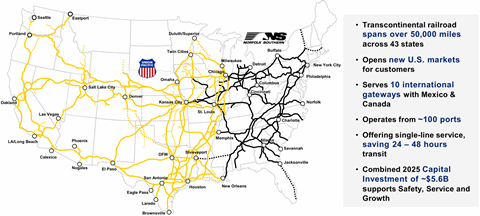
Figure 1 represents a snapshot of the two company rail networks and a summary of the proposed benefits, as supplied by UP and NS in their transaction investor presentation.
To put the proposed new entity into context, Table 1 shows the size of a combined UP and NS company and how it will dwarf the two remaining Class 1 US railroads in terms of financial metrics, route miles operated and number of employees.
| UP | NS | UP & NS | BNSF | CSX | |
|---|---|---|---|---|---|
| Notes: * = Pre-tax earnings, ** = Operating margin, *** = Operating income Source: Individual railroads |
|||||
| Revenue | $24.3bn | $12.1bn | $36.4bn | $23.4bn | $14.5bn |
| Operating Ratio | 60% | 64% | 62% | 68% | 36%** |
| EBITDA | $12.5bn | $5.5bn | $18.0bn | $6.6bn* | $5.3bn |
| Route Miles | 32,880 | 19,200 | >50,000 | 32,500 | 23,400 |
| Employees | 32,400 | 16,600 | ~52,000 | ~36,500 | 23,500 |
POSITIVE FEEDBACK
In terms of what customers, investors and employees think of this proposed merger, provoked a clear and unequivocal response from UP and NS. Jim Vena, CEO, Union Pacific said, “We’ve already had positive feedback from customers – customers who pay the bills,” while Mark George, President and CEO, Norfolk Southern states, “When the details are absorbed by the market, they’ll understand the value we’re creating. Both companies are operating from positions of strength – we’ve got excellent safety and service records and high net promoter scores with our customers.”
However, competing railroad, BNSF, disagrees, arguing that the merger will negatively impact both competition and service levels, with reductions in choice, increased cargo rates and even leading to what it called an “operational meltdown.”
The company is also openly disputing positive customer feedback to the planned transaction: “No customer is asking for a UP-NS merger to happen. It’s driven by Wall Street on the promise of a big shareholder payout. BNSF does not believe a merger is necessary at this time when we can deliver immediate benefits to our customers while preserving competition.”
Indeed, BNSF is encouraging railroad customers to raise concerns with the Surface Transportation Board (the regulatory authority responsible for approving the proposed merger). The company has created via its company website a dedicated section titled “Preserve Rail Competition” that offers a direct link to the STB under the auspices of telling “the STB to say no to unchecked market power and the loss of competitive options that you’ll never get back.”
COMPLEMENT, NOT COMPETE
In a hard-hitting response, BNSF also added: “Wall Street and UP would like to force BNSF into a competing merger that creates a coast-to-coast duopoly controlling over 90% of our nation’s rail traffic….. BNSF is not looking to create a national duopoly and doesn’t believe the appropriate competitive response is for BNSF to acquire CSX at this time. We should not be viewed as the fix to correct the competitive imbalance that UP-NS are trying to create.”
BNSF said interline collaboration, rather than undertaking a merger with CSX, is the more appropriate competitive response to the proposed UP-NS option. “We should not be viewed as the fix to correct the competitive imbalance that UP-NS are trying to create,” the railroad stated, adding that a better approach is to increase cooperation between railroads.
“These partnerships provide more, not fewer, options for our customers while preserving competition and flexibility. We can also implement them now, not two years later, after an expensive and arduous regulatory process,” BNSF explained.
Clearly a merger with CSX is not on the cards for BNSF.
For its part, CSX has not openly commented on the UP-NS merger, but it has just changed its CEO, with the new incumbent (Steve Angel) joining from Linde, where he oversaw the successful integration of Linde AG and Praxair, Inc., which created the world’s largest industrial gases and engineering company. So, extremely largescale merger processes are part of his forte, although Angel is not from a railroad background.
At the time of writing, mid-October 2025, UP and NS are targeting early 2027 for transaction closure, assuming that the paperwork is filed with the STB in the October 29 2025 – January 29, 2026 period. “We’re in a position of strength—great service, great safety, growing volumes. Our respective cultures are aligned. And more broadly, the country is going through reindustrialisation. Freight demand is rising, and the administration and STB appear more open to thoughtful, growth-oriented mergers. The timing just makes sense,” stated George, when originally outlining the proposed deal.
The STB has already referenced changes to the proposed timescales, noting an additional 15 days to give the Justice Department and Transportation Department more time to consider comments filed by other railroads, shippers, labour unions, and communities.
The UP-NS merger represents a potential significant shift in the US railroad industry. The regulatory process will be crucial in determining the merger’s future, with the outcome a long way down the track at present, with many considerations yet to be faced.