![PortStrategy[GreenPort]](https://www.portstrategy.com/wp-content/uploads/2026/09/PortStrategyGreenPort.svg)


Port-community relations and environmental solutions at GreenPort Congress America 2018
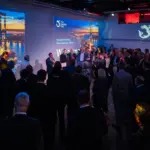
The second day of Green Port Congress America 2018 centred around the opportunity for delegates to exchange ideas and troubleshoot issues surrounding sustainability.
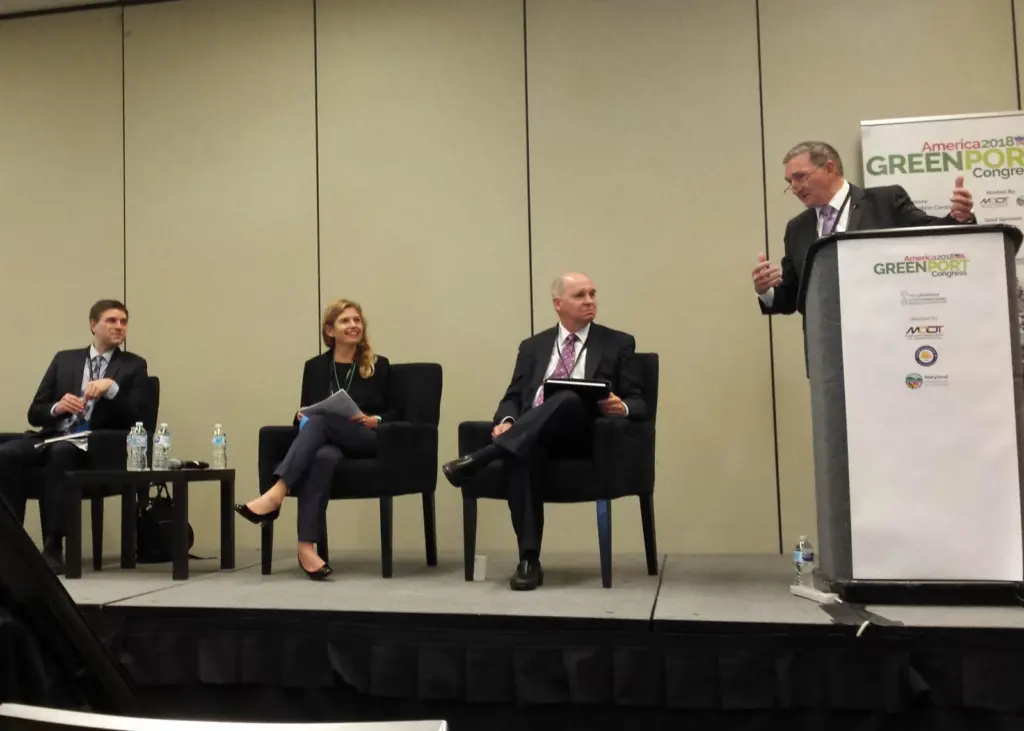
GreenPort host, the port of Baltimore, has an important role in the community, said Dave Thomas, of Maryland Port Administration. “The port creates 14,000 jobs and US$2.9 billion in annual personal income. We must look to engage, educate and collaborate with our surrounding community regarding the benefits the port brings and the resulting social and other impacts.”
Lee Kindberg, director of environment and sustainability, Maersk Line, said: “Operations in port impact adjacent communities. How do we decouple environmental impact from business growth so we can grow responsibly?’ She said that the Clean Cargo Working Group that Maersk participates in had developed methodologies to consistently measure and report the footprint of making a shipment.
Millie Pitts, CEO of The Ocean Exchange said her organisation’s mission was to advance sustainability in shipping. ‘We give away free money to startups – these are grants, we do not take equity. It’s non-dilutive.’ She said the Ocean Exchange’s Orcelle Award recognised solutions that could make logistics operations more efficient and reduce emissions.
Shinpei Ueda of the port of Yokohama outlined actions against global warming and for environmental protection at the port, which is located 30km from Tokyo. The Blue Carbon project tackles CO2 fixation and reduction, carbon offset, and environmental regeneration. The port also has a hydrogen energy project underway. “We expect our hydrogen supply chain experiment to generate wind energy to forklift to reduce carbon emissions by 80 % compared to traditional methods,” said Ueda.
A cruise operator perspective was provided by Mauricio Lacayo, manager, energy management at Royal Caribbean Cruises Ltd. (RCCL). “With 7 brands, 50 ships and 10 newbuilds on order, every new ship features new technologies that makes it about 20% more efficient than the previous ship,” he said. ‘Last year we achieved a US$32m fuel saving, equivalent to the CO2 of 62,000 cars.’ He added that RCCL will be testing fuel cells on a ship next year. ‘In 15-20 years we should see a cruise ship fully powered by fuel cells,’ he said.
Sustainability practices were in the spotlight with a forthright presentation by Alan Dirks, programme manager, policy and planning at the port of Rotterdam,which is participating in a new climate agreement in the Netherlands. Dirks said port operations require 175 petajoules (PJ) per year, which could be supplied by building 1,500 8MW wind turbines at sea. He added that carbon capture, use and storage would also form part of ‘a survival strategy for the port’.
Martin De Jong of non-profit organisation Deltares urged port operators to introduce sustainability during the development or extension of a port. ‘Taking impacts into account at the beginning and not as a closing term at the end is important,’ he said.
Tim Van Wormer, senior marine planner at the Port of Portland, shared the port’s experience of collaborating with six other US West Coast ports for best practice. ‘West Coast ports are leading the way in storm water management and emission reduction,’ he said. ‘Although at first the fact we are competitors was an obstacle, we all believe in sustainable design and construction and we all felt that developing a tool by ports and for ports was better than ports working alone.’
Collaboration in the form of sister port arrangements was in the spotlight, introduced by Clare Petrich, commissioner at the port of Tacoma and board member of Sister Cities International. Petrich described some of the insights she had gained from visits to sister ports over the years. The US ports of Seattle and Tacoma presented their experiences of collaborating as sister ports, as did the Japanese ports of Kitakshuyu and Kobe. Jason Jordan of the port of Tacoma said the formation of the Northwest Seaport Alliance by the ports of Vancouver, Seattle and Tacoma had led to environmental successes for all three ports. ‘There were discussions about how we could work together and focus our resources around competing with other ports in different locations.’ A joint Clean Air Strategy is one outcome of the collaboration between the ports.
Yuji Mitsutake of the port of Kitakyushu, Japan said that his port situated in a major industrial city had ‘overcome severe environmental pollution – in half a century we went from gray to green. Our Green Energy Port Hibiki Project aims to be an integrated centre for the windpower-related industry.’
Paul Meyer, who handles compliance for the port of Seattle, said that the port was preparing to accept ships up to 20,000 TEUs. ‘Terminal 5 is located very close to downtown and we conducted extensive community outreach regarding tribal treaty rights, and consulted regulators and environmental groups.’ He said the port successfully addressed concerns about air quality and noise while in the process of doubling container throughput.
Masao Tanaka of the port of Kobe said that his port had seen a significant improvement in sea quality in recent years due to mitigation actions. ‘We have introduced countermeasures to environmental impacts, and our port zone and urban area are now completely separated by a Green Zone,’ he said.
Harry Conway, representative of Liberia at IMO and MEPC vice chair, presented views from the African port of Liberia, which has strong historic ties with Baltimore. ‘The port of Liberia was destroyed by the war that ended in 2003, but we are now IAPH compliant and have a very big mission to expand,’ he said.
A keynote speech by International Association of Ports & Harbours (IAPH) managing director for policy and strategy, Patrick Verhoeven, examined the recently formed World Ports Sustainability Programme. ‘The programme shows we care about sustainability and empowers port members to create sustainable value added for the wider regions they’re located in,’ he said.
Elizabeth Leavittt, senior director, environment and sustainability for the port of Seattle, remarked: ‘Permission to grow is important to all ports and without it we are going to face challenges to meet the world’s shipment needs.’ She added that mutual support was crucial in this context.
Bill Richardson, environmental manager at the Maryland Port Administration, led a panel that considered ways to improve water quality and reduce marine litter. Mario Tamburri of the Maryland Center for Environmental Science shared ideas about innovations to prevent the spread of invasive species, while Peter May, a researcher at the University of Maryland, explained how algae can be converted to biogas to produce electricity. Richard Hardiman, CEO of Ranmarine Technology BV, explained how the WasteShark aqua-drone trash collector is reducing pollution in Chesapeake Bay, while Tom Sprehe of KCI Technologies looked at how ‘trash-eaters’ can reduce harbour pollution.
Pete Rahn, secretary of Maryland DOT, said that Maryland is unique in being responsible for everything in its port area. ‘This is very unusual and it means we understand that this port is an engine to our economy, because we own it.’ He said the previously polluted Poplar island had been recreated using dredge materials and had been transformed ‘into an environmental oasis’.
Several other American ports described how they had improved sustainability. Rick Cameron, MD, planning and environmental affairs at the port of Long Beach, said the port, which falls under the California Coastal Act, was the second busiest container facility in the US and brought 300,000 jobs region-wide. He said that thanks to the port’s Clean air Action Plan and a Greenest Terminal programme, ‘Middle Harbor has nearly zero emissions and is probably the greenest terminal in the world.’
Scott Whitehurst of the port of Virginia said his port was pursuing a 12.8% increase in barge traffic, ‘to get goods moved by barge and get trucks off the roads.’ Its Green Operator Retrofit Program has seen upwards of 80% reductions in air emissions in 2016.
Shawn Kiernan, chief of program and projects at the Maryland Port Administration said green ports have in common ‘supportive leadership, a plan, and strong stakeholder engagement. We are making sure these factors continue as part of our value system.’ He said that Maryland has recently developed a new holistic environmental strategy as part of its strategic plan.
Redevelopment and reuse of brownfield sites was explored, with case studies on converting former industrial contaminated areas into useful properties. Tradepoint Atlantic’s Aaron Tomarchio reported on a ‘brownfield to state of the art logistic centre’ transformation, while representatives of Maryland’s Port Administration and Environment Department looked at local projects to remediate brownfield sites.
The final conference session focused on measuring of environmental performance, monitoring and reporting of environmental practices. Kurt Nagle, president and CEO, American Association of Port Authorities, offered a breakdown of the various funding opportunities available to US ports to promote sustainability, including CMAQ congestion mitigation air quality funds, EPA diesel emissions reduction grants, freight funds from the FAST Act, and Volkswagen emissions diesel settlement funds. Renee Hovey, senior consultant, Sprott Planning and Environment, compared and contrasted ports and terminals to distinguish the various challenges, barriers and opportunities they face. Tracy Fidell, consultant, WSP, presented several of WSP’s modelling systems for port planning.
David Bolduc, executive director of Green Marine, said the certification system was now the largest of its kind and was benefiting from the availability of ten years of data gathering. Jan Fransen, executive director of the Green Award Foundation, said that the non-profit organisation, started by the port of Rotterdam in 1994, would soon add a new level of award for low- and zero-emission ships. ‘For fuel cells and battery powered ships, we are introducing a platinum level. Those ships will be free of port charges.’
After these presentations, delegates had the opportunity to exchange ideas and troubleshoot issues identified in small groups. Moderator Chris Wooldridge of Cardiff University described the session as ‘deliberately interactive, with the aim of encouraging dialogue between ports and organisations, culminating in a “mind map” of key issues and concerns.’ Wooldridge said he hopes to revisit the findings of this event with a view to further analysing key trends and sharing them with the ports community.
Related Articles
 GREENPORT CONGRESS
 GREENPORT CONGRESS GREENPORT
 GREENPORT CONGRESS GREENPORT