
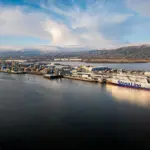

Economic hurdles remain
COMMENT: Ports and terminals around the world are making major investments in upgrading facilities, building new ones and re-financing what they have. It seems as if there is a general belief that global trade will return to the growth paths seen before the Great Recession and that shipowners will pursue economies of scale to the maximum, writes Ben Hackett.
Does this really make sense? Do Asia, Africa and Europe really need all the spare capacity that is being created? Has anyone looked at the real volume growth rates for the last five years? Or is it just the belief that size matters?
Looking at the fundamental macroeconomic drivers of growth around the world we see quite a few hurdles. China’s growth rate is now half or less than it was before 2008 and it does not look like it will return to those heady heights. The US is excited by GDP growth over 2.5% and the poor austerity-driven EU is over the moon with GDP increases of less than 0.5%. Seasonally adjusted GDP rose by 0.3% in the euro area (EA 19) and by 0.4% in the EU 28 during the second quarter of 2015, compared with the previous quarter, according to flash estimates published by Eurostat. This is not the stuff of strong trade growth for bulk or for containers.
With China in the dumps, commodity prices for items such as copper and iron ore are down and crude oil prices are unlikely to bounce back in the foreseeable future, unless there is a dramatic cut in supply. Likewise, consumers remain reluctant to return to the heady days of pre-2008; a lack of real gains in disposable income and conflicts wherever one looks have kept confidence low.
In the US, the inventory to sales ratio, a good indicator of trade flows for the coming six months, remains stubbornly high at levels that suggest a potential slowdown in economic activity.
What this means for the ports is that it will take longer to make a return on investment in a world that has slower growth and greater competition. One only needs to look at the Pearl River Delta, northern Europe, the Thames estuary, Dubai and Abu Dhabi to see the challenges.
Related Articles
 INSIGHT & OPINION
 INSIGHT & OPINION
 INSIGHT & OPINION