![PortStrategy[GreenPort]](https://www.portstrategy.com/wp-content/uploads/2026/09/PortStrategyGreenPort.svg)



Forward commitment
Busan is ploughing ahead with infrastructure works to stay ahead. Michael King reports
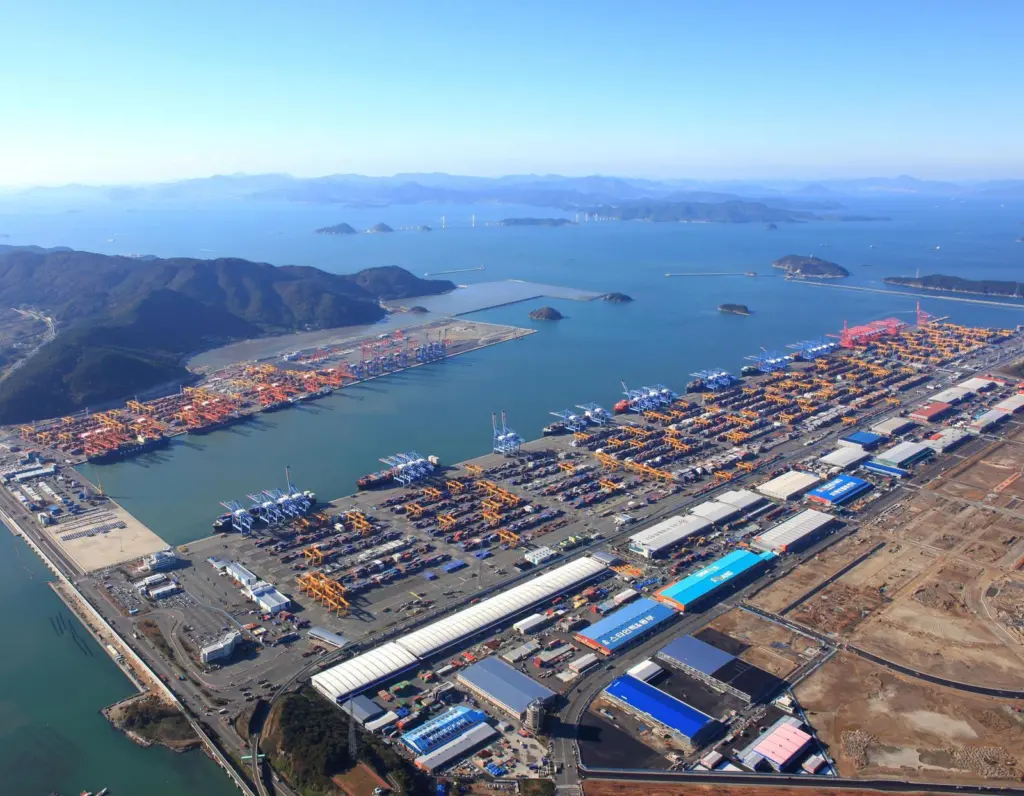
Busan Port is investing in new facilities and networking infrastructure as it looks to further grow its transhipment volumes, logistics services and non-trade revenue.
Key to this is the redevelopment of Busan North Port, a huge project that will cost over $8.5bn. This will see the old piers at the port covering an area of some 1.5m sq m transformed into a new waterfront and leisure destination, even as business continues at adjacent container terminals.
The development is split into a series of zones covering accommodation, entertainment, sports, recreation, culture, industrial and housing. Partly funded by the Korean government, infrastructure is due to be completed by 2015 with private investors then building superstructure in phases through to 2020.
In the first phase, a new International Cruise Terminal will be opened by January 2015 and is designed to receive 2.7m passengers each year and handle the world’s largest cruise vessels.
Mr Eung-hyuk Lee, manager of Busan Port Authority’s International Cooperation Team, says landfill for the overall redevelopment is now 80% complete and due to be finished by 2015. After that work will begin on the construction of buildings and public facilities including a marina, housing and a convention centre. “We’re redeveloping older wharfs phase by phase, but we have five terminal operators there and they will continue to operate,” he adds.
Volumes up
BPA is also continuing to invest in new container facilities in anticipation of good forward growth. Last year the port handled 17m teu, up 5% year-on-year, despite a sluggish domestic economy and slow growth in the key markets of China, Japan and the US. Most of the throughput expansion came from transhipment, which increased 10.5% year-on-year and now represents 47% of Busan’s annual container throughput, a share of container throughput that is expected to grow in the years ahead.
Of the 45 planned container berths due to be constructed at Busan New Port, 21 are currently in full operation. Busan New Port now handles 55% of the port’s total throughput at five terminals operated by, respectively, DP World, HMM, PSA, Hanjin Shipping and a consortium that includes CMA CGM.
Mr Lee says that container volumes are forecast to be near 17.6m teu this year. However, he said it was unlikely any more berths would be opened in the medium-term with expansion plans scaled down due to slower than anticipated growth in global container volumes. “We have slowed investment, but this can change,” he says. “If volumes start increasing, we will start investing. We are working on the basic infrastructure such as quay walls, so we can add superstructure quite quickly if volumes build up.
“It takes five to seven years to build a container terminal, so we’re doing the first stage now so we have the latent capacity. Then when they’re needed they will take two to three years to complete.”
BPA-Net, an internet-based customer-tailored ‘one stop service’ for all liners and operators at Busan Port, is also nearing its first phase launch. It aims to completely integrate all port-related cargo and logistics information using Simple Object Access Protocol (SOAP) systems to provide G2G, G2B and B2B services for all users and related government and port authority offices, speeding up the logistics flow at the port.
Mr Lee says the system is now 75% complete, and will be partially launched in the first quarter of 2013. It will be fully operational by the end of next year.
Truck track
The 3,331m Busan North Bridge construction is due for completion in 2014 and is expected to ease traffic congestion between Busan North and New Port. However, Mr Lee says truck traffic between the ports will gradually slow down as Busan New Port handles an ever-growing proportion of the port’s overall container traffic, thereby reducing the number of truck shuttle movements required for transhipment operations.
In all, 30 warehouse operators are also now in place at Northern Distripark at Busan New Port and last year this generated some 660,000 teu of container cargo. “Four companies opened last year, so it’s taking time for them to start generating cargo, but volumes will rise,” says Mr Lee.
Western Distripark, another major free trade zone logistics complex, will open in phases and eventually offer almost 7m sq m of manufacturing, packaging and assembly space at Busan New Port. Here, 16 companies have been selected for the first phase development, 11 for the second, while a third tender process will take place this summer and autumn and is set to select around 10 more companies.
“It is mostly logistics companies in the two distriparks,” says Mr Lee. “Japanese investment in those companies represents about 50% of them, and Chinese 20%, all in partnership with Korean companies.
“Their biggest advantage is that they are tax free zones, so there are no tariffs and no customs. Secondly, the lease fee – at a minimum of Won43 (3¢) per month per sq m and up to Won281 per sq m per month – is very low. The companies also have a contract period of 30 years and can extend for another 20 years.
“These developments will help Busan attract more transhipment traffic for years to come.”
Related Articles
 CONTAINER & CARGO HANDLING
 CONTAINER & CARGO HANDLING
 BULK HANDLING