![PortStrategy[GreenPort]](https://www.portstrategy.com/wp-content/uploads/2026/09/PortStrategyGreenPort.svg)






Feedering fan
MICT offers some instructive lessons to its peers in feeder terminal operation, reports Mike Mundy
The usual image of a container feeder terminal is of a two or three berth facility that handles an annual volume of up to 400,000 teu. Nine times out of 10 it is also a facility whereby the infrastructure has been public sector funded, although it may now be operated as a concession.
Build Operate Transfer (BOT) container terminal development is also an activity more associated with main haul container terminals rather than those in the feeder category.
International Container Terminal Services Inc’s Manila International Container Terminal is, however, a notable exception in both these respects and generally represents an interesting case study for top of the range feeder terminal development.
Total volume handled at MICT in 2012 was 1.8m teu, a big step on from the annual volume of 330,000 teu handled in 1989 when the terminal completed its first full year of operation. ICTSI was formed in 1987 initially for the purpose of bidding for the 25+25 year Manila BOT concession.
“This year is our 25th anniversary,” notes Christian R Gonzalez, head of Asia Region, ICTSI and vice president operations, MICT, “and it is also the year, fittingly, when we handled our 25th million teu.
“The 25-year journey has seen MICT progressively built out with the latest component of this being the opening of Berth 6 in mid-2012.”
Forward planning
Berth 6, built at a cost of $200m, provides a 300m quay and 25-acre terminal, and raises overall capacity at MICT to 2.5m teu from 1.9m teu. The construction also included piling works for Berth 7 in order that MICT can seamlessly meet the need for new capacity over the longer term as well as accommodate system changes such as a steady increase in vessel size. MICT currently has a depth of 13m, differentiating it from the rest of Manila, and a design depth on two berths of 14.5m.
The average vessel length overall handled at MICT is 172m and teu capacity is 1,564. A typical top-of-the-range vessel handled has an length overall of 289m and a capacity of 3,600 teu.
In terms of quay crane set-up, there is an average crane split of 1.5 cranes per vessel with a low exchange rate but even so MICT is able to deliver a total average berth productivity in the range 40-44 moves/hr.
Berth 6, effectively a satellite terminal, operating with a crane split of 2.1 and an average exchange that is still below 1,000 moves, performs at an even higher level with over 60 moves per hour. This easily places it among the best performing feeder terminals in the world.
Berth 6 deploys the latest post-panamax cranage but installation of this type of container gantry is not a new event at MICT; it has been deployed since 1990, well ahead of any requirement.
Optimisation options
Modern systems thinking is also evident in several other key respects – a principal objective being to optimise container flow and generally to tweak operations wherever possible to improve efficiency and reduce cost.
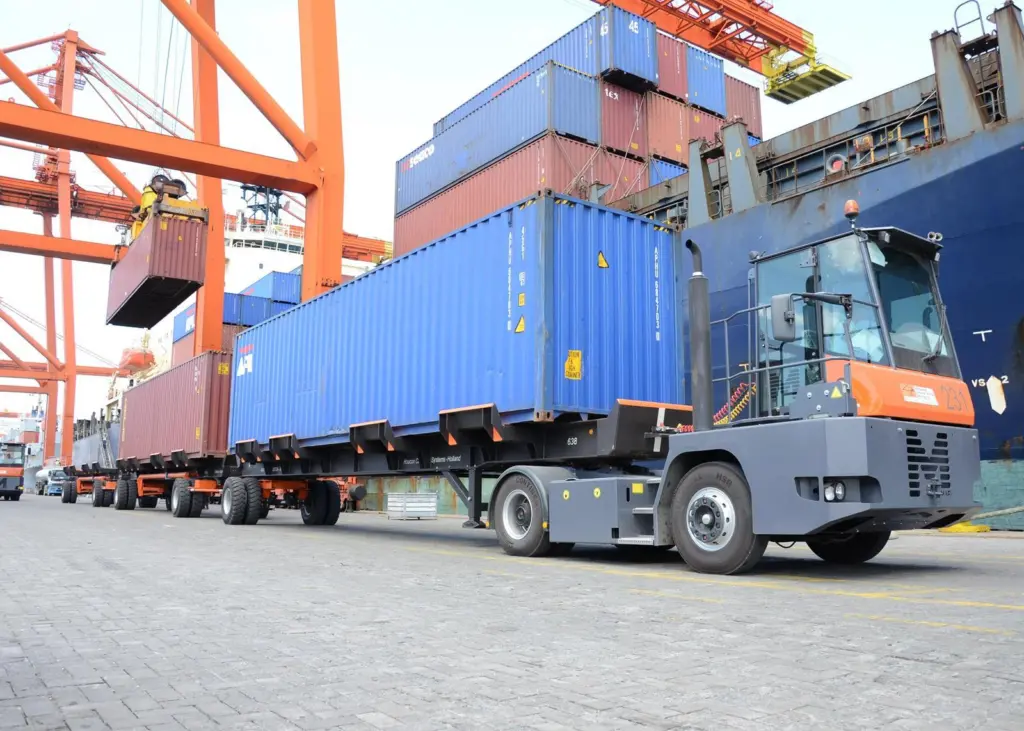
Multi-trailer systems (MTS), able to carry six 20ft or three 40ft containers, are deployed for the haul of containers between Berth 5 and Berth 6 facilitating the efficient movement of units over a longer distance. The system also allows for quay to stack transfer and vice versa, expediting container flow at an efficient cost. A typical MTS is comprised of Houcon-built trailers and a Mafi tractor providing the pulling power. Mafi provided a two week intensive training course for operators as part of the system’s introduction.
MICT has also adopted N4, the latest, acclaimed, terminal operating system from Navis. It was among the first terminals worldwide to do so. It was also, at one time, the largest terminal to have the system in full operation. The N4 technology platform is maintainable and adaptable, allowing the terminal operator the flexibility and scalability it needs to run its operations, from a single terminal to multiple terminals across multiple geographic locations, all within a single instance.
Considerable thought has gone into road traffic management both in and outside MICT. The emphasis is on full automation including providing for full automated contact with customers and their agents. The terminal gates are fully automated/paperless; filtering of trucks within the marshalling areas is automated and so too is ‘job promotion’, the ordering of work priorities.
Free flow
Outside the terminal MICT started the task of regulating truck flow early on and has deployed barriers and RFID loops to control the flow of traffic. This has entailed winning the support of the trucker community to adopt the system. This aspect remains an ongoing area of attention for ICTSI as it faces the challenge of accommodating truck bans in Manila which serve to reduce the window (15 hours) through which truck’s can be accommodated via MICT’s South Access Road.
“It is a challenge for us just as it is for many of our peers worldwide and we are now actively considering other solutions deployed in the worldwide port market,” says Mr Gonzalez. “The message we are getting back is that a lot can be done in short-term, quick fixes, but the real solution lies in long-term coordinated planning between all interested parties. The reality is that ICTSI has stayed ahead of the game providing the right infrastructure at the right time but there has been a shortfall in investment in road infrastructure generally in Manila. Not to do so would be to undermine the private sector investments made at MICT and elsewhere in the port, to increase costs for cargo importers and exporters, and generally to reduce the considerable positive economic impact of the port of Manila.”
He further notes: “Ultimately if you seek efficiency any terminal is dependent on its workforce and the investment you are prepared to make in it. This is something as a group we attach a lot of importance to. It is notable that with manpower our labour turnover is less than two per cent and that over the years MICT has trained and developed the top management for 12 of ICTSI’s terminals around the world including five chief executives.”
A recent workforce-related innovation is a computer-based management system aimed at optimising employee rostering. The system, known as Microster and introduced in conjunction with Australia-based software developer ComOps, has advanced capabilities such as accessing self-service information including manning schedules, and the use of interactive voice response when outside the terminal to update personnel work status.
Via automated processing of time and attendance data the system is able to determine the next best available person or persons to fit a shift by aligning skills based on the workload requirement. This determination includes managing aspects such as work-related fatigue and thus the system has strong potential to enhance personnel safety.
Microster, which is integrated into MICT’s Navis terminal operations system and timesheet software, generally provides improved visibility of workforce assets and how best to deploy them.
Related Articles
 CONTAINER & CARGO HANDLING
 CONTAINER & CARGO HANDLING
 BULK HANDLING