






A moving target
Varied storage solutions are needed to cater for different cargoes and strategies. Dave and Iain MacIntyre report
In the ever-expanding ports industry, cargo space has become increasingly hard to come by. As ports grow in throughput, so storage space is squeezed. What is the solution and are temporary moveable buildings a serious option?
UK-based consultant Richard Clarke, of Richard Clarke Marine Ltd, sets the scene by saying the primary question is what sort of storage is required. “In most ports the storage has to be permanent (containers and bulk liquids) although some types of dry bulks and general cargo (breakbulk) can use temporary storage.
“Container handling requires large areas of pavement and high-value handling equipment so that in everything except the most basic of facilities (say on a small island or at some small river port), the facilities will be fixed.
“Container ships normally follow a fixed route so you only get a call if it is regular and scheduled. This will not happen with temporary facilities.”
Experts agree that in most cases, it is desirable to have storage facilities located on or next to container terminals. But should these be fixed?
Moving motive
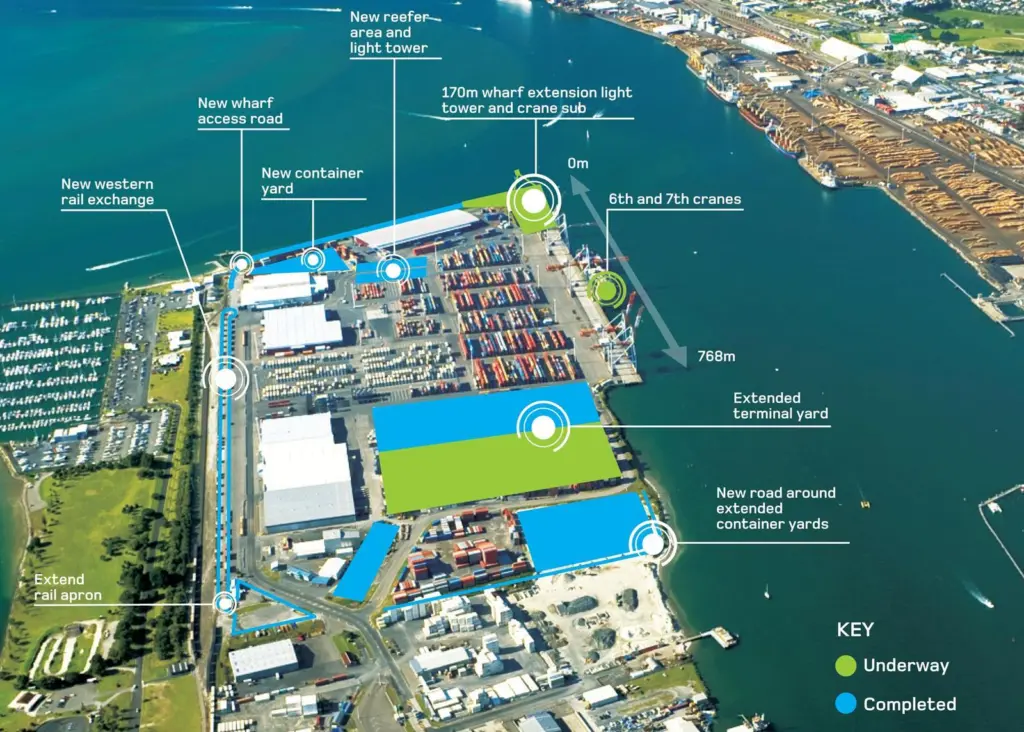
Pieter van Deventer, terminal shipping and planning manager at the Port of Tauranga in New Zealand, argues that for container storage, there is a case for the short-term/moveable type of set up.
“It will have to relocate as the terminal’s throughput grows and more area for the yard-grid needs to be made available. A fixed set-up will inhibit a terminal’s ability to grow.
“Empty container storage should not infringe on a terminal’s capacity as extended dwell will reduce operational capacity. Remember the adage – halve your dwell time/double your capacity.
“As ports realise that they should focus on value-added services to gain a competitive edge, it will be advantageous for a port to become or become part of a logistics hub, since such hubs attract cargo and cargo attract ships and vice versa.”
For this reason, Mr van Deventer says storage facilities ideally should be located adjacent to terminals with buffer transfer areas, which would serve to freely exchange imports and nominated exports.
“Any amount of distance that storage facilities are separated from container terminals, will add cost to the logistics chain. Container ports are generally a preferred choice to set up any type of logistics centre, since they are already closely located to various inland transport facilities and a highly-skilled workforce.”
Long distance
Mr Clarke makes the point that because loading and discharging cargo is expensive, it is not sensible to move cargo to nearby freight hubs or storage. “Once the cargo is on the inland transport, it may as well go some distance towards its destination. The only time when it is sensible to use nearby freight hubs or storage is when a port is short of land and cannot expand, possibly because the city has encircled the port.
“This happens in places such as Melbourne but you only do it because you have to. Out of choice you would always distribute straight from the dock or by say block trains to a remote location which is nearer to the centre of demand for the goods.”
For non-containerised trades, or for a newly-growing business without established infrastructure, a different approach to storage may be needed and this is where a moveable or temporary solution could be ideal.
Beth Wilson, marketing manager for Memphis-based Mahaffey Fabric Structures, says adequate on-terminal space can be an issue. “In those cases, nearby storage facilities are set up. These temporary structures can be installed on just about any surface; and being that they are portable, this provides the added convenience of easily moving the structure should your project needs change or expand.
“As product demands continue to grow, so does the need for adequate storage space. Fabric structures can offer ample storage room, adding a great deal of flexibility with respect to multiple handling methods.
“Because of their portable, modular design, relocating and reusing them is both easy and cost-effective. This flexibility makes them increasingly popular in the current state of the economy, as they are suitable to meet the changing needs of a busy or test market port.”
Ready reckoner
The idea of “testing the market” for the ports industry is emphasised by Ms Wilson.
“[It] is especially important for those areas where commercial development is booming. Temporary structures provide an excellent solution for these areas. Whether you’re in need of cargo storage space, shelter to protect workers from the elements or a terminal for cruise ship passengers to load on and off, a temporary or semi-permanent structure works well.
“Furthermore, they provide an economic alternative to new construction. Leasing is the optimal solution for temporary buildings. Short-term leases free up capital and credit. When you consider the life cycle costs of a building, maintenance etc, there are significant savings to renting or leasing.”
But could there be any security issues with temporary storage facilities?
“Security issues can arise in any location,” says Ms Wilson. “With temporary structures, it’s no different than a permanent building. Steel sides can be installed and are typically used for this type of application. All door options have locks, which provided added security. Perimeter fencing can be installed as well.”
Mr van Deventer says if the temporary storage is located on a container port’s premises, security is usually not an issue as terminals are customs-controlled areas and accordingly have to be compliant with certain standards.
“Any form of security can easily and cheaply be extended if storage depots are located nearby. Again, depots/centres any distance away and isolated will have to set up an independent security regime, which will add to costs.”
Security certification
However, Mr Clarke has some doubts — “Any international port these days has to be ISPS security certified. This has certain requirements for perimeter security which it would be very difficult for a temporary facility to comply with.”
Whatever the solution chosen, environmental considerations now play a big part in storage facility design.
“I imagine that waste water management is of vital importance,” says Mr van Deventer. “Also what is called in Europe, ‘horizon’ pollution, i.e. the impact of building(s), stacks of containers etc on the living environment. That means the location of the facility needs to be carefully considered and chosen.”
Adds Mr Clarke: “What aspect of the environment is important depends on the cargo to be stored. A badly-managed coal storage facility will spread dust all over the place. An oil facility will require protective bunds and other anti-pollution measures. An LPG facility will require measures to eliminate the possibility of a BLEVE [boiling liquid expanding vapour explosion].”
And Ms Wilson concludes: “Most companies are moving toward sustainability and pushing to be ‘green’. Therefore, temporary buildings, especially those that are fully recyclable, are in higher demand.”
Related Articles
 CONTAINER & CARGO HANDLING
 TERMINAL OPERATIONS
 CONTAINER & CARGO HANDLING