

Climate change: No easy answers
Ports are particularly exposed to the effects of climate change, but sizing up therisk is a tough call, with no easy answers, writes Stevie Knight.
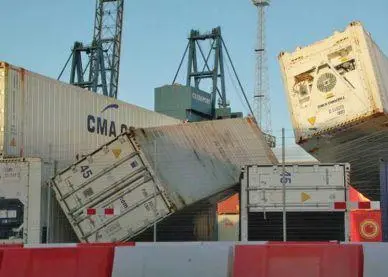
Over half the initial responses to the recent Navigating a Changing Climate (NCC) survey indicated ports “are experiencing more extreme occurrences, more often,” says coordinator Jan Brooke, adding, “Of those reporting on a specific event, nearly half say it was unprecedented.”
This has not been the only surprise. When the survey (undertaken by PIANC, IAPH and other partners) was launched, Brooke was “expecting to see the costs of repair as the main problem”.
However, while 30% of respondents reported ‘severe’ or ‘critical’ damage, 50% assigned these same categories to closures or downtime – and over a third had experienced a shutdown of 24 hours or more.
Chronic issues were not, therefore, limited to those who had had their infrastructure undermined. Drilling into the details, while 14% of respondents said their repair bills came to millions of dollars, closure and downtime also hits ports where it hurts.
Of those who could put a price to it, 30% estimated it as between US$10,000 and U$1 million, while another 6% said it totalled above U$10 million.
It is a rising issue. While breakaway vessels blocking Durban’s entrance made headlines in 2017, the underlying trend is possibly just as problematic for business.
As Dr Kana Mutombo, Climate Change project manager and principal R&D engineer at Transnet National Ports Authority (TNPA) notes, “We are increasingly receiving reports of major climate-induced delays in our ports in South Africa.”
While it is reasonable to expect ports to be keeping abreast of this element, “Of those responding to our survey, relatively few can provide a cost-estimate of the port closure or downtime,” says Brooke, further stating, “And this is worrying. After all, how can you argue for resources to strengthen resilience if you cannot put a price on the consequences of not acting?”
The real problem that remains behind this position is that ports need to calculate risk – but with very weighted dice on an uneven table. “The trouble is, these effects pile up,” says Don Cockrill of the UK Maritime Pilots’ Association. “You do not just get an ‘average’ impact, you get cumulative impacts. More intense summer storms, for example, with more rain adding volume means the current itself will be stronger. That also impacts manoeuvring of the ships.”
In fact, swollen rivers closed the port of Itajal in Brazil for three weeks and as Adrienne Newbold of the Port of LA explains, on top of projections for sea-level rise “we have to add another two-and-a-half feet” to account for storm surges.
“Further, these issues have a multidimensional character, adds Cockrill: “Increased water levels also means a rise in debris,” he explains. While posing a lower risk factor than the events of 2017, this has furnished Durban’s recent incidents with a certain unpleasant factor.
Only last spring, rains washed down logs big enough to make it difficult for a handful of ships to move in or out of the berth, along with churning together effluent, sewage and large amounts of litter. The IPCC’s Ocean and Cryosphere in a Changing Climate report also points out that “compound events in turn trigger cascading impacts”.
In Tasmania, for example, heatwaves and storms left emergency services simultaneously fighting both floods and lightning-strike forest fires. Plus, normal hydroelectric energy sources dried up and the power cable from Australia failed, leaving people reliant on diesel generators.
The effect on port throughput can be quantified. According to IPCC research, “System inter-dependencies” reduced Tasmania’s gross state product to 1.3%, well below the anticipated growth of 2.5%.
But how can you quantify the associated risks? Mutombo outlines the problem: “It is important to note climate change is characterized by constant uncertainty; thereby making traditional probabilistic risk management methods inappropriate.”
Also, issues never arrive on a schedule or even from the direction expected. James Trimmer of the Port of London Authority explains what happened on the River Thames: “We assumed climate change meant more storms and eventual sealevel rise… and we thought it was all decades away.”
“However, the very next winter the rainfall went on and on for months and suddenly we had small boat crews being faced with life threatening conditions, or rowboats getting pinned under moorings by the current,” says Trimmer.
He adds that a warning flag system was quickly introduced “it brought home the unpredictable nature of these events”. As these events highlight, it is not just about heavy infrastructure investment.
Therefore, it is dis-concerting that the NCC survey indicated a significant number of ports still lack basic response procedures. Only 14% reported having an extreme weather assessment, contingency plan and warning system in place, “but it’s even more of a concern that 30% say they have none of these things,” says Brooke: “A contingency plan may not help you avoid closure, but it can certainly help you get back up and running quicker.”
Despite this, some are already aware of the need to marshal resources and put together not one, but a range of strategies with different timelines. Interestingly, the IPCC report takes the view that faced with uncertainty, what’s needed is “an integrated approach to ensure trade-offs between short-term and long-term gains”.
This seems to be the approach by TNPA, which has formed a climate research group exploring both future resilience and more immediate business continuity initiatives “in collaboration with various identified stakeholders”.
These stakeholders should include the local pilots, says Cockrill, for they are often at the sharp end of the issues. While larger pressure effects can impact tidal water depths to the point where ships cannot get in as expected, there are subtler challenges, such as wind direction.
“A shift in pressure patterns can mean you get more, and stronger easterlies, for example,” he says. This can present challenges for those ports and harbours designed for sheltering against a northwest air flow – and may result in more trouble berthing and unberthing ships.”
More extreme weather does not sit well with vessel evolution, says Allan Gray, president of the International Harbourmasters Association. “The new generation containerships are far larger in windage area,” he points out, so 20 to 30-knot winds that may have been merely inconvenient for earlier designs “are now outside the parameters of these vessels”.
He adds that the mooring arrangements often have not kept pace with the change in scale, so the resulting forces can push line loads over safe limits. Given all of this, it only takes “high afternoon sea breezes or regular winter squalls” to diminish a port’s capability, says Gray.
For those looking at this position with more uneasiness than a clear forward pathway, Brooke recommends collating local data including from local weather monitoring bodies to yield some idea of trends. However, research should not stop there, given the lack of predictability associated with the events highlighted.
Global reports, such as the IPCC document, are essential to help to put things in context. It must be said, this study doesn’t make for comfortable reading and neither is Brooke that bullish about current climate trajectories.
“We are currently on track for significantly more than a 2°C rise,” she explains. “Even if we managed a huge turnaround and met the 1.5C° target, impacts such as sea level rise are already locked in for decades.”
Chris Cannon of the Port of LA sees practical advantages in thinking ahead and putting in money at the point it can be most effective: “It does not take lot more investment to incorporate climate resilience measures into a new project where you are starting from scratch. It’s much, much more expensive to try to add on measures later. That is why we are being proactive.”
Yet as the IPCC report notes “the ratio between risk reduction investment and reduction of damages of extreme events varies” adding that while prevention and preparation “is very likely less than the cost of impacts and recovery”, there’s no final guarantee.
Further, there may be no easy answer. “For some ports it may be impossible to justify protecting everything,” says Brooke. “While some measures to improve resilience will be viable, others may prove too much to swallow. As a result, some facilities could simply be left to their fate, potentially earlier than expected.
She concludes, “As with other exposed and vulnerable coastal infrastructure, it maybe we have to say, ‘this port in this location will not be viable in 30 years, we cannot afford to protect it so we have to look to relocate.”
Related Articles
 CONTAINER & CARGO HANDLING
 TERMINAL OPERATIONS
 DIGITAL