



Dredging in sensitive environments
Frederik Mink*, Environment Advisor to the European Dredging Association, considers the need for dredging should take place with an “ecosystem” approach – and explains why some sites are not suitable for dredging, or the disposal of dredging material
With 90% of the goods traded into Europe transported by sea, it is obvious that ports play an essential role in transport logistics. There are over 1000 seaports in Europe handling in total 3.5 billion tonnes of cargo per year. About 700 of these ports each handle less than 1 million tonnes and there are only 10 ports in Europe which handle more than 50 million tonnes.
Need for Dredging
A sizable part of these ports need to undertake regular dredging to maintain the port and its navigational access in such condition that maritime safety can be guaranteed. The need for dredging is typically stronger along the North Sea and the Atlantic coast, due to strong tidal forces and large estuaries. In some ports the navigational access needs to be dredged on a permanent basis.
Other ports situated in the Baltic or the Mediterranean need to dredge far less frequently, but they need to dredge anyway and dispose of the dredged material! These ports often have to face the fact that their marine environment is more sensitive and it requires special precautionary measures, in particular for sea disposal. This article discusses the main environmental considerations and the mitigating strategy that may be necessary.
An important factor to keep in mind is that many rivers in Europe have been modified considerably under anthropomorphic pressure (dams, locks, barriers, etc). The result is far less sediment transport to sea to date than would have been the case in former days. A comprehensive study into the effects of this sediment shortfall, carried out in the framework of the EU integrated coastal zone management (ICZM) policies, estimates that the sediment deficiency in Europe amounts to some 100 million tonnes per year! The overall effect of this shortfall is not a reduced sedimentation of navigation channels, but pressure on the coastline: stronger erosion effects, mainly resulting from littoral drift. (ref. Eurosion)
The dredging activities and the placement of dredged material at suitable locations near the coast can partly help to compensate for this sediment deficiency. A rough estimate of the dredging activities in Europe comes to a total of over 200 million m3 per year. It is important that much of this sediment is kept in the marine ecosystem and placed at strategic locations in order to offset erosion effects.
Dredging strategies
Dredging strategies in Europe have mainly been driven by two regulatory developments:
• The London Convention
Developed under the auspices of the International Maritime Organisation (IMO), the London Convention recognizes the need to dredge and the possibility to dispose of the dredged material at sea, provided it is not severely contaminated. The details of the approach have been developed in the so-called Dredged Material Assessment Framework (DMAF), which provides guidance to the signatories of the Convention on suitable preparation for dredging projects. (ref. London Convention) These principles have been further developed under the LC daughter conventions: OSPAR (North Sea), HELCOM (Baltic), Barcelona (Mediterranean) and Bucharest (Black Sea).
• EU waste legislation
The European waste law defines ‘waste’ as: anything one needs or wants to ‘discard’. (Directive 2006/59/EC). This definition does not give any consideration to the properties or characteristics of the material and is not helpful in dealing with a natural resource like sediment, even when slightly contaminated. The notion that dredged material (d.m.) might be ‘waste’ has nevertheless had serious repercussions at member state level, because it influenced the rules on permits. The EU waste law implicitly recognizes the importance of a ’waste hierarchy’. Before disposing of ‘waste’, one should explore more beneficial uses of the material. For dredging, this results in the following: the dredged material is a natural resource and one should aim to handle it in a ‘sustainable’ manner. This leads to the following set of preferences and priorities:
• Avoidance or prevention of dredging
• Beneficial uses of d.m. (e.g. land reclamation, construction material)
• Controlled placement in the ecosystem (‘disposal’)
• Processing or treatment (when d.m. is contaminated)
• Contained disposal site. This hierarchy of options to deal with dredged material can also be put in the form of the conventional safety philosophy: prevent-mitigate-contain. In this terminology the emphasis lies primarily with the fact that dredged material may contain contaminants and thus present a risk to the environment. Prevention covers the avoidance of dredging and the beneficial uses of dredged material as a resource; this includes the possibility to optimize dredging volumes. Mitigation deals with limiting the impact of disposal of d.m., in particular in sensitive environments, and also with the treatment or processing of d.m. if it contains too much contaminants. Containment covers the storage in dedicated disposal basins, excavated subaquatic disposal sites or specially designed landfill sites. In the remainder of this article we limit the discussion to the placement of dredged material in the water compartment at locations where the environmental characteristics may be sensitive and in combination with the possible need for mitigating measures.
Sensitive environments
Many ports around the Mediterranean experience difficulties in dealing with their dredging needs, either because the permits will not be given under the existing waste regulations, or because the environmental conditions at proposed disposal sites are (too) sensitive. In order to put this somewhat in perspective, it is useful to reflect on what constitutes sensitive marine environments.
The first parameter or dimension to consider is the resilience. Resilience signifies the speed at which the biotic community of an ecosystem returns to a sound equilibrium state following a perturbation. It comes about via the redundancies in the food web and multiple relations between the species. It appears that resilience is tightly correlated with the energy flows in the ecosystem: high energy systems display high resilience and vice versa. The energy flow in coastal aquatic systems is manifested by tidal movements, currents, wave climate. Ecosystems experiencing high energy flows are ‘used’ to perturbations and are structured to return quickly to a new equilibrium. (ref. Ulanowicz) Estuaries are a case in point: although they represent valuable and productive habitat, they can also deal effectively with disturbances and change, be it naturally or man-made.
The second dimension is more difficult to grasp: it deals with the complexity of the ecosystem. An ecosystem is a biologically qualified ‘system’ functioning on the chemico physical substrate necessary for the specific biotope to survive. The system manifests itself in the biota structure, but also in the structure of the habitat and the habitat status. Complexity of the structure is an expression of the quantity and variation of species, of the special conditions (eg light intensity, stable temperatures, and so on), of the degree of specialisation of species (eg symbiosis). It can also be seen as the degree of progression towards specialisation of the ecosystem. Highly complex systems will be vulnerable to significant interactions and disturbances; they will find it much harder to return to equilibrium. Aquatic ecosystems tend to become more complex in deeper water and with lower energy flows.
With these general distinctions one can structure a diagram as in fig.1 that ‘classifies’ marine areas. The diagram establishes 4 categories of marine sites:
0 High energy, shallow sites, such as found in estuaries, should not pose fundamental problems in placing dredged materials. Of course specific site investigations remain necessary.
+ Sites that are likely to show sensitivity and where mitigating measures may be necessary.
++ Sensitive sites that should preferably be avoided when looking for disposal sites.
+++ Sensitive marine ecosystems that must be avoided.
With this classification in mind it is not difficult to conclude that the Baltic and Mediterranean marine sites are much more likely to display sensitive features than the North Sea and Atlantic coasts because of the lower energy flows and complex structure of the habitats; they thus typically need more consideration in choosing dredged material disposal areas.
Impact Assessment
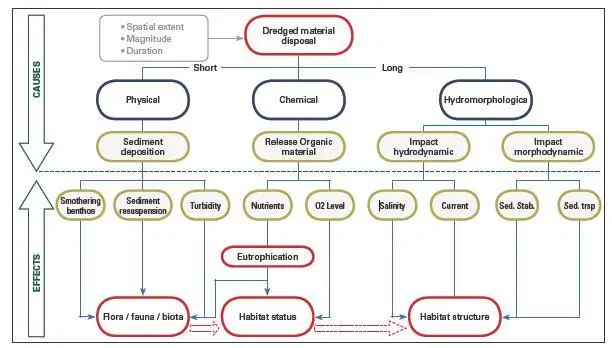
Any dredging campaign will start with some kind of impact assessment. This article will not deal with this process in any detail, but it is pointed out that the ecosystem approach can also provide more insight in the cause-effect relationship triggered by events such as the placement of dredged material.
In the Fig 2 on the following page, the possible impact of disposal of non-contaminated dredged material is outlined. Distinction is made between the impacts on the physical, chemical and morphological functioning of the ecosystem. The primary event (disposing of d.m.) results in at least four secondary causes. These causes produce a series of possible events that may in turn have impact on the biota, the habitat status and the habitat structure. The effects of contamination of dredged silt are thus not considered in this discussion. It is important to note that the time scale on which the effects manifest themselves is differentiated: The covering of the benthic community living in the surface layer of the seabed is immediate. The overall impact depends on the quantity of dredged material, the length of the dredging campaign and the thickness of the deposition layer. In a layer of some 10cm the benthos can probably move up and restore the community within a short period, but the footprint of such thin layers is unacceptable. In general one would opt for a compact disposal site. The time necessary for recovery of the benthic community varies obviously, but field data from actual disposal sites suggest that full recovery takes place between 6 months and 2 years.(ref. Bolam et al. (2x)). The impact on the overall food chain is limited as the feeders can easily move temporarily to adjacent areas where the seabed is undisturbed. Sediment re-suspension (caused by dredging) is a short term phenomenon. It could lead to some entrainment of solids by species in the vicinity; it could also lead to sediment deposition at some distance from the disposal site. This would normally be of concern only when the disposal site is within reach of vulnerable habitats (coral reefs!). For some projects a maximum deposition rate of suspended sediment has been specified (ref. Oresund) in order to limit the impact.
Turbidity typically draws wide attention because the dredging plume or turbidity cloud is visible. Turbidity is the effect that light penetrates less into the water column because of suspended particles. It is mainly caused by fi ne grained particles. One should maintain a clear distinction between suspended sediment and turbidity: the concentration of suspended matter in the water column can be as high as 1000mg/l without causing turbidity; turbidity can occur already with a fine sediment concentration of 5mg/l. The question whether turbidity has negative effects depends again on the sensitivity of the site, as well as on the length of the dredging (disposal) campaign. At most high energy sites turbidity occurs naturally and should not be of concern. In sensitive marine areas the long term reduction of light intensity should be avoided. The release of organic material from dredged silt is mainly of concern for maintenance dredging. (Capital dredging targets clean undisturbed sediment). Organic material may cause local overabundance of nutrients, which can lead to eutrophication and ‘underperformance’ of the biotope. (The term ‘underperformance’ implies in fact that the carbon flow through the ecosystem diminishes and is sub-optimal). Some nutrients introduced into the ecosystem may trigger excessive algae production. Such a drastic effect has a longer term impact on the status of the marine habitat, but the scale of these effects is certainly not caused by a single dredging campaign. A well known example is the Baltic, where run-off of agricultural land contains fertilizer and is rich in nitrate and phosphates, is transported by rivers into the sea and causes excessive levels of these substances, frequently causing algae blooms. The practical evidence from dredging disposal sites is rather more positive: because of the richness in food in the water column they attract fish and subsequently fishing boats! With respect to the oxygen level: the release of organic material may lead to high oxygen consumption and initiate a trend toward an-aerobic conditions. This would only be of concern for large-scale dredging efforts in combination with deep disposal sites where limited flow circulation prevails. Once anaerobic conditions appear, it is very difficult to restore healthy aerobic conditions. The morphological effects are very much long term and their impact is difficult to predict. Moreover, these effects are mainly of concern for capital dredging projects, where the navigational access is deepened or repositioned. The hydrodynamic effects are a direct result of deepening the fairway: in estuaries in particular this can cause further inland penetration of the salt wedge, different current velocities and changes in patterns. Such effects will at the medium to long term change the structure of the habitat, in the shorter term the habitat status may be affected. It is difficult to state whether these impacts are negative, but they do lead to changes. An example of a negative effect is the increase of erosion. The morphological changes can cause changes in sediment transport patterns and sediment deposition. Again, this may be positive or negative. For ex. in estuaries deposition of dredged material at strategic locations can help to stabilize or restore sandbanks, while maintaining the water velocity in the navigation channels. As mentioned, the effects are difficult to predict because the available modelling tools are often not yet capable to forecast long term evolution in dynamic marine environments. To sum up: dredging impact assessment often focuses on the physical impacts of the project. The chemical factors are more uncertain or limited in their spatial extent, while the morphological effects are long term and difficult to predict. They can be followed through well designed monitoring campaigns that can trigger mitigating measures when required.
A Toolbox
For all practical purposes project owners and dredging contractors have now a well-filled toolbox available to mitigate the potential impacts of dredging and to select suitable disposal sites as well as to effectuate sustainable dredging disposal. A Pianc Report (ref. Pianc) has been published which gives an inventory and overview of all the instruments available to deal with specific circumstances and a methodology to select the most suitable tools (‘Best Management Practices’). In keeping with the focus of this article, a few examples of mitigating measures that may be applied to disposal sites near sensitive areas are presented.
– The placement of d.m. on the seabed may be optimised with respect to sediment resuspension by delivering the material via the dredge pipe to the placement site.
– The placement may be optimised with respect to d.m. layer thickness and footprint by means of a diffuser pipe or a spreader.
– The placement may be made subject to seasonal restrictions, e.g. when the site is close to a spawning area. So-called environmental windows are defined during which the site may be used. – The site may be subject to restrictions in volume of d.m. that may be disposed of. In such a case alternative sites in the general area must be operated.
– Alternatively the rate of disposal may be restricted: this then calls for the selection and deployment of optimized equipment. In cases where no alternative disposal sites are available and the ecosystem is vulnerable, further specific containing measures may be taken, such as
– The installation of silt screens at the disposal site to prevent suspended sediment transport or the spread of a turbidity plume.
– The provision of an excavated disposal area that can be covered with clean material. Note that this is only relevant if the d.m. is severely contaminated.
Conclusion
• The need for dredging in ports has been fully recognized by the IMO London Convention; the European legislation on ‘waste’ should not be used as an excuse to bring dredging and port maintenance to a grinding halt.
• This article puts the consideration of dredging projects in the wider context of an ecosystem approach.
• The article gives some guidance on the classification of sensitive marine sites; not all sites are suitable for dredging and/ or dredged material disposal.
• Nevertheless, a toolbox is available that describes possible mitigating and containing measures for dredging campaigns in great detail; they can be applied if dredging is necessary and when there are no alternatives for disposal available. Its use is highly recommended.
References
S. G. Bolam, H. L. Rees et al – “Ecological consequences of dredged material disposal in the marine environment: a holistic assessment of activities around the England and Wales coastline.” – Marine Pollution Bulletin 52 (2006) 415-426. S. G. Bolam, H. L. Rees: “Minimizing Impacts on Maintenance Dredged Material Disposal in the Coastal Environment: A Habitat Approach.” – Environmental Management Vol.32, no.2 171-188. (2003) Eurosion: “Living with Coastal Erosion in Europe: Sediment and Space for Sustainability.” – Office for Official Publications of the European Communities, 2004. (www.eurosion.org). LONDON Convention: Convention on the prevention of marine pollution by dumping of wastes and other matter, 1972 and the 1992 Protocol. Resolution 52 (18) on a Dredged Material Assessment Framework. (1995). Oresund: A. Jansen, J. E. Lyngby: “The Oresund Fixed Link – Environmental Management and Monitoring.” Terra Aqua no.74 (1999). Pianc Report no.100 – “Dredging Management Practices for the Environment; a Structured Selection Approach.” – Pianc 2009. R. E. Ulanowicz: “Ecology, the Ascendent Perspective.” Columbia University Press, 1997.
Related Articles
 ALTERNATIVE FUELS GREENPORT