

Driving forward
Vehicle manufacturers and shippers are increasingly seeking to streamline the supply chain while at the same time reducing costs and integrating value added services, as Benedict Young discovers.
Some vehicle manufacturers are opting to operate their own terminals forcing shared facilities to enhance their offerings.
Meanwhile there are opportunities for ports to gain new business if they can provide everything the motor giants now demand, not least optimum location and space.
As an example, before setting up its own import terminal and pre delivery inspection (PDI) workshop at Tilbury in 1999, Hyundai cars were handled through a shared facility at Sheerness where the operator had three or four contracts. “There were often conflicts of interest, particularly at peak times when it was always a fight for resource, ” explains Clive Beer, Hyundai Motor UK’s operations planning & development manager. “Having our own site puts us in control rather than relying on someone else. We can implement process improvements and it gives us a tremendous amount of flexibility.”
Hyundai initially signed a five-year deal with the port which in turn agreed to some hefty investments in facilities including a river berth adjacent to the terminal so that vessels don’t have to transit the locks.
Setting up a vehicle handling terminal was relatively uncomplicated.
“As long as you’ve got the flat land to park cars on and the experience within your organisation to make the most efficient use of it, it’s just a matter of developing the workshop, ” says Beer. “Provided you’ve got a decent sized building, you can set up the workshop quite quickly. If you want to put in things like paint shops for transit repairs and customisation, it’s more complex. We outsource our paint work because we don’t currently do sufficient volumes to warrant the heavy investment required. However, as volumes grow over the next couple of years that will need to be re-evaluated.”
For Hyundai cars to reach the UK and Europe, they are in transit from Korea for four to five weeks, unlike some European manufactures which can reach the market in a few days. Until recently the cars arrived coated in wax which had to be removed with chemicals and high pressure hoses. “Because we only had one de-waxing facility, it was quite a log jam, ” explains Beer. “De-waxing had to happen before we could do anything else and so we sometimes had to extend working hours on certain operations to get the cars through that process.”
The introduction of wrap-guard (plastic and paper covering) has eliminated this logistical problem and alleviated environmental concerns allowing much greater flexibility in the processing of vehicles.
JURY STILL OUT “By improving productivity and efficiency, we’ve successfully managed to bring down operational costs over the years, says Beer. “We’ve experimented with different working formations in the workshop and have moved away from a line of cars because if there’s an odd problem with one car, it will hold up the rest. The optimum system is to have cars worked on in individual bays but the jury is still out on whether one man or a team of three or four men working on each car provides the greater efficiency.”
Ford Motor Company recently established a large vehicle handling centre (VHC) at Vlissingen in the Netherlands which became operational just over two years ago. Previously Ford had a major presence in Zeebrugge but there was insufficient space for the company to expand. Vlissingen not only had adequate space but is also suitable for vehicles to be transported by barge from Ford’s Cologne factory and by rail from factories in Saarlouis and Ghent.
“You tend to use locations where you have the lowest land cost, ” says Steve Applebee, manager of vehicle operations at Ford’s Dagenham terminal. “The most important thing is to be strategically positioned on the supply chain with a natural flow from the factories to the market. Generally, you’d want the VHC as close to the customer as possible while ensuring you have a cost effective way of getting those vehicles from that location to the dealerships.
“When you’re looking for space to operate at peak periods every other manufacturer wants space too. The only way you can guarantee to protect 75-80% of your normal business is to have that space there for you, paid for by you in the hope that you’re going to utilise it as best you can through the year.”
THE ONLY WAY IS UP With port land at such a premium, building multi-story vehicle terminals is one answer. “Normally we use vehicle handling or holding centres as storage facilities, says Applebee. “As a storage facility, I do not see at this stage any reason why a growth in multi-story car parks for vehicle storage will happen. The investment is too high and it’s just not cost effective.
“Where the application does lend benefit is if a facility has a relatively small storage area and a high and regular turnover. So you’ve got a high volume throughput but you’re not holding five thousand vehicles at once. That obviously does lend itself to dock operations. If by building them you generate additional business through a port operation, I can see it being attractive for port operators.”
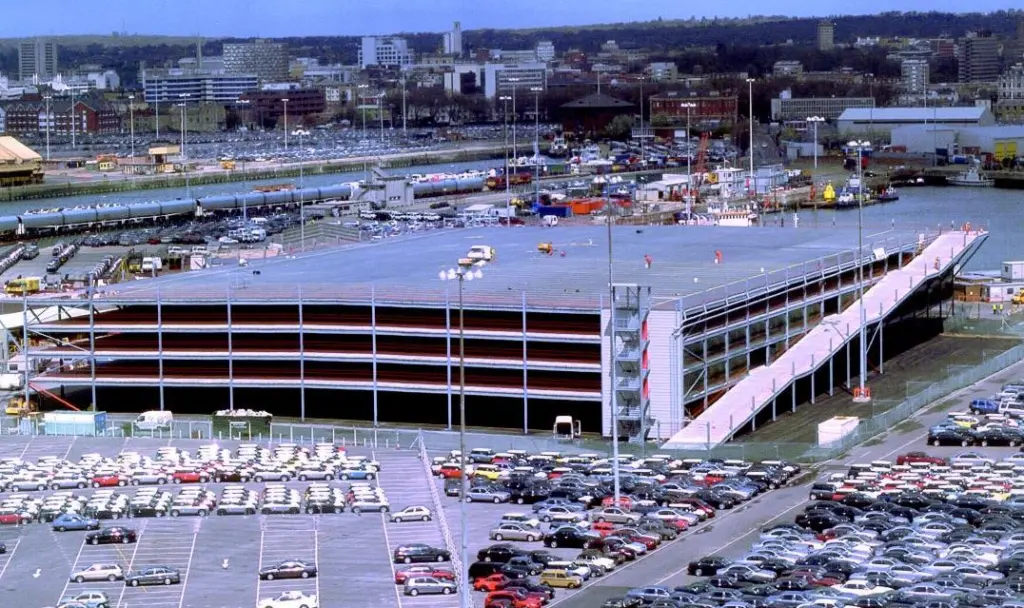
This is exactly the situation at Southampton where Associated British Ports (ABP) invested in a five-storey vehicle terminal in 2002.
ABP’s £4m investment secured a ten-year deal with Wallenius Wilhelmsen Lines which operates the terminal. ABP is currently constructing a second £4m multi-deck vehicle terminal which will be used by various deepsea carriers.
The multi-storey facility provides almost five hectares of storage on a footprint of just one hectare and the terminal is able to accept up to four car trains each day. Vehicle volumes at the port have doubled since 2000 with 750,000 vehicles handled each year. ABP estimates that total trade value of Southampton’s vehicle business at £6bn.
“Multi-storey is the future because decent land is becoming scarcer in port areas and there’s very little room for expansion, ” says Hyundai’s Beer “We’re up to 51 acres of land here at Tilbury but over the next three to five years, multi-storey will come much higher up the agenda.”
Related Articles
 CONTAINER & CARGO HANDLING
 TERMINAL OPERATIONS
 CONTAINER & CARGO HANDLING