






Easier quayside operations
Haropa Port has invested in a solution to make quayside operations easier and more efficient.
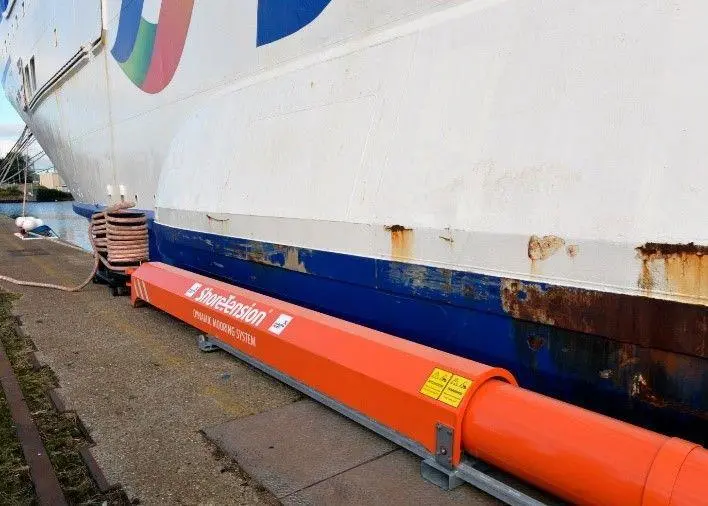
Vessels calling at Le Havre will benefit from the ShoreTension system incorporating solar power that enables vessels to remain securely moored along the quayside, so that vessel operators can concentrate on tasks in the port. The system was developed by KRVE, boatmen operating in the Port of Rotterdam
The ShoreTension solution “consists of special mooring ropes made from Dyneema (an ultraresistant polyethylene fibre) attached to hydraulic rams,” said Haropa Port. This standalone system is additional to the ship’s conventional mooring.
How it works
The ShoreTension system is positioned on the quay between two bollards and can be used on the bow and stern lines or the breast lines to counter ship movements away from the quayside in the presence of offshore winds; and on the spring lines to counter surging.
Using solar power, the system records the data remotely, most notably enabling terminal operators and ships’ masters to monitor the applied tension in real time. The port actors concerned automatically receive a text message immediately the system registers an abnormal level of tension on a mooring line. The system also offers greater flexibility since it can be positioned on any quay, irrespective of level.
Several shipping lines and stevedores are involved in the testing phase. Le Havre boatmen will attend training after the system is installed on Brittany Ferries’ Bretagne ferry.
52 “full scale” trials will be carried out over a one year period. The ultimate objective is to extend the solution to terminals across the port.
Ships regularly have difficulty in keeping securely alongside quay, a problem known as “surging”, which refers to back and forth movements by the ship along the terminal berth. Such movements are generally encountered when other vessels pass nearby.
In June, the ports of Le Havre, Rouen and Paris merged to form the single Haropa Port.
Related Articles
 EQUIPMENT
 EQUIPMENT
 EQUIPMENT