



Eastern Allure
India has the promise that port investors look for but there remains significant scope to enhance its attractiveness. Mike Mundy reports There is no disputing that India needs new port capacity and where new port capacity is needed there are opportunities.
The evidence of India’s fast shaping economic miracle is plentiful: in 2005 the United Nations Council for Trade & Development highlighted the relentless surge of the Indian economy alongside that of the Chinese economy; in 2004-2005 gross domestic product growth was nearly 7% and in 2005-2006 was over 8%, and, significantly, exports now account for more than 10% of India’s $661bn economy and are climbing fast. The forward picture is also positive – restraints on foreign trade are being relaxed, privatisation is increasing and overall India is forecast to become the world’s fourth largest economy by 2025.
The conditions are such that any global or niche investor in maritime port facilities cannot afford to ignore India as a country which could yield significant opportunities and returns. And all the more so because today’s reality is that available port capacity is not sufficient to meet demand.
Over the last few months stories of congestion have become legend in locations such as Jawaharlal Nehru Port Trust, even following the opening of significant new container terminal capacity. Demand continues to outweigh, notably in the container sector but in others too such as coal and iron ore – Table 1 underlines this point.
<img
Table 1:The 2003-04 capacity/demand balance
| Commodity |
Capacity (in Traffic 2003-04 Sector million tonnes) |
(million tonnes) |
| Liquids | 155 | 122.30 |
| Iron Ore | 51 | 59.35 |
| Coal | 60 | 48.94 |
| Fertilizer | 4 | 7.49 |
| Container | 50 | 50.96 |
| Other Cargo | 70 | 55.51 |
| Total | 390 | 344.5 |
NB: Presuming 30% surplus, capacity should have been about 570m tonnes.
Growth and problems
The practical realities that underpin the lack of capacity are on the one hand surging trade growth, as is most visible in the container sector, and on the other, diverse practical problems including a lack of or inadequate port infrastructure, poor draught in ports, insufficient equipment and inadequate and inefficient interfacing infrastructure.
In container terms, as Figure 1 illustrates, theories abound as to the rate of future growth, from a 2003-04 annual throughput of 3.9m teu traffic to between 8.2m teu and 11.4m teu by 2008-09 and 17.2m teu to 33.5m teu by 2013-14. In effect, Figure 1 plots the course of what will happen if three different growth rates apply – 16%, 20% and 24%.
It is hardly surprising then that recent experience in the Indian container market has seen exporters vocalising complaints over container system slowdown, terminals operating way in excess of theoretical capacity, liner operators underlining the need for large scale, timely infrastructure development and the suspension of cabotage laws banning foreign vessels from carrying cargo between Indian ports. The container system has been “creaking”and this has become manifestly evident. Shaping a response
The response of the Indian Government to the latter problems has been to draw up a National Maritime Development programme that foresees an investment of $14bn in the country’s 12 major ports – those directly under the control of central government – by 2014. Out of this $14bn it is foreseen that the private sector will account for 65% of the total. In addition,it is expected that over the same period an investment of $5bn will be realised in state ports – ports which, as their name suggests, fall under state control.
Industry analysts suggest, however, that even with a near $20bn slated for port expansion in India that this will not be enough and that “continuing further investment is required to keep pace with demand growth and stave off recurring congestion problems”. Clearly, it is expected that the Indian economy can mirror the “China syndrome”and if so that ongoing port expansion is a must.
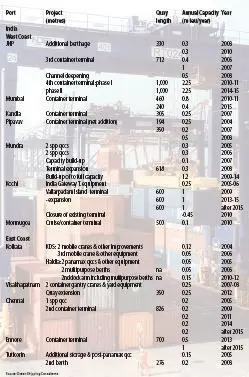
Table 2 highlights the major new port development plans currently being worked on in the container sector and while there are a good number of them it is already evident that these will not be enough.Many more can be expected to come off the drawing board into the “live” stage over the near to medium term in both central government and state ports.
Industry analysts Ocean Shipping Consultants put total containerport capacity for India at 9.15m teu at end 2007 and forecast that this will rise to 14.40m teu by 2010 and 21.42m teu by 2015 – more than a doubling of capacity in a 10-year period.
As indicated above and as history confirms, the private sector will have a major role to play in this enlargement of capacity – DP World/P&O Ports, PSA International and APM Terminals are, for example, all well known international terminal operators that have already made their mark on the Indian ports scene as well as smaller niche investors such as Mersey Docks & Harbour Company.
Other influential international terminal operators also want to get into the market; Dragados has just secured the much delayed Mumbai container terminal project and International Container Terminal Services Inc is known to be assessing various opportunities. Common sense may even prevail at some future date and Hutchison,the world’s largest terminal operator,be allowed into the market following it obtaining the security clearances that have so far not been granted.
No one misses the massive irony that while Hutchison has been allowed to own a massive telecommunications group in India it has been prevented from participating in the country’s port business due to “security concerns!”
This latter situation is indicative of the Indian government’s sometimes less than positive attitude towards foreign investors active in the ports sector, a situation that it needs to address to optimise investor interest.
One other major example of this is the Tariff Authority for Major Ports (TAMP), the body that exists to regulate the charges applied in central government ports. TAMP can be seen to have had some relevance when there were literally only a few container terminals in India but as the number has grown logic suggests that market forces will dictate the level of charges that should be applied and not some fairly distant, bureaucratic government agency.The presence of such a body is plainly a disincentive to foreign investors and terminal operators in particular – especially when it can be seen to have a history of stepping in and reducing rates as it has done at JNPT. If incoming investors shoulder significant risk then why should the rewards they have strived to achieve be reduced?
Other factors that have emerged as points of criticism regarding the port investment climate include government not taking a strong enough role in coordinating infrastructure development typically between marine developments and road and rail – excessive bureaucracy and too much political influence within port authorities. And specifically with the packaging of container terminal concessions, international terminal operators complain about three major areas – long delays in processing bids, inadequate consideration of important satellite issues such as labour and onerous concession terms where certain projects are based on unrealistic expectations.
The allure of India is plain in port investment terms but equally it is clear that the Indian authorities can play a major part in enhancing the attractiveness of India as a location for port investors to commit to.
Related Articles
 EQUIPMENT
 PORT & TERMINAL NEWS
 PORT & TERMINAL NEWS