

The Commission Von der Leyen II has placed the strengthening of Europe’s competitiveness and resilience, while keeping pace with the decarbonisation goals, at the heart of its agenda, writes Isabelle Ryckbost.
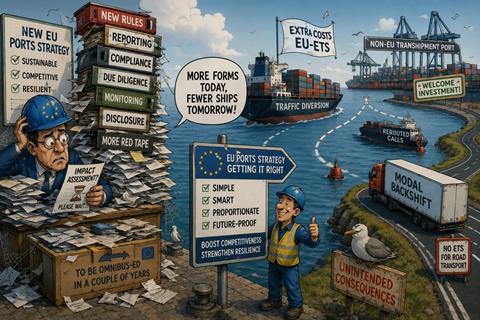
To show its engagement is serious, the Commission has been developing a series of so-called omnibus packages, including an environmental omnibus, aimed at checking the legislation in place in different policy fields and detecting where red tape and bureaucracy can be reduced.
This exercise is going well, with of course some political fight between those who fear a certain weakening of measures and targets and others who are the believers of such simplification.
At the same time, the Commission is now developing “strategies” rather than real legislation, the subtext here being that it is not the aim to add new rules but rather to look at implementation and exchange of good practices. By far, the most relevant for us, as representatives of Europe’s ports in Brussels, is the EU Ports Strategy.
But in addition to this dedicated Ports Strategy, we spend our days looking into the Industrial Maritime Strategy, the Ocean Pact, the Strategy on Islands and Coastal Communities, and we are waiting for a Strategy on Outermost Regions, an EU Sustainable Tourism Strategy, and a revised Security Strategy, to name some.
Some additional plans, acts and packages can be added to our focus list: the EU Grids Package, the Military Mobility Package, the forthcoming Electrification Plan, and the Industrial Accelerating Act, to name the most relevant ones.
Whereas the intentions behind all these strategies, plans and acts are very good and they all talk about competitiveness as a driver, this new wave of policies that is coming in our direction risks to, again, add burdens and confusion to existing rules, as well as to create a lack of consistencies between different initiatives.
Strategic thinking
Looking more specifically at the EU Ports Strategy, I believe that we can speak about a document that is solid in its analysis of how ports in Europe today are evolving, how they need to combine commercial and public interest roles, how diverse they are, and how they need to be supported.
When it comes to outlining the to-do’s, the Commission acknowledges and refers to the measures already in place. But then it puts forward the wish to work on guidance for the implementation of some of those measures - so far not clear to what those will lead - and also proposes quite some monitoring and mapping obligations for the Member States.
Whereas all this in principle can be seen as a good way forward, it could equally lead to new reporting obligations and - if we do not pay attention - an extra layer added on horizontally agreed legislation. Let me give two examples to illustrate this.
In early June, the Council gave its final green light for a reviewed Foreign Investment Screening Regulation, which sets out a more harmonised framework for screening foreign investments in critical infrastructure and thus ports.
Referring to the legislation, the Commission proposes in the EU Ports Strategy to develop guidance on how to implement this framework in ports. And it already adds features (f.i. thresholds) which are not in the agreed legislation. While we are supporting guidance on the implementation of the Regulation, we must be careful that it does not create an additional administrative layer to what has been discussed and agreed democratically in the Council and Parliament.
Increasing competitiveness
Another example is about onshore power supply (OPS). The Strategy is announcing that it wants to promote the transparency of pricing for onshore power supply. Here as well, we try to understand what it means concretely. Will the Commission come forward with a legislative proposal on that? What is the aim?
We all know that the cost of development and operating OPS is very dependent on different factors, including the CAPEX cost which differs very much from port to port and even from quay to quay, the energy cost which is not only different depending on the case but also volatile in the current geopolitical context, and finally the level of public support received.
Moreover, the OPS investments in ports are ongoing and progressing well in line with the requirements set out in the Alternative Fuel Infrastructure Regulation, while the use of OPS awaiting the obligation in 2030 is not always what it should be. This has lead many ports not to charge the real cost of OPS yet, just to encourage its use during the start-up phase.
So, while we are quite enthusiastic about the EU Ports Strategy, we must be sure that unintentionally it does not lead to again extra burdens, again red tape, which then will need to be “omnibus-ed” in a couple of years.
To me, if Europe really wants to make work of stepping up both its competitiveness and resilience, it should address the negative impact of the current EU-ETS for maritime transport. Many examples show that the current system is leading to diversion of traffic – and in the longer run of terminal investments to non-EU transhipment ports, to rerouting of calls which reduces the direct deep sea connectivities, and even leading to a modal backshift in absence of an equivalent ETS for road transport.
The proposal which could address this is due to come out in mid-July. Let’s see if the Commission really walks the talk.