



Various standards, codes and schemes have been developed to certify a port’s environmental performance. What systems are available? And how can they be integrated into other certification systems within a port? Kate Royston reviews the options.
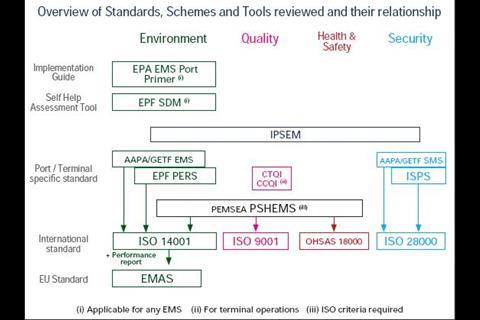
Port Authorities, port managers and terminal operators throughout the world are faced with a complex web of regulations and standards. For some years, Quality Management and Health & Safety were the key “drivers” – but now, it is the Environment and Security which are at the top of the agenda. The common theme of all these issues is “Risk Management” – and for some port organisations, this extends into the supply chain. Risk is best managed through effective management systems tailored to the organisation and established as part of daily business processes. Various standards, codes and schemes have been developed to assist business. They may include options for recognition such as Certification and Verification, which can be advantageous. The best-known standards are those of the ISO (International Standards Organisation) – for example, ISO 9001 (Quality management) and ISO 14001 (Environmental management), both of which are ideal for organisations operating in an international context. This article examines some of the options available to ports, focusing on Environmental Standards and Certification, with an overview of trends and opportunities. Table 1 provides an overview of the standards, schemes and tools reviewed and Figure 1 shows how they might fit together.
Environmental Management System (EMS) Standards
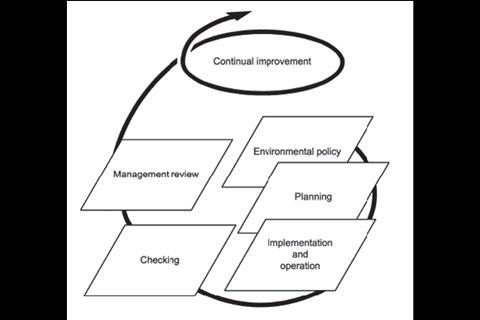
ISO 14001 was introduced in 1996. Its aim, with the EMS at its heart, is to enable an organisation to continually evaluate the impact of its activities, products and services on the environment. It can then more effectively control these against established objectives and targets for continual improvement. The standard lays out the requirements for an EMS. ISO 14001certification is a confirmation that the required EMS elements are in place. Achievement of continual improvement requires a regular revision of goals applying the ‘Plan-Do-Check-Act’ cycle.
ISO 14001 Certified ports and Terminal Operators
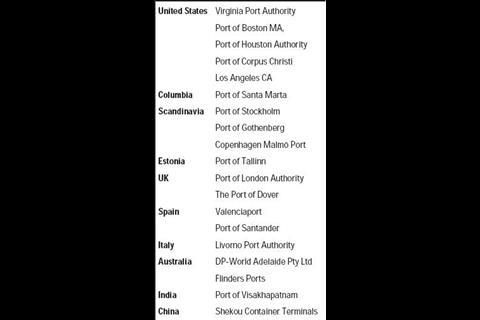
There are a growing number of ISO 14001 certified ports and terminal operators. Some examples are listed in Table 2.
Eco-Management and Audit Scheme (EMAS)
In Europe, organisations have the option to implement an EMS compliant to the European Commission’s (EC) EMAS. This can be in addition to ISO 14001. The aim of EMAS is to “recognise and reward those organisations that go beyond minimum legal compliance and continuously improve their environmental performance” http://www.iema.net/ems/emas. An organisation must publish an independently verified Environmental Statement of its performance to demonstrate improvement. The report is the key difference between EMAS and ISO 14001. EMAS also requires an initial environmental review (or environmental audit) at the beginning of the implementation. This is good practice for any EMS and can be supported by tools such as the EcoPorts Self Diagnosis Method (SDM).
Livorno Port Authority
The Livorno Port Authority (LPA) gained ISO 14001 certification in 2004. In the same year, LPA published its Environmental Statement and was registered PEMSEA PSHEMS (iII) as an EMAS compliant organisation.
Alternative EMS Approaches
Phased approaches to EMS implementation can be helpful. An example is British Standard BS8555 which focuses on early environmental performance improvement and recognising achievements gained through the phases to ISO 14001. A number of port adapted tools and approaches have been developed. These include:
* Initiatives between the Association of American Port Authorities (AAPA), the Environmental Protection Agency (EPA) and the Global Environment and Technology Foundation (GETF) in the US
* The tools developed by the EcoPorts Foundation (EPF)
* PEMSEA’s PSHEMS
Virginia Port Authority
The Virginia Port Authority (VPA) gained ISO 14001 certification in June 2008. The addition of systematic environmental management to terminal operations followed many years stewardship of the areas waterways. “This is global recognition of our efforts” said Jerry Bridges, VPA’s executive director. “The port had several programs in place. Bringing them together under a system that outlines specific checks, balances, training and audits were the way VPA wanted to go” commented Joe Harris from VPA. He added “This system ensures the port is accountable for its actions on a regular basis. In the long-run we believe we’ll be ahead of any mandated local, state or federal regulations that could be placed upon the industry. If we’re not ahead, then getting up to speed will not be nearly as costly or time-consuming. We believe that in the long-run this will be a value-added service for customers.”
EMS developments in US port operations
In the United States, the AAPA has been working in voluntary partnership with the US EPA Sector Strategies Division for four years. Kathleen Bailey, EPA’s Port Sector Liaison, presented this at the GreenPort 2008 conference in Amsterdam in February. Development of Port EMS’s is a key element. Kathleen also stressed the importance of sharing best practice, an important benefit from the EMS Assistance Programme. This has also led to EPA’s development of a number of EMS development tools from the Programme, including an “EMS Primer for Ports” and “EMS - Systematically Improving your Performance”. These documents are available on http://www.epa.gov/sectors/ports/emsprimer.pdf and http://www.epa.gov/sectors/ports/ports_bizcase.pdf.
Developed by the EPA, AAPA and GETF, the first Assistance Programme brought together nine ports and two federal marine facilities to develop their organisation’s EMS’s. It’s based on the ISO14001 standard. Graduates receive a Certificate of Recognition.
Some of the 13 graduates have progressed to ISO14001 certification, including the Ports of Boston, Corpus Christi, Houston, Los Angeles and the Virginia Port Authority. The 3rd round of the programme also includes a pilot with a private marine terminal operator to see if the model is a good fit for terminal operators. Meredith Martino, AAPA Manager of Government Relations and Environmental Policy notes: “AAPA encourages its members to use EMS’s to institutionalise their best practices and ensure compliance with state and federal laws. Ports that have EMS’s in place have been enthusiastic about the benefits they’ve realised, from energy savings to avoiding enforcement actions against them.”
EMS developments for European ports
Improved port environmental management practices have been promoted by the EC through its support of the EcoPorts Foundation (EPF). EPF is a partnership of Ports and port related stakeholders for exchange of best practice internationally. EPF has designed and developed an EMS for ports. The system includes the Self Diagnostic Method (SDM) and the Ports Environmental Review System (PERS).
SDM, an audit tool which assesses ports performance, has been used annually by the Port of Dover since 1998 (see: Dover Harbour Board Environmental report 2007 on www.doverport.co.uk). Ports successfully implementing PERS can elect to apply for Certification. This is presently undertaken by Lloyd’s Register who supported the SDM and PERS development. There are currently 33 ports from seven countries who have gained PERS certification. During 2008, the ports of Rotterdam, Dublin, Peter head and Alicante gained their first PERS certification. PERS is also an ISO 14001 based system, enabling PERS certified ports to progress to ISO 14001.
ESPO (European Sea Ports Organisation) promotes the use of EcoPorts Foundation tools in its Environmental Code of Conduct.
PERS as a stepping-stone to ISO 14001
The Port of London Authority (POLA) achieved ISO 14001 in April 2006 and the Port of Dover achieved it in October 2008. PERS certification was seen as an important stepping stone.
EMS examples in Asia
The EcoPorts approach has also been used to assist the ports of Haiphong, Danang and Vung Tau in Vietnam and the ports of Phnom Penh and Sihanoukville in Cambodia to introduce EMS’s (The Indochina EcoPorts Project was co-financed by the European Union’s Asia Pro Eco Programme.
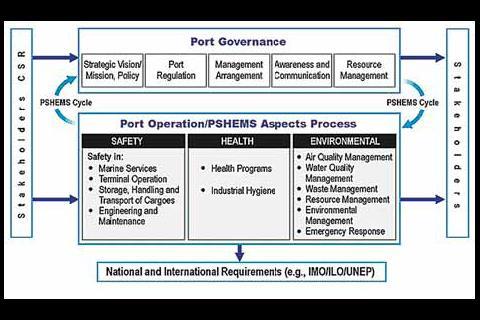
Also in Asia, the UN-funded Partnerships in Environmental Management for the Seas of East Asia (PEMSEA) have developed a comprehensive code for ports combining health and safety, quality and environmental management. The Port Safety, Health and Environmental Management System (PSHEMS) provides a framework for the integration of safety, health and environmental programs into the daily activities of ports (see figure 2). Where ports are compliant to the PSHEMS code and consistent with the requirements of ISO 14001, OHSAS 18001 and ISO 9001 they can achieve Level 1 PSHEMS recognition. To encourage continuous improvement, there are two additional levels for ports to strive for. These are Level 2 - Recognition for Proficiency in PSHEMS and Level 3 - Recognition for Performance Excellence in PSHEMS. PSHEMS was developed and demonstrated at the ports of Bangkok in Thailand and Tanjung Pelepas in Malaysia. PEMSEA is currently working with the Laem Chabang Port in Thailand to develop PSHEMS.
Why follow the EMS route?
A well-implemented EMS plays an important role in an organisation, systematically embedding environmental and sustainability considerations into day to day operations. In this way, the EMS provides benefits including:
* Reduced risk from managing significant environmental impacts and aspects
* Assurance that legal, regulatory and other obligations will be met
* Employee confidence from well-established procedures, also facilitating absence and succession
* Cost benefits through improved environmental performance e.g. Reduced waste and energy costs
* Improved internal and external image. Organisations may implement an EMS suitable for their operation, and decide not to certify to a specific standard. The need for this will depend on whether the benefits derived from certification justify the associated costs and benefits.
Houston: The EMS Platform
The Port of Houston Authority was the first US port to achieve ISO 14001. It participated in the 1st EPA/AAPA Assistance programme. Following this, it also developed a Security Management System standard, which helped shape AAPA’s SMS approach. In February 2008 the port achieved ISO 28000 certification. Aston Hinds, Ports Environmental Affairs Manager notes: “The EMS provides a platform for proactively and comprehensively addressing environmental and sustainability issues and creating a roadmap for continuous improvement of our compliance and stewardship programs”. The Port, which recently became an EPF partner, will shortly receive a prestigious ‘Gulf Guardian Award’ for outstanding environmental performance.
Who’s involved in EMS implementation?
The different parties involved in EMS implementation will depend on the type of EMS being implemented, the size and complexity of the organisation and its own internal competence. External assistance may be sought for initial assessments and EMS selection. For certification to a specific standard, the services of an accredited certifying organisation will be required. The success of the implementation will be significantly influenced by Senior Management commitment from the outset and sound communication and engagement with employees and stakeholders throughout the process. If consultants are used it is important to ensure that knowledge is transferred and embedded within the organisation for lasting benefit. Using consultants as mentors or coaches to support internal resources can be a good option. The Port of Cork (see Box story) has developed a team of internal auditors to support this process.
Certification Bodies supporting Ports and Terminal Operators
There are many accredited organisations able to provide certification and verification services for specific standards, including Bureau Veritas, Lloyd’s Register, Germanischer Lloyd and ERM Certification and Verification Services. Some have developed services tailored to port and terminal operations.
Bureau Veritas
Bureau Veritas provides consultancy and verification services including ISO 14001, has also developed IPSEM - International Safety and Environmental Protection Management in Ports. This voluntary code of practice and certification scheme (see Box story) was featured in the May/June 2008 edition of GreenPort Journal. The content of the IPSEM code is similar to the ISM code for ships.
The Port of Cork Company’s EMS development
IPSEM was implemented at the Port of Cork in 2003/4 and certification gained in February 2005. IPSEM is implemented as a set of procedures forming the backbone of nearly all operations, addressing health, safety and environment issues. Its implementation has been significant in improving the Port’s efficiency and performance. The consistent adoption by the workforce of agreed procedures is an essential element of the Port’s risk management. With a good structure in place, the workforce no longer has an excuse for doing something different. Having gained better control of procedures, the Port then progressed to implementation of an EMS. A detailed environmental audit was undertaken by Marenco Environmental Services. The Port then chose to implement the EcoPorts PERS system. Finbarr Kearney, Environment Management Representative at the Port said the PERS implementation would have been far more difficult if IPSEM had not been in place. They have found PERS compatible with IPSEM which holds the procedures upon which the EMS calls. This also avoids duplication. The Port of Cork gained their PERS certification in 2006. They are now working towards ISO14001 certification by early 2009. PERS was an important step in this progression. An important element in Cork’s implementation and ongoing improvement is regular auditing carried out by an internal team. This is soon to be increased to 16, including three lead auditors. Finbarr Kearny comments that the larger audit team means the individual auditors can spend less time auditing, yet still benefit from additional insight into the Port’s operations and continue to identify further improvement opportunities. Whilst the investment implementing these systems has been significant, the port has gained greater efficiency, cost savings (e.g. reduction in landfill through recycling) and importantly become legally compliant in their operations.
Lloyd’s Register Quality Assurance
Lloyd’s Register Quality Assurance (LRQA) provides business assurance and management system assessment through training, certification and verification services, including ISO 14001. As a partner in the EcoPorts project, LRQA recognised the challenge faced by ports with ISO implementation. They worked with EPF to develop the PERS system. LRQA continues to work with EPF on tools related to the logistics chain. Paul Bokdam from LRQA stresses that an organisation seeking continuous improvement will need to consider influencing its supply chain and extending its management system to integrate with its customers, suppliers and logistics elements. This is a feature of ISO 28000 which deals with security management in the supply chain. Of growing importance in sustainable port management is asset selection. Asset purchases have implications for many years into the future. A thorough risk assessment should be undertaken of the design and operation of the asset and its place in the chain. A framework for supporting this for ships is the Lloyd’s Register Environmental Protection (EP) classification.
Germanischer Lloyd Certification
Germanischer Lloyd Certification (GLC) provides certification of management systems in all industrial sectors, especially maritime. They have also developed some specific maritime certification services. For terminal operations, the Container Terminal Quality Indicator (CTQI) and the Cool Chain Quality Indicator (CCQI) schemes are focused on the efficiency and effectiveness of terminal operations, which can result in environmental benefits. Also recently developed is GLC’s Ports of Excellence concept. This recognises the achievement of a port as a whole, including its facilities and terminals, in attaining ISO 9001, 14001, 28000, OHSAS 18000, together with CTQI and CCQI.
Belfast: towards an Integrated Management System The Port of Belfast has used its OHSAS 18001 certified Health & Safety Management System as the basis for developing its environmental and carbon management programme. David Knott, their Safety and Environmental Manager: “The intention is to develop this into a single Integrated Management System which can be used as a vehicle to deliver enhanced performance in the areas of Health, Safety, Environment, Quality and Business Continuity. It will provide a common approach to achieving continuous improvement in all areas of our business”. The port was certified as a Carbon neutral ® company in January 2008.
Germanischer Lloyd AG similarly to Lloyd’s Register offers an Environmental Passport classification for ships. Wilhelm Loskot from GLC also advocates supply chain management: “Organisations may not be aware that having met ISPS requirements they are probably 80 per cent of the way to meeting the needs of ISO 28000. The focus of this standard is on security, with a fundamental requirement to establish communication procedures with upstream and downstream participants in the supply chain. Improvement in this communication within and between organisations will result in more sustainable and efficient operations yielding, for example, savings in waiting times and fuel usage.”
Future Trends and Opportunities
This article has highlighted Standards and Certification systems which contribute to sustainability in port and terminal operations. The focus has been on EMS’s. The trend towards integration with other systems has also been illustrated. This can bring efficiencies in areas such as administration and auditing and can also save confusion with staff and others if the management systems have the same look and feel. Once an organisation has implemented one management system effectively, this can be used as the basis for further initiatives.