

FEASIBILITY OF ‘DARK’ TRADE
In this second part, Ron Crean of London-based Windward, outlines what ports and terminals need to be wary of to be safe from sanctions.
What if there was good coverage in an area and yet also a chunk of a ship’s time unaccounted for? Well, then the move is to the final step which is to assess the feasibility of ‘dark’ trade.
If you see a significant amount of time unaccounted for, the ship may have been able to call at a port or meet with another vessel for transhipment, yet to load or discharge cargo takes time – as much as several days.
In the case of this example in the Eastern Mediterranean, it is clear to see how high the risk of sanctions evasion is during the ship’s period of ‘dark’ activity.
LOST OR ‘DARK’?
There may be a reason to assume a lost signal is actually ‘dark ‘activity and escalate the case for further investigation. However, to establish more conclusive evidence we need to take a deeper look at four factors:
Geographical context: Is the ‘dark’ activity near a known transhipment area or sanctioned port? Going ‘dark’ in the eastern Mediterranean, Gulf or off the coast of Venezuela is certainly different than doing so in the North Sea.
Historical sailing activity: Has this vessel traded with a sanctioned country in the past? If they used to visit there before sanctions were introduced it’s more likely they might still be trading there covertly after sanctions kicked in.
Established patterns of illicit behaviour: Is the vessel following a similar pattern to known cases of sanctions evasion, smuggling or trafficking? This is the most damning evidence since there is usually no economic justification for the anomalous operations employed by bad actors.
Context of the trade: If a vessel discharged at port, then was lost, and then discharged again, it is a strong signal that somewhere during the time it wasn’t transmitting it loaded cargo with unknown origins. Or if a vessel is sailing all the way to a certain area, disappears and then resumes transmissions while heading elsewhere, it indicates it had a financial motivation to sail towards a certain area to begin with – possibly to load or discharge.
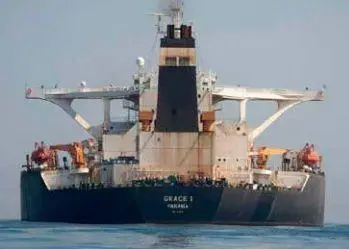
Which brings us back to the Grace 1. Behavioural analysis provided the strongest signals that sanctions may have been violated. If we look at the vessel’s port calls and historical locations, the Grace 1 was last detected in port almost two years ago, in Qingdao, China. Since then, it’s been operating continuously at sea; any port calls it may have made have been masked by turning off its mandatory AIS transmissions.
As with the recent case of the Pacific Bravo, the use of front companies, transhipments, ‘dark’ operations, and identity changes creates new risks for ports and terminals which are now required by OFAC to go beyond existing vessel tracking and list-based screening.
The scale of the problem is undoubtedly daunting. Screening by list matching alone is no longer sufficient to get ahead of sanctions risk and protect a business and its reputation. Yet the burden of knowing what every vessel is doing is huge and likely to throw up many false positives.
Reducing the number of vessels in that category needs a new approach. Companies need to consider what tools they can access to get a grip on the issue sooner rather than later because the risk must be understood and recognised as being urgent.
As the U.S. sanctions of Venezuelan oil show, those working in the maritime supply chain have to get a grip on the issue now more than ever, finding ways of reducing the compliance burden while still addressing the new behavioural requirements of OFAC.
The challenge for port operators is to stay on the right side of these onerous behavioural sanctions’ requirements by adopting the latest screening tools, before the regulators come knocking.
Ron Crean is Vice-President, Commercial, of London-based Windward, a leader in maritime analytics and supports a wide-range of industry participants reduce possible sanctions risk and meet regulatory expectations.
Related Articles
 CONTAINER & CARGO HANDLING
 TERMINAL OPERATIONS
 CONTAINER & CARGO HANDLING