The rapid escalation in container ship size presents challenges, especially in an era of strong inflation. More public sector support can facilitate going beyond doing the minimum and being ready to capitalise on the new opportunities round the corner. Mike Mundy presents the facts

Pressure is building on the container terminal operating sector caught between the two realities of having to invest in order to meet the requirements of rapidly escalating container vessel size and the fast increasing cost of dredging works and new terminal development.
In 2013 Maersk Line unveiled its E class vessel design which featured a capacity of 13,000TEU. Ten years on, in 2023, we are seeing Megamax vessels with capacities in excess of 24,000TEU enter service, nearly double the capacity of the E class vessels. This rapid scaling up contrasts with the much slower rate of development that preceded it – in 1996 maximum container vessel size was 6600TEU, taking 17 years to rise to the 13,000TEU level in 2013.
The last 10 years has taken some considerable effort on the part of terminal operators to keep pace with the new, larger ship sizes – not just at the top end of the vessel capacity range but also as higher capacity vessels are cascaded down into secondary trade lanes.
In the near term, there is no prospect of matters getting any easier – there is a new containership building spree underway which promises to be equally, if not more, challenging. A record 1.2 million TEU of new tonnage was delivered in the first seven months of this year and BIMCO forecasts a total of 2.4, 2.9 and 1.9 million TEU of new vessel capacity to be delivered in 2023, 2024 and 2025 respectively. In overall terms, the fleet is expected to grow by approximately 4.5 million TEU, an 18 per cent capacity uplift, taking place between early 2023 and early 2025.
Promising to have a particularly significant impact is the number of larger container vessels on order. As of August this year, the current fleet of vessels larger than 14,000TEU capacity stood at 391 units totalling 6.98 million TEU, with an order book for another 254 vessels with a combined capacity of 4.46 million TEU. Out of this figure there are 59 vessels on order with a capacity of 22,000TEU or above.
There is no doubt there will be another significant round of vessels cascading down from the main arterial trades to secondary and even other smaller trade lanes.
The lesson from this is that the pace of change is rapid and forward port and terminal planning must take account of this, be proactive, and expect the unexpected.
Over the previous decade, there have been quite a number of ports that have not gone far enough in their development works and have lost significant ground as a result. It provides serious food for thought when, for instance, contracting dredging services, which tend to have a high mobilisation cost and are now subject to inflationary pressures. The advantage of hindsight tells us it can prove a better option to step up development works, to go to the next level, a larger scale, in order to not lag behind rapid container system development and as a path to cost containment overall.
THE COST PICTURE
The Port Authority of Valencia (PAV), the management body for one of Spain’s leading ports, reports that the road and rail remodelling project that it commenced in 2021 and which is still underway has so far suffered from a price uplift of 11 per cent, equivalent to a €4.7 million increase – with this governed by pricing formulas and price indices laid out in the contracted works. For its new, recently completed, North Container Terminal, possessing a quay length of almost 2000 metres and a yard of 1.9 million square metres, the PAV states that the investment originally planned has risen by more than 20 per cent, due to price increases and some changes of project scope.
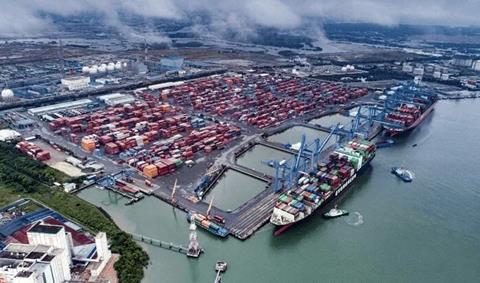
Similarly, Taiwan International Ports Corporation (TIPC) notes: “Influenced by the rising cost of construction materials, inflation, the COVID-19 epidemic and the war in Ukraine, the construction price index in Taiwan has reached record highs, with the average annual rate of increase of the construction price index (total index) being nearly seven per cent.
TIPC, together with the concession holder Evergreen Marine Corp, has recently launched the seventh Taiwanese container terminal in the port of Kaohsiung. Taiwan’s first completely automated container terminal, with a draft of 18m and a total length of 2415m, features five deep-water container berths and can accommodate four 24,000 TEU super-large containerships at the same time.
Brad Saunders, British Maritime Technologies, Senior Principal Engineer, Program & Technical Lead APAC – Coastal & Maritime Engineering, adds with specific reference to dredging projects:
“Inflation in economic terms or increases in cost due to a range of factors such as the availability of contractors, major plant, and the cost of mobilisation from other areas of high demand all impact dredging costs. The impact on a project business case and then design development is uncertainty in cost estimates that are very difficult to gauge and can often ‘blow out‘ predetermined budgets, which were developed in more normal periods of activity with higher levels of certainty for access to resources and without the added challenge of inflationary pressure on current value of funding and indeed the construction cost indexing.
“Project owners and investors,” Saunders underlines, “may need to reassess the feasibility and financial viability of certain projects in the light of these changing circumstances.”
Add to this scenario the reality that comtainership operators are sailing into hard times, the hallmark of which is much reduced freight rates, then the downstream impact of this on port operators is container lines attempting to freeze or cut terminal tariffs. So, there is little prospect of an uplift in revenues to cancel out cost increases.
RETHINK ON SUPPORT
The International Monetary Fund (IMF) states:“ Global headline inflation is expected to fall from 8.7 percent in 2022 to 6.8 percent in 2023 and 5.2 percent in 2024. Underlying (core) inflation is projected to decline more gradually, and forecasts for inflation in 2024 have been revised upward. It further notes global growth remains weak by historical standards and that, “Inflation could remain high and even rise if further shocks occur, including those from an intensification of the war in Ukraine and extreme weather-related events, triggering more restrictive monetary policy.”
Against this difficult cost and earnings picture, however, containerports have to continue to evolve and accommodate the latest requirements of their shipping line clients.
This, industry experts suggest, may mean a rethink on sources of finance and allied to this ‘how to spread the load.’ The finance sector has been reasonably creative in recent years, adding to basic debt and non-recourse financing structures with different forms of equity finance, project bonds and seeing the entrance of pension funds and more recently state investment agencies, the highest level of which is the new phenomenon of government-to-government deals, although it remains to be seen if these are a welcome development – see pxx.
What may be a more realistic approach from a public sector financing point of view is for port authorities and other government agencies to step into projects and take responsibility for core project elements such as the associated dredging or berth line construction works. It is indeed notable that full Build-Operate-Transfer (BOT) projects, where terminal operators undertake the whole development themselves, are becoming much rarer as costs escalate and public sector authorities recognise that the participation of public funding is an essential prerequisite to maintaining timely and fit for purpose project development. Indicative of this are a number of recent or current container sector projects highlighted in Table 1.
| Project Infrastructure & Dredging Works Funded by the Public Sector | |
|---|---|
|
Cai Mep, Vietnam |
By 2025, the Cai Mep – Thi Vai channel from buoy number 0 to the Cai Mep Container Terminal will be implemented under the phased programme for public maritime infrastructure development |
|
New Second Container Terminal Damietta Port, Saudi Arabia |
The infrastructure works (dredging and quay wall construction) are being implemented by the Damietta Port Authority |
|
Taiwan International PortCorp(TIPC), Taiwan |
Infrastructure and dredging are part of the public infrastructure and are funded by Central Government, states TIPC. Terminal development can be financed either by TIPC’s operational fund, or by investment by public or private entities under contracted terms. |
|
Sihanoukville Deep-WaterPort, Cambodia |
Cambodia has sourced JICA finance to the tune of US$300 million to expand and modernise the port’s infrastructure. The first phase is scheduled to be completed by 2026 and will cost US$275 million. This will cover the construction of a 350-metre- long and 14.5-metre-deep container terminal. |
|
Port of Tauranga, NewZealand |
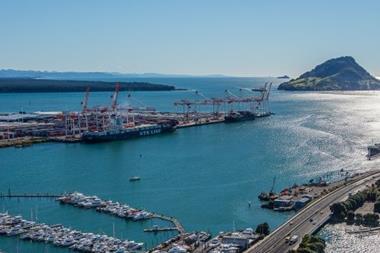
The Port of Tauranga reports it plans to construct a new 385m berth at its container terminal precisely with the objective in mind of accommodating larger size container vessels. Allied to this and other berth extensions is the upgrade of the port’s shipping channel involving dredging up to 1.8 million cubic metres. The port company is 54 per cent owned by the Bay of Plenty Regional Council but is publicly listed. The entity Quayside is the investment arm of the Bay of Plenty Regional Council and is expected to be directly involved in the port’s new development plans. |
|
Lien Chieu Port, DeNang, Vietnam |
Lien Chieu Port, a component of Da Nang national port, is intended to serve as an international gateway for Vietnam’s central region and link with the economic corridor connecting Thailand, Myanmar and Laos. The project has two main phases: the general components will be developed through public investment, including breakwaters, dredging and the provision of connecting roads. The second phase is to expand logistics capacity. |
|
Tuas Port, Singapore |
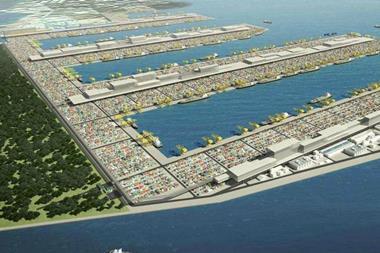
The first two berths at Singapore’s Tuas Port started operations in December 2021, three more in December 2022 with 21 deep water berths able to handle 20 million TEU by 2027. The Maritime and Port Authority of Singapore (MPA) commenced reclamation works for Tuas Port Phase 1 in February 2015 and completed it in November 2021. Tuas Port Phase 2’s reclamation works commenced in March 2018. MPA had completed all caisson fabrications in April 2022 - 227 10-storey tall caissons had been used to form 9.1km of seawall for Phase 2. The Maritime Port Authority of Singapore is a government agency as is port operator PSA, the entity responsible for container handling. |
Topics
- BIMCO
- British Maritime Technologies
- Cai Mep
- Cambodia
- Concessions & Investments
- Cost of Living
- COVID-19
- Damietta Port
- Evergreen Marine Corp
- IMF
- International Monetary Fund
- Kaohsiung
- Lien Chieu Port
- Maersk Line
- Megamax
- NewZealand
- Port Authority of Valencia
- Port of Tauranga
- Projects & Initiatives
- Saudi Arabia
- Singapore
- Taiwan
- Taiwan International Ports Corporation
- TIPC
- Tonnage
- Tuas port
- Ukraine crisis
- Valencia North Container Terminal
- Vietnam
Related Companies
- Previous
- Next