

Size matters
Should ports invest in infrastructure to handle bigger ships or stay on the sidelines?
To invest in the infrastructure to handle bigger ships, or to stay on the sidelines, as the “cascade” effect sheds larger vessels down through the trade lanes?
That dilemma is facing port executives as they consider the conundrum of whether major new investment will pay off or they would be safer by avoiding the capex equation and accepting a role as a feeder port.
Deciding which way to go is not easy. One port which has grasped the nettle of capex investment – but is a firm believer in making a business case stand up – is Melbourne.
Head of corporate relations Peter Harry says major infrastructure investment must have business rationale, because the port corporation is financially self-sustaining. “The successfully completed channel deepening project is a good case in point. [We] recognised the need for additional draught depth to accommodate deep-draught vessels, particularly when the port was constrained to an all-tides draught of 11.6 m.
“By the March quarter 2009, up to 60% of the vessels calling at the Port of Melbourne were potentially draught-restricted. Already the project has seen a number of vessels call with an available draught which exceeded the previous constraint. Since the project’s completion, at least one vessel is making use of the deeper draught every second day – which will grow over the 30-year project life.”
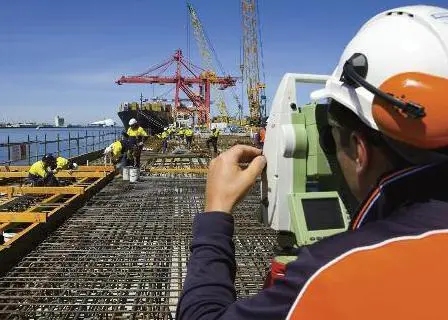
Another port that has taken on the risk of “future-proofing” is Fremantle, Western Australia’s biggest and busiest general cargo port. The average size of container ships calling at Fremantle has increased by more than 85% in the past 15 years. Fremantle harbour and its approach channels are currently being deepened so that the larger container ships can call fully loaded. The Aus$250m ($245.6m) project will take the container berths at North Quay to a depth of 14.7 m.
An additional 180 m of quay was created by reconstructing an old berth to ready it for bigger new ships. Other existing container berths are also being strengthened. In addition, an extra 27 ha of port land has been created from the dredging spoil.
The business rationale is to avoid the port being bypassed and ensure that services by larger ships are retained.
Such quandaries are faced by ports internationally. Larry Lam, chairman and managing director of Portek International, the Singapore port operator and equipment supplier, is in no doubt that, in many cases, ports at the bottom of the ladder could benefit from strategic upgrading.
“Many regional and feeder ports are still stuck in the groove of relying on geared ships and not being able to service the non-geared ships,” he says. “Many of them take comfort from the fact that the other feeder ports in the same port rotation are in the same situation, and therefore gearless ships will not be calling anyway, even if one individual port were to equip itself with shore cranes.
“Such reasoning is fast losing ground as smaller and geared ships are losing market share to the larger ones. Ports which are able to modernise and gear up will give a better turnaround time to ships calling, be it geared or gearless, and hence be able to attract more cargo and enjoy the first mover advantage.”
Mr Lam says investment such as deepening, quay strengthening and terminal management software can often be recovered through a higher volume of cargo, together with justifiable increases in tariffs that are matched by productivity improvement.
“Hence, not having sufficient return on investment is seldom the reason for not undertaking the needed modernisation. Rather, it is inertia, bureaucracy, complacency and lack of motivation which weigh down a port and allow status quo to persist,” he says.
“Those who are slow to react to the changing trends towards use of large ships will find themselves marginalised. Some may lose their international calls and may only serve as a domestic port, for the domestic trades.”
Related Articles
 CONCESSIONS & INVESTMENTS
 PORT & TERMINAL NEWS
 INSIGHT & OPINION