![PortStrategy[GreenPort]](https://www.portstrategy.com/wp-content/uploads/2026/09/PortStrategyGreenPort.svg)



Get it where you can
Experience in the UK demonstrates that ports can pull significant business that never actually goes over their quays. Felicity Landon reports When is a port not a port? When it is a multimodal hub or a distribution centre? Or a reception, unpacking, repacking, storage, labelling and barcoding facility? While most of the traffic handled remains directly port-related, the strategic location of ports in the supply chain and the infrastructure they already have in place mean they are strongly placed to attract freight that doesnt necessarily arrive by vessel.
There are clear arguments for this move – not the least of these being better use of existing resources.
“When Neil Kinnock took over as Transport Commissioner for the EU, one of the first things he identified was that regions should be emphasising the importance of ports as distribution centres for all types of trade, ” says one industry insider. “Unfortunately this idea didn’t seem to be taken up as the years went by.
“But there is a very strong environmental case for this; you should use existing resources more intensively rather than build on greenfield sites.”
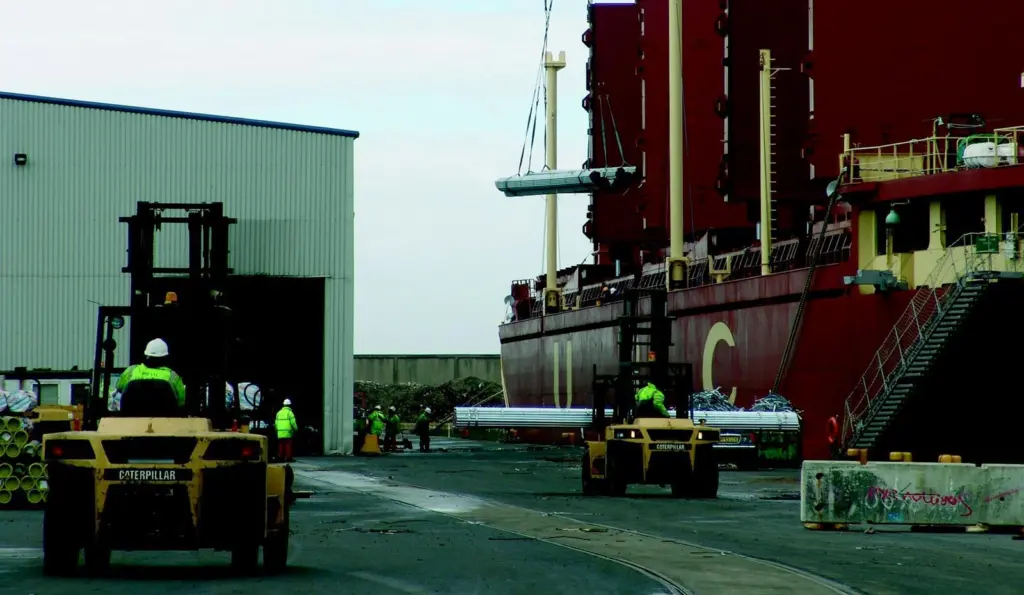
A good example of this is the Port of Liverpool’s Gladstone Steel Terminal, which receives steel coil and plate from South Wales by rail.
Some is shipped across the Irish Sea; the rest is for onward distribution into the north-west of England.
According to Mersey Docks and Harbour Company, part of Peel Ports, volumes of steel moved by rail through the port are expected to reach 180,000 tonnes this year. To meet demand, Britain’s largest rail operator EWS has stepped up its trains from one or two a week last year to as many as five a week.
“Our facilities are being used to attract port cargo first and foremost, ” says Frank Robotham, Peel Ports’ group marketing director. “But they can also be used to complement and meet our customers’ needs by handling domestic-based cargo, which will achieve greater economies of scale.”
Hopes are high that a rail facility being developed by forest products group Stanton Grove within Liverpool’s Freeport area will be used to serve the Primovis print works under construction at Speke, about 12 miles away.
EWS has already run trial trains along the loop line in readiness for the movement of Europe’s largest reels of paper – measuring 4.3 metres high – into Stanton Grove’s specialist store.
“The facility has the capacity to unload eight rail wagons at any one time. The spur from the main rail line runs into a canopied area alongside our warehouse, so we can unload in all weathers, ” says Rob Stewart, Stanton Grove’s Managing Director.
The EWS trial was prompted by growing interest in moving imported newsprint by rail from the UK east and southeast coasts to the Stanton Grove facility. In particular, the focus is on bringing the giant reels for Primovis by rail from Germany via the Channel Tunnel, says John Rogers, Mersey Docks & Harbour Company’s Business Development Manager.
Primovis is due to start operations in June with four presses which will together require 180,000 tonnes of newsprint a year. There are plans to install another four presses at a later date.
“The print room’s holding area of stock is limited, so they need to have something close by that can handle the product properly and which can duplicate their systems, ” says Rogers. “Stanton Grove would store the paper, which would be called off and delivered by road on a JIT basis.”
In the south-east, having secured its reputation as the UK’s leading fresh produce import port, Sheerness – also part of Peel Ports – is attracting increasing business thanks to its position as a central hub, with added value activities ranging from unpacking and repacking to bar-coding, box-end labelling and case picking.
“As a port we are not just a place that discharges ships; we are a multimodal point, ” says Paul Glock, Medway Ports’ Marketing Manager for fresh produce. We will receive products from all around the globe whether by road, rail, sea or air; we consolidate it here and make available the type and quantity of fruit that a particular customer wants at that particular time.”
While southern hemisphere fruit arrives via deepsea ship, a good volume of French and Spanish produce arrives by truck via the Channel Tunnel or the Dover-Calais crossing, for example.
And then there is the air-freighted fresh produce. Until the early 1990s, this would have to be discharged at Heathrow or Gatwick before it could be trucked to Sheerness. To cut out that chunk of the supply chain, Sheerness put in place all the components required to qualify for airport designation – without the runway, of course. This gives the port the official standing to process air waybills which can only be discharged at an airport.
“Sheerness has a reputation for being the leader in handling fresh produce in the UK and as a consequence of its quality services, traffic is being moved from other south coast ports to Sheerness for handling and distribution throughout the UK, ” says Peel Ports’ Robotham. “Once again, clients are enjoying economies of scale.
“This is basically a replay of developments in the 1980s when Britain started to develop freight villages. Liverpool developed the first of these with its first Freeport in 1984. As a consequence of embarking on that initiative, we developed warehousing complexes for third party logistics companies to operate themselves – but with all the advantages that the port offered, including road, rail and sea connections and a secure environment.
“And of course, this is taking place on Brownfield sites which have been redeveloped rather than encouraging the use of greenfield sites.
It is making the best use of the land and maximising the use of the infrastructure.”
DRINKS ON TILBURY London City Bond (LCB) has expanded fast since moving its warehousing and distribution facility for wine, beers and spirits into the Port of Tilbury’s former chill store a few years ago – and subsequently relocating its head office to the port too.
The major retailers are increasingly using LCB for cross-docking their promotional wine, almost entirely from the New World, into Tilbury Container Services. This achieves obvious efficiencies and cost savings. But up to two-thirds of the goods handled by LCB at Tilbury do not come over the quay.
“Most of our customers are wine merchants or brand owners who have a mixed portfolio of wines from Germany, France, Chile, and so on, ” says sales director Jeremy Pearson. “The products from France and Germany are coming driver-accompanied, almost entirely through the south-east. Tilbury is strategically well-placed for goods coming in via lorry Dover-Calais or through the tunnel.”
In the old days, says Pearson, “it was all about warehousing. The warehouse keeper said to the customer, ‘where we keep your stock is no concern to you and provided we get it into the right place at the right time, it doesn’t matter where it is kept’.
“But then it became more and more competitive, so for the companies selling wine in the UK it was more about sales and marketing and not distribution. Suddenly they needed third party carriers so our role dramatically changed from being warehouse keeper to distributor. At the same time, their customers changed;
suddenly they were dealing with whole chains of restaurants, so that it was not just the restaurant down the road but the ones in Cardiff and Edinburgh, too.
“As a result, instead of warehousing being a cheap shed up in the Fens, it had to be strategically placed on the supply chain.”
Tilbury gives other benefits for LCB too: the former chill store is ideal for wine, as the heavy insulation prevents day-to-day temperature fluctuations. Being based inside the port, overweight containers can be run round from TCS to LCB without using public roads. Pearson estimates that the cost of transporting a container from quay to inland warehouse is around £250, but because LCB is in the port, this cost is reduced to about £90.
“Also, we are handling high-value products, and the port security is excellent – everything goes in and out of one gate. For all these reasons it is great to be in the port and actually on the supply chain.”
Related Articles
 CONTAINER & CARGO HANDLING
 EQUIPMENT
 PORT & TERMINAL NEWS