



Glimpse of a hydrogen future
COMMENT: The transition away from fossil fuels in the ports and maritime sector poses conundrums, opportunities and — at the moment — many challenges, and the huge costs involved are causing headaches, writes Charles Haine.
A year ago, no-one was talking about the carbon footprint of liquefied natural gas. That alternative — with its fugitive emissions of methane, some 30 times more warming than carbon dioxide (CO2) — is now at best only a stepping stone to a low-carbon future. It’s possibly a candidate for the stranded asset catalogue.
While not naturally occurring as a fuel, hydrogen is a worthy energy storage medium. That is because electric power can easily convert water into its hydrogen and oxygen components via electrolysis. Converting it back to electrical power in a fuel cell only results in water and heat as by-products. That’s an upgrade on the nasties — CO2, carbon monoxide (CO) — you get from burning diesel. The use of hydrogen and fuel cells to reduce greenhouse gas (GHG) emissions and improve air quality in ports and neighbourhoods is a real option if it can be scaled-up.
And that’s already happening. When launched for testing this summer in San Francisco Bay, the Water-Go-Round will be the first fuel cell vessel in the US and the first commercial fuel cell ferry in the world. In the Western Isles of Scotland, the Swift H2 project, including Caledonian Maritime Assets Ltd, is looking at hydrogen-powered craft produced from wind turbines. The Scripps Oceanographic Institute — in California again — is developing a silent and diesel fume-free ZERO-V vessel, perfect for marine research.
In Europe, ABB plans to use fuel cells for hotel loading on cruise ships. Viking Cruises will use this in the fjords of Norway, which need to become zero-emission zones.
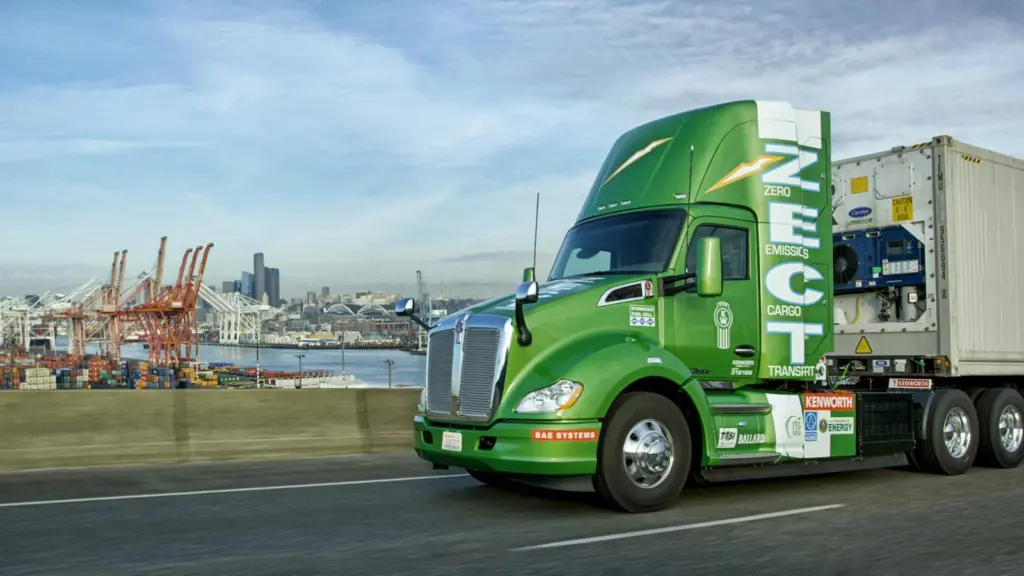
Out of the saltwater, the Ports of Los Angeles and Long Beach — keen pursuers of testing innovations — are committed to zero emissions by 2035. They’re looking at tech in on-dock vehicles and mobile equipment to reduce nitrogen oxides, sulphur oxides and particulate matter from traditional fuels in cargo handling. The 5m-teu Port of Valencia is testing a reachstacker and terminal tractor powered by hydrogen batteries. This H2Ports Project includes a mobile hydrogen supply station at Grimaldi (Valencia Terminal Europa) and MSC terminals. Interestingly, 88 regions and cities of 22 European countries are joining forces to promote the use of hydrogen in an EU-funded programme. The ports of Honolulu and Auckland are also testing hydrogen power solutions.
Government silence
As is always the case, many ports look to governments for clarity on the policy framework around alternative fuel types because the financial outlay for connecting infrastructure can run into millions. But they are being left wanting, and it’s surely the job of ports to better communicate what they need from government. There is only one chance to get it right, yet hydrogen is up against other alternatives. Which fuel horse are you going to put your money on? Further testing, fair funding and other incentives are needed to slash emissions from shipping, port and freight operations.
Shipping’s rising position in the top ten of global polluters — albeit if it was viewed as a country — has caught the attention of hydrogen innovators. Hydrogen (H2) could play a vital role in the future of shipping as a final fuel or as an input source to e-fuels like e-ammonia and e-methanol. Advocates declare that hydrogen — in combination with sector coupling — can achieve 96% decarbonisation of shipping by 2050. But without financial support, the cost of changing an entire system, and the need for huge storage facilities, are worrying barriers.
Multi-megawatt fuel cell ships are on the horizon. This works because many container vessels already use electric motors powered by gensets. Fuel cells in vessels will require thousands of kilograms of H2 per day, in volumes that will require infrastructure able to contend with gigawatt-scale.
However, the IMO does not have a standard on this most abundant of chemicals. That means no one is going to swap over to hydrogen on an existing vessel. At a minimum, the IMO needs to bring hydrogen into the policy equation when they recalibrate their 2050 target (for 50% GHG-reduction) in 2023. And safety concerns will need to be addressed.
Hydrogen and fuel cells can play a key role in meeting sector targets. Hydrogen will likely be produced in the Middle East, where renewable electricity will be cheaper, and where renewables abound — for instance, Australia, Chile and Scotland. It will have to be transported in bunker ships. Mobile refuelling strategies will also play out. Terminals and port authorities have yet more considerations for new services, the use of their space and yards and transformation of their energy strategies as they prepare to become future-ready.
Charles Haine is technical director of maritime at WSP.
Related Articles
 INSIGHT & OPINION
 THE ENVIRONMENTALIST
 THE ENVIRONMENTALIST