

GLOBALISATION IMPACTS STOWAGE
As with many other sectors of the shipping business, towage companies, especially those engaged in providing shiphandling services, are increasingly influenced by the effects of globalisation reports Jack Gaston .
Companies with their core business in shiphandling and port services reside in one of the most competitive and volatile sectors in the towage industry. Within the past decade the effects of fierce competition, often reported as ‘Tug Wars’, have taken their toll, affecting not just revenue but also new investment.
Orders for new tugs, particularly in Europe, have been at an all time low for two or three years with few substantial orders for shiphandling vessels. There are, however, signs that recent major takeovers, consolidation and rationalisation programmes are now beginning to show positive results.
Among those major takeovers were transactions that increased further the scope of a number of operators already trading on a ‘global’ basis. For towage companies operating on a worldwide scale true globalisation is proving to be very much a ‘two edged sword’.
Such groups may gain some of the advantages of a multi-national company but equally suffer some serious disadvantages.
Towage organisations having perhaps 250 tugs operating in various ports throughout the world are likely to offer a quality of service and availability of suitable plant difficult for the smaller operator to match. This brings with it the commercial security of long-term contracts and possibly the status of a ‘preferred supplier’.
For the shipowner there is almost certainly less risk associated with using an established towage group with the ability to guarantee continuity of service. There are also some benefits accruing from group purchasing and economies of scale. A ‘selling point’ used frequently by towage majors trading in multiple ports is the greater ability to choose the most appropriate tugs to suit the conditions of a particular port or terminal. This process can be highly effective within a large group but the expenses involved in the long-range transfers sometimes undertaken cannot be disregarded.
For the towage company trading in a global market place there are also considerable disadvantages. Many of their clients will be major shipping companies also trading on a worldwide basis and looking to reduce port costs to an absolute minimum throughout their area of operation. Towage industry pundits are quick to point out that this has progressively driven down the revenue available to towage companies worldwide. Large reductions in towage rates have affected revenue to the point where investment is seriously reduced. Examples quoted to PS by a major UK towage operator indicate that towage rates in some British ports have diminished to levels first established a decade ago.
RERPLACEMENT TONNAGE NOT CHEAP In order to maintain profitability, and protect the interests of their shareholders, operating costs are continually under review. All tug owners, not just the owners of large fleets, are faced with the same dilemma where vessel replacements are concerned. Older plant can be increasingly costly to maintain and operate, yet modern replacements at perhaps £3 – £4 million each represent a very large investment.
Reduction in manning levels is a priority target for many operators but difficult to apply effectively when large numbers of elderly vessels are present in the tug fleet. Reductions in crew, particularly engineroom staff, can only be made in older tugs where current standards pertaining to safety on deck and automated engine monitoring can be met. This has resulted in the increasing popularity of compact, powerful and extremely agile vessels, capable of operating with a crew of two or three persons.
Neither is the multi-national group immune from the need for efficient vessel utilisation. Most ports in the western world have seen vast reductions in the size of tug fleets. Where fleets have been pruned to the absolute minimum spare capacity is minimal and high standards of maintenance and availability paramount. This does however restrict the operators’ ability to undertake additional ad-hoc revenue earning tasks such as coastal towing or other work that will take a tug away from it’s home port. Conditions such as this can and do encourage small competing operators to grow and eventually become a threat to be reckoned with.
It is in this climate the world’s largest towage groups are having to operate. In Australia last year, Adsteam Marine Limited announced the commencement of a major restructuring of its entire global operations.
This followed hard on the heels of the earlier takeover of Howard Smith, an Australian operator with interests in Britain and elsewhere. The plans were introduced as part of a comprehensive review of the company’s operations undertaken by their new md, John Moller.
On making the announcement Adsteam chairman, Bruce Corlett said: “The Board recognises it has been a difficult 12 months for shareholders. With the appointment of John Moller as Managing Director, and the rapid and wide ranging review of operations just completed, the Board has moved to address the Group’s disappointing performance. Through John and his management team, the Board is committed to the re-alignment of Adsteam’s strategic and operational priorities”. He went on to say, “Despite challenging market conditions, Adsteam’s fundamental businesses remain strong, and can generate significant and reliable cash flows”.
The main proposals resulting from the review include refocusing on Adsteam’s traditional core ship-assist business. Non-core assets will be disposed of with the divestment process commencing immediately.
The latter will include the 50% investment in the North American based barging and fuel distribution company Northland Holdings, bunkering businesses in Australia and overseas, and the Australian stevedoring business. Complimentary ship services such as line handling, mooring, deep-sea services, salvage and tug barging will be retained along with Flinders Port.
Included in the plan is the establishment of a centralised operating centre in each of the key Australian and UK markets, replacing the distributed operating network. A three-man crew manning scheme will be implemented where possible and a number of tugs are earmarked for upgrading and redeployment including the modernisation of a number of vessels and procurement of new tonnage. One new vessel, of the latest compact ASD tugs from Damen Shipyards, entered service in Australia in January. Within the UK a careful review of vessel deployment has taken place to ensure that the most appropriate plant is available in each of the six main operational areas. Two major units have also been transferred from Australia for use in the Thames area.
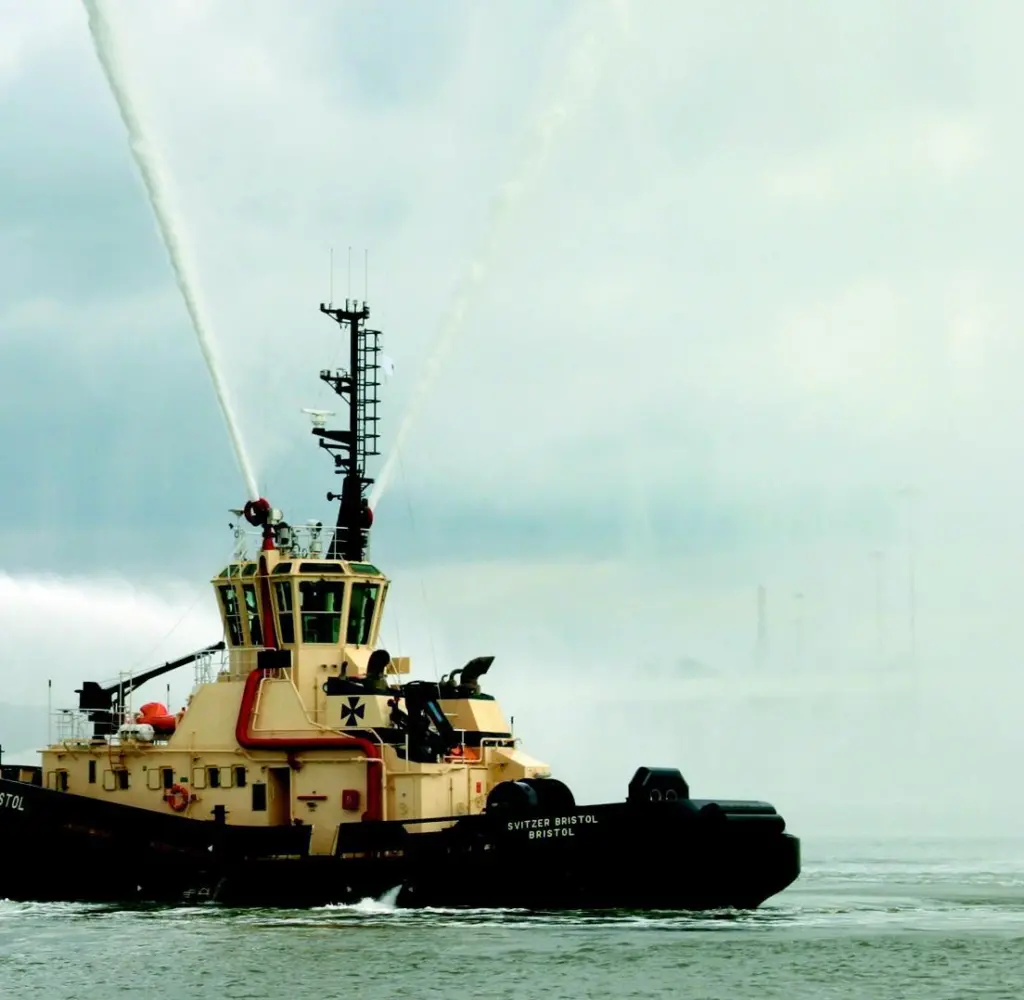
DANES INVEST Recent news from the giant towage and salvage operator SvitzerWijsmuller, with it’s headquarters in Copenhagen, included the announcement of a massive tug-building programme representing orders and options for approximately 30 vessels of various types. Part of the AP Moller Group, Svitzer acquired Dutch based multi-national Wijsmuller in 2001. The deal included the fleet of Wijsmuller Marine Ltd purchased from Cory Towage Ltd in the UK less than a year earlier. A total of 240 tugs are now operated under the Svitzer-Wijsmuller banner in 24 countries, by a staff of over 2000. Those acquisitions have resulted in a period of careful appraisal and the formulation of plans for the replacement of outdated tugs and the redeployment of others. The new vessels are required not only as replacements for existing tonnage but also to service new contracts in various parts of the world.
One of the most significant orders placed is for six tugs from the Moller owned Odense Steel Shipyard, in Denmark with options for a further eight. The vessels are being built by their subsidiary the Baltija Shipyard in Lithuania, an arrangement used to produce an earlier class of successful harbour and coastal tugs for the Svitzer group.
Spanish yard Astilleros Zamakona of Bilbao has completed four tugs for the British fleet based in the Bristol Channel and Liverpool.
Singapore based ASL Shipyard Pte Ltd has an order for six tugs and a further three vessels will be built in Australia by Strategic Marine of Perth. Two new safety standby vessels, already under construction, will also be procured from Sea Tankers of the UK. At the time of writing very little information was available on the type and deployment of the various vessels.
In Europe, Smit International N.V. Overseas BV, of Rotterdam has carried out further rationalisation and redeployment of tugs in Holland and elsewhere in the world. The company recently formed a 50/50 Joint Venture with Fairplay Towage of Hamburg to own Antwerp based Unie van Redding- en Sleepdienst (URS). SMIT and Fairplay have agreed that URS will continue to operate as an autonomous company, and that it will retain its own name and identity. URS currently operates in Antwerp, Ghent/Terneuzen, Flushing, Zeebrugge and Ostend and is active in deepsea and offshore-markets. Fairplay is one of Germany’s leading towage companies, operating in German and other European ports and also undertakes offshore and deepsea towage services.
Related Articles
 EQUIPMENT
 EQUIPMENT
 EQUIPMENT