The small grab unloader and two-rope system could soon be something found only in maritime museums as more and more port authorities look to optimise their cargo handling capacities with larger units, quick release links and special greasing systems to reduce bearing wear and tear. This is the picture manufacturers paint.
They see this as an increasing trend across the sector with a “number of enquiries” for larger bespoke units normally used with four-rope systems.
These observations suggest that port authorities remain reluctant to invest in standard, off-the- shelf products, preferring instead to grab specific units for specific cargoes.
Of course this fits with manufacturer recommendations that the size and dimension of a grab must always correlate to the weight of the material or cargo being loaded/unloaded, the type and size of the rope, and the safe working load of the crane to which the grab is to be attached.
However, Jan Eggert, product manager at Akerbergs, a Danish agent for crane manufacturer Liebherr and Smag and Vestergen grabs, says: “Of course you can have an all-round grab which can do a number of jobs, but it does depend on the cargo: if it’s a loose powder, coal, wood chips, sand or stones, then there are grabs for each particular material. If you have a cargo of coal, for instance, then you have to look at the crane capacity and then choose a standard grab that fits in that, but normally you get a grab specified for the cranes you have.”
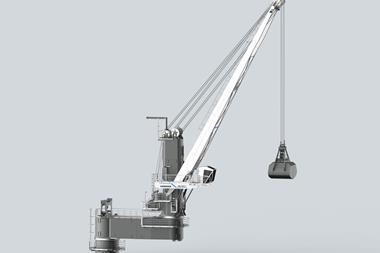
Basically, there are three types of grab: rope grab, motor grab and hydraulic grab. As the name suggests, the rope grab pulls the rope over a pulley, but there is a distinction between single-line, double-rope or four-rope grabs (depending on the numbers of closing and holding ropes existing at the crane). The motor grab, on the other hand, has to be connected with a crane hook, since the grab utilises the power source from the crane. The hydraulic version does not have the drive unit of a motor-driven grab – its power comes direct from the hydraulic dredger or from the hydraulic crane via the hydraulic horse.
And, as Mr Eggert, suggests, it is ostensibly a materials-handling machine. “We see a trend in that the small rope cranes are being exchanged for hydraulic excavators for loading and unloading. So there will be less need for these small rope cranes. We think they will go out, because they are too slow to handle as much material as the hydraulic machines.”
Nemag’s grabs are all designed for a specific group of bulk materials and are, by and large, fourrope- based systems. Its established scissor grab, for instance is claimed to be the largest of its type in the world with a volume of 60 m³, making the unit particularly suited for handling large bulk cargoes such as coals and ore in relatively little time. Tapping in to the market zeitgeist for economies of scale, the scissor grab, is said to be a very high efficiency grab for unloading large amounts of coal.
There are other cargoes which a scissor grab can be used for, such as nickel, lead, copper grain, but coal handling is more usual, manufacturers say.
Making a mark where coal and ore cargoes need to be transferred, the unique closing mechanism of the scissors grab is said to afford reduced unloading/loading due to the swiftness of the closing operation, allowing more movements per hour than conventional units. It is also benefits from a greater surface area, with the result being a 30% increase in “clean-up capacity” compared with other types of systems using bulldozers or manpower.
Manufacturer Gottwald is also celebrating new grab business with an order from a new customer at the port of Rio Grande. Vanzin Serviços Aduaneiros will use the four-rope HMK 260 EG crane, which is scheduled to start work in June 2010, for handling fertilisers and grain. Gottwald is no stranger to the port; two HMK 280 E and one HMK 300 E have been in operation at the Tecon terminal since 1997 and 2003 respectively, and more recently, Tecon Rio Grande ordered a Generation 5, G HMK 6407 Mobile Harbour Crane, a variant of Model 6, to “improve their container handling capabilities”.