![GreenPort[PortStrategy]](https://www.portstrategy.com/greenport/wp-content/uploads/sites/4/2026/09/GreenPortPortStrategy.svg)

Baltic Ports map their hydrogen future
A new report outlines Baltic Sea ports’ readiness for alternative fuels and assesses port infrastructure, port bunkering and future hydrogen supply demand.
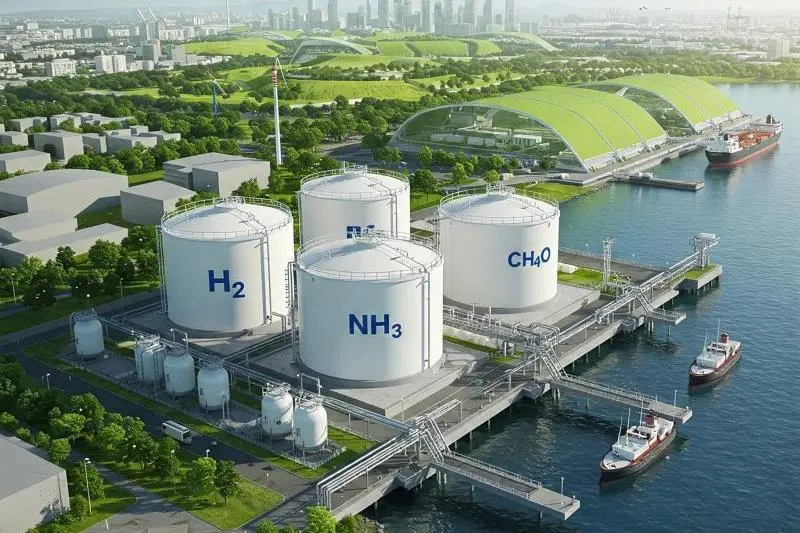
The H2-Derivatives Market Demand Analysis for Baltic Sea Ports was developed under the Interreg Baltic Sea Region H2-Deri@BSP initiative led by Port of Hamburg with partners including IVL Swedish Environmental Research Institute, Port of Helsinki, Port of Kiel and others.
“Electrofuels, or hydrogen derivatives such as electroammonia, electromethanol and renewable hydrogen, are all alternatives to conventional marine fuels. However, the readiness of fuel production, distribution and port infrastructure varies significantly” concludes the report, emphasising the need for more coordinated development to reap the benefits from the market.
Future opportunities
Teh report maps nearly 300 hydrogen-related initiatives across the region, exploring demand, production, infrastructure and regulatory frameworks, though most remain in planning or feasibility stages.
It highlights that current production is nascent, with only around 2 per cent operational today, but future capacity could reach the equivalent of 31 million tonnes of marine gas oil beyond 2030 if planned projects are realised.
The study identifies both established bunkering hubs and emerging ports near planned hydrogen production sites as pivotal nodes in the transition to climate-neutral maritime transport by 2050.
Denmark and Finland aim to become major exporters, Germany is developing import corridors and port conversions and Sweden is focusing on industrial and maritime hydrogen use.
The Baltic States and Poland are still in early development but show promising hydrogen valley initiatives. For example, under the auspices of the H2-Deri@BSP initiative, Baltic ports including Port of Klaipėda are already examining the possibility of port bunkering arriving vessels with green fuels, advancing hydrogen-derived fuel uptake.
In total, if planned projects are realised, hydrogen-derived energy production could reach 338 TWh, equivalent to 31 million tonnes of Marine Gasoil, by 2030 and beyond.
The report signals that enhanced hydrogen supply strategies, cross-border collaboration and targeted investment in alternative fuels and port infrastructure could deliver widespread sustainability benefits by positioning Baltic Sea ports at the forefront of the maritime green energy transition going forward.
Related Articles
 ALTERNATIVE FUELS GREENPORT
 ALTERNATIVE FUELS GREENPORT
 ALTERNATIVE FUELS GREENPORT