![GreenPort[PortStrategy]](https://www.portstrategy.com/greenport/wp-content/uploads/sites/4/2026/09/GreenPortPortStrategy.svg)





Durapowered AGVs to decarbonise Tuas Port
Lithium-ion battery manufacturer, Durapower has successfully commissioned 54 Automated Guided Vehicles (AGVs) for operations at PSA Singapore Tuas Port.
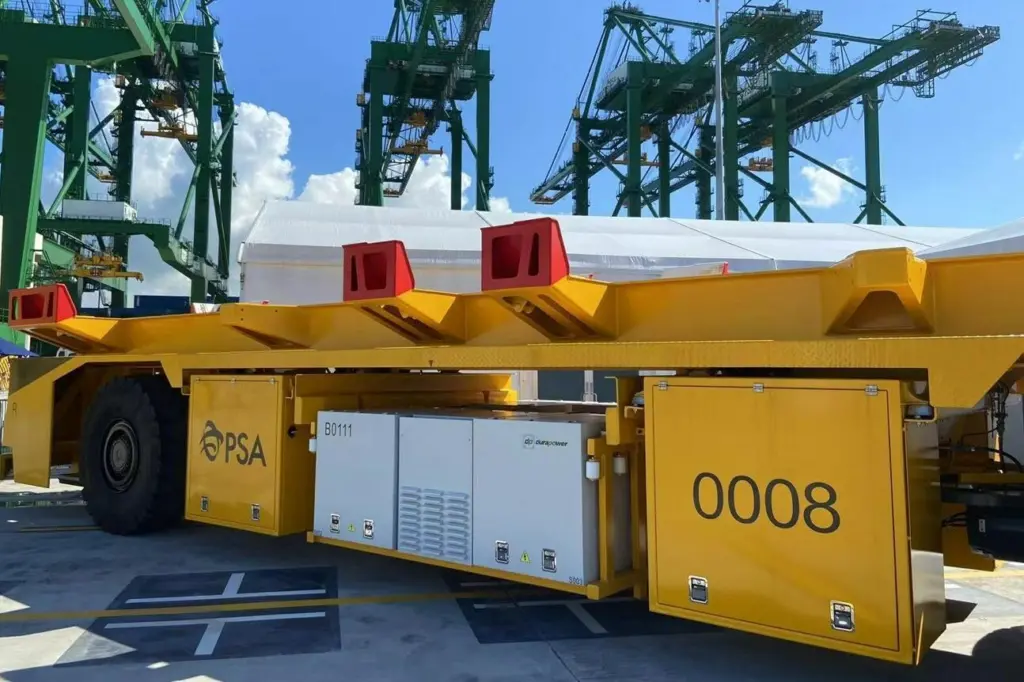
The successful launch builds on Durapower’s ongoing efforts to advance global port decarbonisation.
“This latest award is a testament to our customers and port businesses’ confidence in the quality, our products, in terms of performance, track record and safety, for heavy duty, specialty commercial electric vehicles that operate under strenuous conditions,” said Kelvin Lim, chief executive officer of Durapower Group.
“It also highlights our strong relationship with PSA and partnership opportunities with various AGV manufacturers. We will continue to build on our technical capability and innovation to advance powerful and efficient clean energy solutions to the world.”
High power batteries
Durapower clinched the PSA Tuas Port AGV battery tender earlier this year and has since completed testing of its 266kWh Battery Energy Storage System (BESS) with a third-party AGV manufacturer.
Durapower’s customised durable, high power battery solutions, first deployed in 2012 for specialty vehicles like AGVs, are built for ruggedness to withstand heavy loads and extreme operating conditions.
To minimise operational downtime, Durapower offers high-performance, fast-charging battery pack systems for operational efficiency.
The company is currently researching a cloud-based technology that can greatly enhance the lifespan and safety of lithium-ion batteries in collaboration with Scientists from Nanyang Technological University, Singapore (NTU Singapore).
Powered by the Internet of Things (IoT) and Artificial Intelligence (AI), this new solution can help companies and data centres lower the risks associated with lithium-ion batteries, including potential fire hazards, particularly in hot and humid climates like Singapore.
The team estimates that their patent-pending technology can help to extend the lifespan of lithium-ion batteries by more than 50%, significantly reducing carbon emission through the reduction of battery waste.
Related Articles
 ASIA GREENPORT
 PRODUCTS & SERVICES GREENPORT
 ALTERNATIVE FUELS GREENPORT