![GreenPort[PortStrategy]](https://www.portstrategy.com/greenport/wp-content/uploads/sites/4/2026/09/GreenPortPortStrategy.svg)
A major setback for marine decarbonisation
The International Association of Ports and Harbors (IAPH) says that the postponement of the adoption of the IMO Net Zero Framework (NZF) is a major setback for decarbonisation ambitions both at sea and on land.
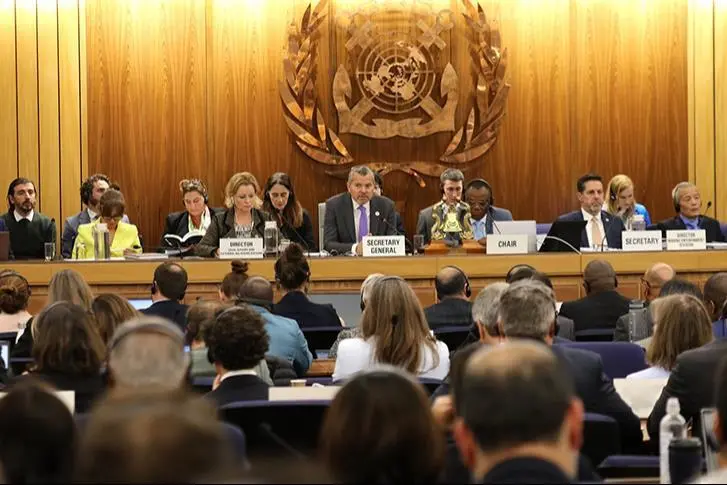
This decision by the Marine Environment Protection Committee (MEPC) which voted to adjourn the decision on amendments to the MARPOL Convention that would enable the implementation of IMO’s landmark Net Zero Framework, means another year of waiting.
”This is a major setback for the maritime industry. Shipping and ports need a global framework that provides them with legal certainty to make the necessary investments in decarbonisation,” said Patrick Verhoeven, managing director, IAPH.
”Only IMO can provide such a framework. We don’t know what this adjournment will lead to, but we fear it will simply open the door for more national and regional measures, which will add to an already complex regulatory patchwork resulting in unintended consequences.”
Continued uncertainty
The Framework includes a global fuel standard for shipping and an economic measure, which consists of a pricing mechanism and credit trading scheme to drive down emissions and fund the transition to zero and low carbon fuels.
Meanwhile, IMO’s economic measure aims to close the gap in pricing between hydrocarbon and low and zero carbon fuels.
IAPH said that this measure is key in assisting funding necessary investments in research and development to accelerate the energy transition of shipping as well as supporting the vital port infrastructure investments to guarantee the supply of those new fuels, particularly in developing countries which will otherwise be marginalised.
Political pressure
Many are sceptical as to the reasoning behind the Member States’ decision to delay adopting the IMO NZF.
Emma Fenton, senior diplomacy director at NGO Opportunity Green, said: “Faced with pressure, too many governments chose political compromise over climate justice, and in doing so, abandoned the countries bearing the brunt of the climate crisis.”
She said that the decision to delay is due to delay tactics and procedural sabotage by the US, Saudi Arabia, Russia and other petrostates.
Ms Fenton said that in the lead up and throughout the meeting, the Trump Administration threatened retaliatory tariffs and sanctions, especially on developing and most climate-vulnerable states, if they support the Framework.
Delegates from many developing countries described this extraordinary pressure on their capitals as “bullying”, “unprecedented” and “undiplomatic”.
She also said that the US and Saudi Arabia also tried to create a delay by proposing to change the IMO’s regular adoption process by consensus to an ‘explicit’ adoption process which would impose additional hurdles to enforce the Framework, especially for many developing countries.
Some delegates believe that putting the talks on hold will give countries more time to find consensus on this flagship climate law. But others fear that the US will further ramp up pressure on developing countries to oppose adoption at a later stage.
The IMO is set to meet again for technical discussions (ISWG-GHG-20) on 20 to 24 October, to discuss key policy details on design and implementation of the NZF, including green energy incentives and the revenue disbursement.
But the original entry into force of the NZF was planned for March 2027. This timeline will now have to be reviewed.
Related Articles
 PRODUCTS & SERVICES GREENPORT
 EUROPE GREENPORT
 REGULATION & POLICY GREENPORT