![GreenPort[PortStrategy]](https://www.portstrategy.com/greenport/wp-content/uploads/sites/4/2026/09/GreenPortPortStrategy.svg)



Are ports lagging?
Everybody accepts that the world is a different place since 9/11 but ports may not be doing enough to protect themselves writes Benedict Young.
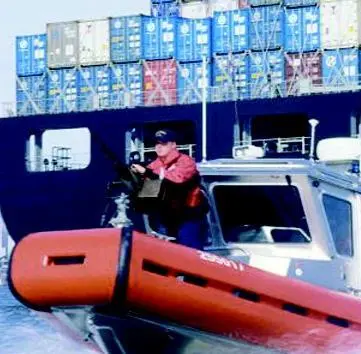
Ports and other supply-chain stakeholders have got used to the increased burden of security since 9/11. With the US in the driving seat, we have seen a raft of legislation and rules which permeate the global economy. The ISPS code has been largely implemented by the worlds’ ports and carriers with only a few grumbles and without many major hitches. However, are we doing enough to protect our ports?
“Most of the systems we have in place are good concepts which are working well, ” says Tim Kinsey, chief of police at the port of Seattle Police Department. “However, we are clearly not doing enough to provide the level of security we need both to protect our ports and to ensure the continuity of global trade.”
In the US over US$10bn has been spent on airport security since 9/11 while port security has seen only a fraction of that amount. It must be said though that airports have a long history of security before 9/11 and had a lot to build on while seaports were more or less starting from scratch.
“In my personal opinion, we overreacted with airport security to a great extent and have fallen very short in addressing our seaports, ” says Kinsey. “It’s imperative for us in the maritime industry to develop standards for supply chain security. We need to ensure that containers are documented and loaded securely and protected against tampering. We should be able to put in place systems similar to programmes like flight tracking for aircraft.”
The National Strategy for Maritime Security, recently launched in the US, is aimed at aligning Federal government maritime security programmes and initiatives into a cohesive national effort involving all stakeholders. The US government says: “Maritime security is best achieved by blending public and private security activities on a global scale into an integrated effort that addresses all maritime threats.”
The new strategy has a number of mutually linked supporting plans which are aimed at addressing specific threats.
PROACTIVE PANAMA The Panama Canal is excluded from ISPS rules because it is not a port. Despite this, the Canal Authority has taken a particularly proactive approach to security and decided to meet ISPS standards.
Transits through the canal are increasing year on year and a terrorist attack on a lock or transiting vessel could block the route with devastating effect.
“There are many different security threats but the focus for the Canal Authority is terrorism and organised crime, ” says Antonio Michel, head of canal security. “We apply a risk management strategy and security measures are based on industrial standards with additional layers on top. Training is a crucial element.” The Canal Authority makes extensive use of surveillance and intelligence information as well as cooperating in joint and combined security operations with other agencies.
Fences are fitted with infrared sensors while perimeter visibility is ensured with high quality lighting. At the waterside approaches to the canal, high-specification infrared CCTV cameras, integrated with AIS, provide long-range tracking capabilities of up to six nautical miles.
High-speed radar can track speed boats from the canal’s emergency management centre. A team of divers provides an additional level of protection using the latest in underwater scanning equipment.
Back in the US, since 9/11 the federal government has stumped up some US$500m in grants for port security. Seattle received US$10.5m. As well as gamma-ray scanning technology, the port is using radiation monitors mounted on container gantry cranes and mobile units around the port. “We need to look at further expansion of radiation monitors in all ports and develop better tools to identify high risk cargo, ” says Kinsey.
WORKER CREDENTIALS One of the biggest perceived weaknesses in port security is the lack of reliable credentials for workers. In the US, the Transportation Identification Card is currently being considered. “All seafarers and transportation workers have ongoing contact with cargo, ” says Kinsey. “Examining every employee’s history is a major requirement and undertaking. This level of credential is a major step in securing the logistics of transportation infrastructure while giving employees the freedom of movement they need to do their jobs.”
Sharing information has not always been a priority for private or government agencies but this seems to be changing. In October, the US Coastguard announced the deployment of a new internet portal called Homeport which is designed to be the primary means of day to day management and communication on port security issues. In terms of the requirement for increased information sharing, the system is expected to bridge many of the current gaps in security management between federal, state, local and industry decision makers.
“The issue of sharing information is absolutely critical, ” argues Kinsey. “For too long we have laboured under a misconception that information is ‘need to know’ which is very restrictive and we need to get into the mind set of ‘need to share’. It was clearly pointed out in the reports following 9/11 that the failure to share information was a primary cause that facilitated that disaster. We can’t afford to let that happen again so we should push strongly to find a way to share information.”
Related Articles
 EUROPE
 TERMINAL OPERATIONS
 TERMINAL OPERATIONS