Real-time or past times, vessel tracking can provide valuable support and information. Felicity Landon reports
Visibility and operational efficiency have always been the key drivers behind Vessel Traffic Services and Vessel Traffic Management Systems – but the trend is increasingly to bolt on extras and, unsurprisingly in the current climate, to use VTS functions to reduce costs.
What’s clear is that there never was a one-size-fits-all scenario and, alongside bespoke systems designed by the major suppliers for larger ports, AIS (Automatic Identification System) requirements since 2005 have added to the options.
The move towards more and more electronic reporting of ship’s data, particularly that driven by European Union regulations, such as Directive 2010/65 on ship’s reporting formalities, is also adding to the mix.
US-based PortVision, which uses data from the AIS system to provide its services, says reviewing historical vessel movements can be just as valuable as tracking real-time vessel movements.
The company says many clients have incorporated its TerminalSmart platform’s historical vessel movement data directly into the supply chain model, enabling them to perform integrated demurrage reporting and analysis within a single, integrated system. These companies, for example, have been able to analyse demurrage charges and validate demurrage billing by tapping into data about not only where a vessel is now but also where it has been in the past.
“A comprehensive VTS typically incorporates a number of distinct components, including AIS, radar, radio communications and other logging and record-keeping features,” says Dean Rosenberg, chief executive of PortVision.
Alternative option
Typical VTS platforms require capital expenditures in the millions of dollars, with ongoing significant operating expense, he says. “While larger ports and regions can benefit from a comprehensive VTS, it is possible for smaller ports and regions to derive many of the same benefits through lower-cost AIS-based services paired with marine radio and other off-the-shelf components.
“Today’s web-based AIS services, such as PortVision, provide smaller ports with real-time vessel reporting, alerting, anomaly detection and historical analysis. And all of this capability can be deployed and operated for a fraction of the cost of a ‘traditional’ VTS platform.”
As AIS-based services evolve, benefits are emerging that are far beyond the ‘points on a map’ capabilities, he adds. PortVision has built a receiver network on land to allow shoreside users to receive other benefits from the technology.
In recent years, PortVision has added a series of enhancements to its service, including predictive ETA to help shoreside personnel to plan towage, pilotage, berth optimisation and other resource planning, real-time alerts to notify stakeholders of arrivals, departures and vessels passing, and document /management and information publishing, including providing information about drafts, terminal security policy and other matters.
Weather information can also be integrated, the service can partner with regional trade associations to share information about waterway closures, for example, and reporting and analysis tools can enable historical review of activities, to help with training, compliance, research, legislative and enforcement activities.
Data aid
At the Port of San Diego, the PortVision service is used to record the maximum speed of all vessels travelling in its Vessel Speed Reduction zone. This is a vital part of the port’s ocean-going vessel speed reduction programme, which sets the voluntary speed limit inside San Diego Bay to 12 knots for cargo ships and 15 knots for cruise ships, to deliver significant emissions reductions.
PortVision’s system delivered a solution when a refinery on the Houston Ship Canal was suffering from surge damage from the many large vessels passing each day. In one case a vessel created a surge large enough to damage a loading arm on the dock, which in turn caused a fire and put the dock out of service, at significant cost to the refinery.
The TerminalSmart system provided historical data through which the refinery was able to identify which vessel was responsible and calculate how fast it was travelling. The company was also able to identify other vessels affected, and find witnesses. “Based on a combination of the forensic PortVision AIS data and eyewitness accounts, the refinery was able to prepare an ironclad case for a compensatory damage claim, and settle the matter with the vessel operator.”
The Port of London Authority developed its own unique ‘Thames AIS’ for smaller craft six years ago, and made it mandatory for all passenger boats, tugs and commercial vessels over 50 gt throughout Central London.
This move was in direct response to recommendations from the Thames Safety Inquiry. Last year the Thames AIS area was extended to include the stretch of river from Victoria Deep Water Terminal as far as Denton Wharf – a key reason for this was to allow for any expansion of passenger services during the Queen’s Diamond Jubilee celebrations and the Olympic Games.
Thames AIS features a geographical display and requires electronic reporting of passenger numbers on board. Crucially, it enables masters and skippers to be much more aware of other vessels in their immediate area.
Tied in
The PLA’s main VTS system underwent a major upgrade last year, which added more flexibility and capability, including enabling VTS operators to control CCTV direct, presenting images onscreen, and enabling the use of CCTV cameras to track radar targets automatically.
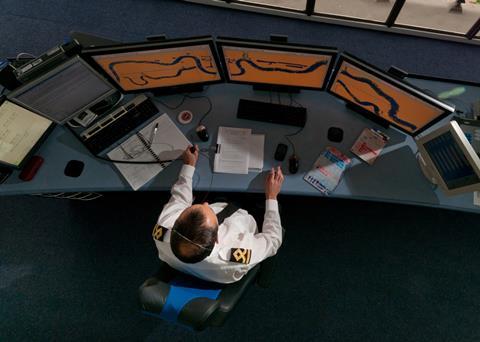
When Harwich Haven Authority recently spent £1.5m on an upgrade of its VTS facility, which was in the main undertaken by Signalis, an important part of the deal was a VTS after-care contract. Described by HHA as ‘an innovative approach’, it provides for the continual update of the new system to ensure that improvements and innovations developed by the supplier are implemented.
The investment also incorporated a complete redesign of the operations room, to accommodate both the VTS and communications equipment. Anxious to ensure that the new layout was the most efficient possible, HHA called in an ergonomic design consultancy for its expert advice.
A full ergonomic assessment was carried out, involving the construction of a real-size cardboard replica of the intended layout of the ops room and evaluation of various furniture designs, in both cases working closely with the operational staff. This study resulted in the selection of Knotty Ash Woodworking to provide and install bespoke furniture in an innovative layout, ‘designed to optimise synergies within the operations team’.
While port VTS systems contain information for the monitoring/managing of shipping locally, the SafeSeaNet vessel traffic monitoring and information system managed by the European Maritime Safety Agency is intended to provide EU-wide information to different types of users.
Moving on
SSN, which has now been operational for three years, is continuing to develop.
“The purpose of SSN is to enhance the safety and efficiency of maritime traffic, improve the response of authorities to incidents, accidents or potentially dangerous situations at sea, including search and rescue operations, and contribute to a better prevention and detection of pollution by ships,” says EMSA communications officer Louis Baumard.
SSN is run at national level by the member states, which provide information to the central SSN system. Typically it is tracking up to 17,000 vessels at any one time. SSN does not overlap with port VTS or any other local monitoring or management system, says Mr Baumard. “These are used to undertake more detailed traffic management and monitoring on a localised basis.”
However, SSN can support the work of the ‘local’ VTS, enabling the system to access more information such as on dangerous goods for ships, accidents or incidents, and early information about a vessel’s ETA.”