
Last month, the World Bank published a new version of the Logistics Performance Index.
New in this edition are the results of a ‘big data’ analysis of the performance of international shipments, using data from, amongst others, MDS Transmodal, Marine Traffic and Tradelens. The data from MDS Transmodal and Marine Traffic have previously been used in publications of the United Nations (the Liner Shipping Connectivity Index/the Review of Maritime Transport).
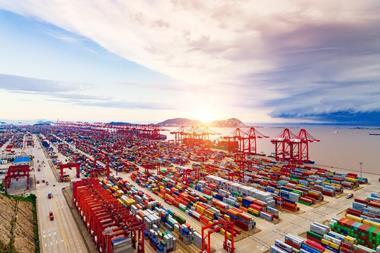
The Tradelens data is new – and relevant. Data was collected regarding the total door-to-door transport time of maritime shipments. There is a huge variation between shipments. As was to be expected, the major ‘source’ of the variation of total transport time is related to ports and dry ports; some containers have very high dwell times in ports, while others do not. This is especially the case on the ‘import journey’ (i.e., from port to final destination).
A comparison of dwell times reveals huge differences between countries, and not always as would intuitively be expected: the average import dwell time is much higher in western advanced economies (8.3 days in Belgium, 7.6 in Germany, 7.2 in The Netherlands and the US) than in emerging economies such as China (5.5) India (2.6) and Cambodia (2.1). Plus, aside from small island states (with low numbers of observations), the lowest import dwell time is found in Japan, where the average dwell time is as low as 1.0 days.
While in general, I definitely agree with the World Bank that lower dwell times are better, a deeper understanding is required to assess whether that holds in all cases. Probably, the most important issue for shippers is the ability to freely decide when to pick up their goods/ containers. Thus, if a high dwell time is caused by unproductive port operations or time- consuming customs processes (as it may be in many countries) and containers were not available for shippers then this can build costs for shippers, not least because the dwell times are unpredictable.
However, on the other hand, when shippers can freely decide when and how to pick up their containers, they may opt for long stays at the terminal, as well as slow, but sustainable and cheap onward transport modes in case stock levels are high enough. Such a scenario would not imply higher generalised transport costs for shippers.
Another caveat to keep in mind is that modern large, semi- automated terminals are designed for an average dwell time of around seven days, while container operations at older terminals with a limited yard space may have to adjust their pricing policies to secure low dwell times and reach an acceptable terminal efficiency.
In short, a more granular approach can extend the important new insights developed by the World Bank.