


Jacksonville article for Jan 2009 issue
Swapping west for east coast, Jaxport boss Rick Ferrin talks to Barry Parker about Jacksonvilles plans for the future
When Rick Ferrin, now executive director of the Jacksonville Port Authority (Jaxport), travelled across the US to Jacksonville in the late 1990s, he was impressed by what he saw.
Even though he was on track for the top job at California’s Port of Oakland – which he joined after a 20 year career in the US Army Corps of Engineers – he accepted an offer to move across the country and spearhead what has since emerged as an exciting growth story.
In the late 1990s, the port’s revenue streams were automobile imports and the trade to Puerto Rico. Fast forward ten years and Jacksonville continues to be pre-eminent in those trades, but has also morphed into a distribution hub for retailers serving the Southeastern US and beyond.
“One third of the country, and 60% of the population, is reachable within 24 hours by truck from our port,” Mr Ferrin says.
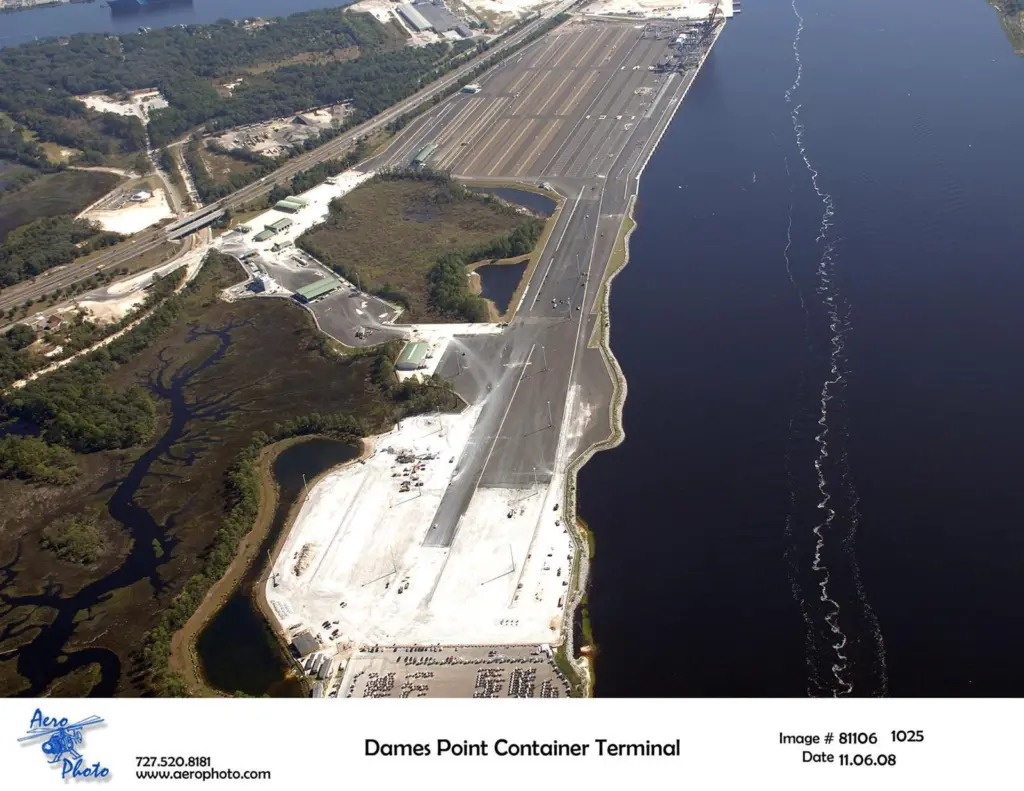
Port Strategy talked to Mr Ferrin following JAXPORT’s announcement that it had attracted Hanjin Shipping Company to build a $300m container terminal on site that it will lease for a 30 year term with an option to extend 10 years beyond that. Its opening is slated for late 2011 after a two year construction period. The TraPac Container Terminal under construction for Mitsui OSK Lines also in the Dames Point area of North Jacksonville, was set to open in January, 2009.
Mr Ferrin says: “New carriers here are not just MOL and Hanjin – we get their alliance partners, as well.” When Hanjin’s terminal opens it will triple the port’s annual container capacity to 2.7m teu.
JAXPORT is self supporting, relying on rentals from tenants at its facilities, and charges based on teu throughput. The port has issued revenue bonds, and has also received funding from the City of Jacksonville, which benefits from the economic multipliers of port activity.
Mr Ferrin explains: “We’ve created an environment that’s attractive to the Asian carriers to make direct calls in the Southeast; a big catalyst for their move eastward was the September 2002 lockout on the West Coast.” He says that his Board had considered the desire of carriers to make direct East Coast calls, while all the while being mindful of the upcoming widening of the Panama Canal.
The JAXPORT package also includes infrastructure; the port is situated near a confluence of major interstate highways, and is served by two leading railroads, NS and CSX. The Dames Point area will also benefit from a just announced $50m project, to be funded by the City, that will increase the capacity of the linkages between the highways and the railroads.
Says Mr Ferrin: “We already had an excellent road network. Now we will have a better one.”
Additionally, planning has already started for deepening of the federal channel beyond the present 41 feet.
Mr Ferrin’s successes are due to a constellation of factors, including his 20 years in the Army Corps of Engineers – the Federal agency responsible for dredging navigable channels at US ports – and his role as director of engineering at Oakland.
One technique that proved to be effective at Oakland was the ability to prepare an accelerated feasibility study. As the impact of the widened Panama Canal looms large on Jacksonville’s plans, Mr Ferrin says: “The Corps is preparing a General Re-evaluation Report (a document combining environmental, engineering and economic analysis). It will be ready about a year from now.”
He describes a timepath that has the port at a draft of 47-48 feet, which Mr Ferrin feels is optimal for accommodating post-panamax vessels by 2014. The GRR is an important step on the path to authorisation for the Army Corps to dredge in Jacksonville. He estimates the overall cost of deepening to 47 feet, over a 15 mile stretch that would reach the docks at Dames Point, to be around $500m, $350m of which would be funded by an appropriation from the federal government.
JAXPORT has also seen the benefits of political representation which is plugged into funding at a federal level. Besides Mayor John Peyton of Jacksonville (the architect of the road linkage project), Mr Ferrin cites Florida’s congressional delegation who “recognise what an important engine of growth the port is…” and have represented it effectively on Capitol Hill. By law, the cost of harbour deepening is shared between the federal government and the local interests (50%/50% at depths greater than 45 feet).
Meanwhile, Mr Ferrin tells PS that he is excited about the potential for an Infrastructure Stimulus package from the incoming Obama Administration, which has indicated that infrastructure spending will be a key component in its economic strategy.
Related Articles
 CONTAINER & CARGO HANDLING
 TERMINAL OPERATIONS
 CONTAINER & CARGO HANDLING