![PortStrategy[GreenPort]](https://www.portstrategy.com/wp-content/uploads/2026/09/PortStrategyGreenPort.svg)





Kalmar reduces fuel consumption and takes new RTG order
Kalmar hybrid shuttle carriers in operation at Virginia International Gateway (VIG) are reducing fuel consumption by as much as 40% over traditional diesel driveline shuttle carriers, according to new data.
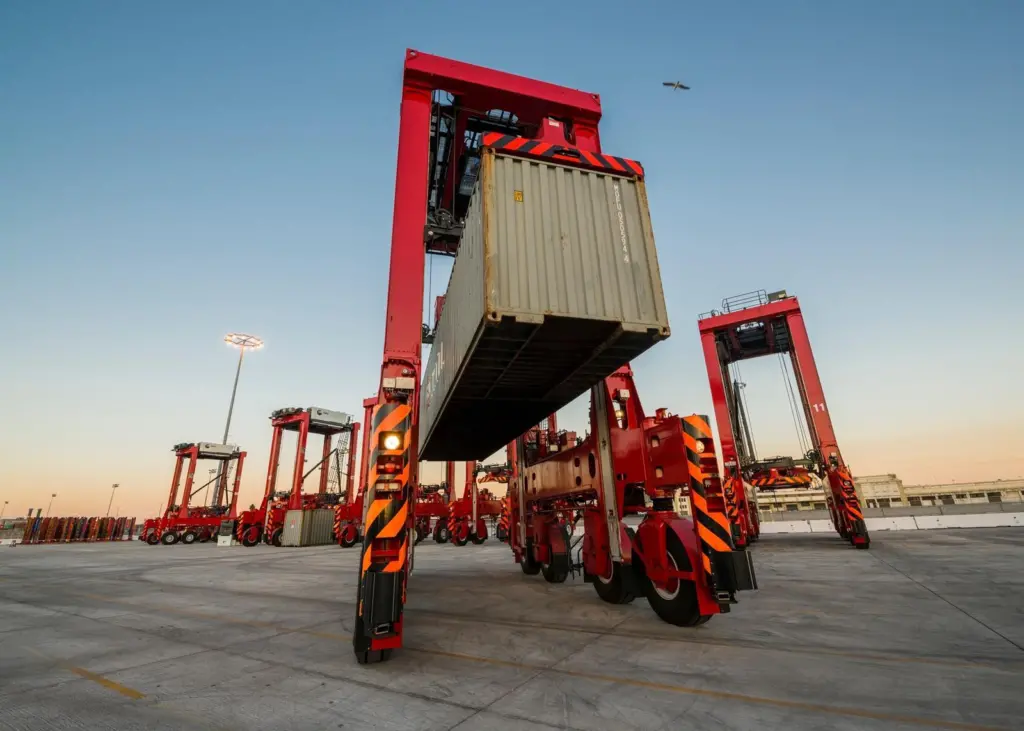
The Port of Virginia and Kalmar, part of cargo-handling giant, Cargotec, have released machine monitoring figures assessing the performance at VIG, one of the port’s two primary container terminals.
“Based on the machine data, the average fuel consumption in operation has been around 10l per operating hour, as the diesel engine only runs about two thirds of the time. On average the machines achieved productivity of 10.5 moves per operating hour,” explained port spokesman, Joe Harris.
“We are extremely satisfied with the results. Thanks to high fuel efficiency, operating costs are at a lower level. We also estimate that one machine produces about 50 tonnes less CO2 emission in a year compared to a traditional machine.
“In the long run, this means significant cost savings and reduced emission levels for our terminal without compromising productivity,” he added.
Data has been collected since October 2015 when the shuttle carriers became operational. Dr Tero Kokko, vice president of Horizontal Transportation at Kalmar, said: “The data from VIG demonstrates that the hybrid shuttle carriers are delivering on the promise and outperforming any competition.”
“They are the first real hybrid shuttle carriers deployed in the USA. We are very proud to be able to help our customer reach its targets,” he added.
In another first, Kalmar will deliver four E-One2 rubber-tyred gantry cranes (RTGs) to Damietta Container & Cargo Handling Company (DCHC), the first order of its kind in Egypt.
The RTGs are set to boost container handling capacity as transshipment increases in the Suez Canal area.
Mika Virtanen, vice president for RTG and STS cranes at Kalmar, said: “We are delighted to have gained this valuable order from a new RTG market for us.”
“As terminal operators gear up for higher container throughput, our RTGs can deliver improved efficiency and cost reduction at various terminals around the globe,” he added.
The cranes have the capability of handling 7+1 wide with 1 over 5 high stacking and a maximum lift capacity of 40 tonnes. The contract also includes spare parts, training and inspection services and the cranes will be delivered this year.
Related Articles
 CONTAINER & CARGO HANDLING
 CONTAINER & CARGO HANDLING
 EQUIPMENT