

Mahgreb article
Moroccos Tanger-Med has thrown the delicate equilibrium in North Africa. What will it take to redress the balance, asks Alex Hughes
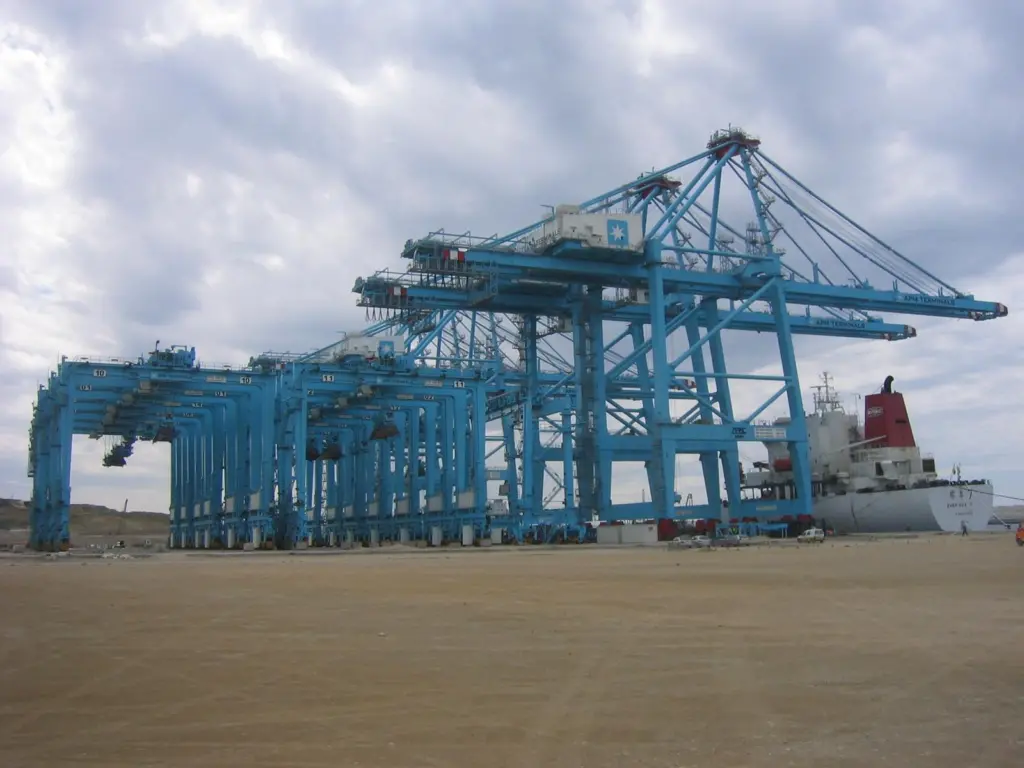
In Morocco, the recent inauguration of Tanger-Med I has changed the entire regional container market. While Casablanca has a modern container terminal, it has been struggling to cope with increased traffic, part of which is now expected to go through Tanger-Med.
The facility is forecast by one regional source to assume the mantle of hub port for the whole of West Africa, while becoming the largest port along the North West African coast.
“The problem faced by Tanger-Med is that its success is generating rival development schemes right along the North African coast. Inevitably, not all of these will see the light of day, while some that are built might find securing traffic harder than they think,” a regional commentator says to Port Strategy.
Within Morocco, the exact impact Tanger-Med will exert on existing and future box terminal developments is not yet fully understood. However, a recent report suggested that a quarter of all import-export containers would eventually pass across its quays.
In fact, at present, it is Casablanca that handles 92% of existing Moroccan container traffic. Over the last eight years, the port has had to accommodate annual growth of 11% and should reach its engineered capacity of 750,000 teu by 2011. There is no obvious additional land into which the port could expand and a certain lack of political will to invest heavily in reclamation work.
Instead, politicians are looking to build a new container terminal facility at the Port of Mohammedia, which is 23km north east of Casablanca on the Atlantic Coast. It would also construct a third berth to handle oil traffic. Mohammedia is already the country’s leading crude oil importing facility, but lacks any infrastructure for the handling of containers.
A pre-feasibility study completed in 2006 suggests that there is a definite financial case for going ahead with construction of a fully fledged box terminal. This would be implemented in two phases commencing this year. The proposed 1.1m teu terminal would be at least 300,000 sq m in area and initially have two berths along 600 metres of quay.
The government would fund breakwaters, dredging and non-terminal works, leaving a concession to finance berths and terminal equipment. The total Phase I cost would be in the region of ¢224.4m ($326.2m), with Phase II estimated at a further ¢162m ($235.5m).
Interestingly, it was calculated that 70% of the total economic benefit of building the box terminal would be derived from savings in the inland transport of goods. In this respect, Mohammedia has significantly better road and rail access/egress than Tanger-Med.
Tunisia’s main container handling port, Radès, nowadays handles in excess of 300,000 teu. Despite this, there is no dedicated container handling facility, while the lack of quayside gantry cranes means that only geared or ro-ro vessels can operate there. Yard stacking is undertaken by straddle carriers. Ports such as Sousse and Sfax in the south are similarly disadvantaged.
“Productivity cannot be compared to that in modern container terminals. Worse still, containers remain in the yard for a long time, due partly to customs inspection requirement on most containers,” notes a local source.
The government in Tunis has therefore put forward a plan for construction of a new deepwater port, at Enfidha, located 100km south of the Tunisian capital. It is close to major shipping lanes, has good road and rail links, while available land is not an issue.
A 2008 study financed by the European Union suggests that Enfidha could fulfil four distinct roles. Firstly, it could function as a major Central Mediterranean transhipment hub, given that this sector is predicted to hit a serious capacity shortage as from 2015. Secondly, Tunisian import-export traffic amounting to 360,000 teu could be making use of the port as from 2020, rising to 830,000 teu within a decade. Thirdly, liquid and solid bulk, not to mention break bulk traffic of up to 4m tonnes is forecast to switch to the port by 2030. Finally, claims are also being made for the high levels of cargo that could be attracted by the proposed Economic & Logistics Activity Zone.
Investment of ¢625m ($908.6m) is needed to build the initial phases of both a container and a multi-purpose terminal. By 2015, the former, expanded over an area of 820,000 sq m, would be handling 3.6m teu, rising to 5.6m teu by 2030. Construction would be phased, with the facility inaugurated in 2011 with an 800m long quay worked by seven quayside gantry cranes. Draught, at 18 metres, would give Enfidha a substantial advantage in attracting the biggest container vessels afloat.
Libya is similarly disadvantaged, having no ports with dedicated container handling facilities. Indeed, most box traffic is handled off-dock, forcing stevedores to truck containers to external bonded areas for customs clearance, stuffing and destuffing. A local source points out that this results in lamentable productivity and low handling rates.
At present, Libya relies on ports at Tripoli, Al-Khoms, Benghazi and Masurata to accommodate existing box traffic. However, given current deficiencies, a new outer harbour extension has been proposed for the latter. Our local source notes that the proposed development of the deepwater container terminal there is needed, since Masurata is seeing a growth in this area. Nevertheless, he points out that there have been schemes to build new container infrastructure in Libya before, although these have not been realised. He cites, for example, the stalled project to relocate box traffic from Tripoli to Al Knoms.
Port Strategy’s editorial director, Mike Mundy, observes that the Masurata project is being backed by the Libyan government, which means that its implementation is being seriously considered. In the meantime, existing facilities at the port are going to be given a boost by the arrival of no fewer than 11 mobile harbour cranes by June this year.
“Masurata could eventually become Libya’s major box terminal, but it will need quayside gantry cranes, not just MHCs, if it is to assume that role,” notes Mr Mundy.
The consultant appointed to oversee the project, Beckett Rankine, says that 2,000 metres of deepwater berth are to be built, along with a 600,000 sq m box terminal. While other details are scarce, a major announcement on the project is expected soon.
Related Articles
 PORT & TERMINAL NEWS
 PORT & TERMINAL NEWS
 PRODUCTS & SERVICES