




MANAGING DOWNTIME RISK
Barry Larrain, Big Trucks Industry Manager, Hyster Company, charts how to comprehensively manage downtime risk with container handling equipment.
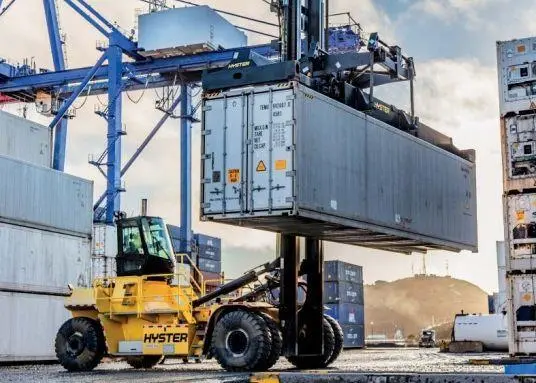
As soon as cargo vessels arrive, port terminals are incentivised to unload them as quickly as possible, freeing space for more shipments and getting vessels back on the water generating revenue. Terminals depend on mission-critical cargo handling equipment, like container handlers, to be ready and available to power through the unloading process. But what happens if unexpected downtime leaves equipment unavailable – and operations shorthanded?
Profits suffer the longer ships sit in port, due to shore power and other expenses, not to mention the opportunity cost of vessels lying dormant. What’s more, delays unloading cargo can thwart on-time delivery to beneficial cargo owners, racking up financial penalties and straining relationships as downstream supply chain consequences come to a head.
As part of complex global supply chains that operate on tight margins, terminals simply cannot afford delays due to equipment outages. Managing cargo handling equipment to minimise the risk of downtime is critical to protecting productivity and profits.
DOWNTIME CAUSES
While some amount of downtime is expected for regular maintenance, service tasks are carefully scheduled to avoid disrupting regular business. Terminals often operate with few surplus pieces of equipment, counting on precisely planned service tasks and the little redundancy they may have to soak up excess volume.
But unplanned downtime is an entirely different story. Little redundancy means reliability is a mission-critical attribute for container handlers, along with the resources and processes to address unexpected issues.
If a unit must be taken out of service to replace a critical part or sensor, the operations department needs to have confidence that the part can be procured and install the part quickly so the truck can return to service in hours – not days or weeks.
So what causes unexpected downtime? Container handlers have long duty cycles, typically operating about 3000 hours per year, for 10 years before being taken offline and replaced. As with most ageing equipment, parts can wear out over time. While many terminals take a more proactive approach to record-keeping and preventive maintenance, it can be difficult to predict when a part might fail.
PARTS LOGISTICS ARE INFLUENTIAL
Not every downtime event spells disaster. But depending on the parts support and service capabilities of the local dealer and the equipment manufacturer, resolution timelines can vary widely, from a swift fix to weeks or even months-long lapses in equipment operation.
The kind of part that is in need of repair or replacement can dramatically shape the significance of a downtime event. A part receives mission-critical designation if its failure can take equipment out of service. Some examples are the joystick, onboard sensors and hydraulic components like pumps and cylinders.
Parts availability and transit time also play a big role in determining the ultimate extent of downtime. Due to the size of some container handler parts, fast shipping methods like air freight are not always a viable option.
If a terminal on the west coast of the USA needs a part that is stocked at a distant location, transit time and customs inspection periods can stall repairs for days or weeks. In the real world, however, when a terminal has an 8000 TEU vessel to unload in four days, it needs that replacement part ‘yesterday’.
MINIMISING DOWNTIME RISK
So how can terminals mitigate the threat of downtime before it happens? Equipment reliability is a good place to start. Reliability and durability are important factors to consider for equipment as a whole and critical parts.
Parts like hoist cylinders for instance, which are essential to the operation of a container handler, are the kind of components that must be built to last – and have a track record of doing so. Purchasing managers can consult with industry peers to help evaluate equipment suppliers and assess maintenance data to understand their records for reliability.
But reliability is only part of the issue. It’s also critical to evaluate if vendors are well-equipped to support and respond in the event of a service issue by securing parts and making timely repairs. Consider the location and resources of your equipment dealer and manufacturer.
Is your dealer able to rapidly deploy parts or service technicians in the event of an issue? Does your local dealer have the financial bandwidth and willingness to stock not only parts necessary for regular maintenance, but mission critical parts that might sit on their shelf for a year, maybe more, simply to ensure that those parts are readily available when you need them?
A terminal’s operations department needs not only a pathway to secure essential parts when necessary, but layers of inventory availability to help prevent extended downtime. For example, some equipment providers may maintain an inventory of essential parts stocked at the terminal’s local dealer, other dealers in the network and a central warehouse in the same state and time zone, with a regular procurement framework in place.
For the most urgently needed but less commonly replaced components, some manufacturers may even source parts directly from their production line to help customers get them as quickly as possible. The financial resources your dealer has at their disposal can also play a role in whether they have skilled and trained service personnel, available in adequate numbers for fast response to diagnose and resolve issues.
One of the greatest challenges for supply chains as a whole and dealers specifically is a lack of trained, experienced service technicians. A well-capitalised dealer may be better equipped to competitively compensate technicians, retaining the steady supply of skilled labour you can count on in a pinch.
SUPPORT IN ACTION
Some terminals with a history of struggling to source parts arrange extra layers of availability to protect supply. In one such case, the dealer and manufacturer worked with the terminal to first identify a list of priority parts, based on criticality and expected need for regular replacement. Then, they forward that inventory to the customer site. The local dealer also stocked critical parts, even during the equipment warranty period, so the terminal could rest assured that parts availability would not keep their equipment out of service.
Another special case involves going above and beyond to provide parts access for a port in a very remote location. The terminal location was so remote that the nearest urban centre and dealer location was thousands of miles away, accessible by a several-hour-long flight.
The only way to transport large parts was by barge, a process that required two weeks. To prevent such long wait times for replacements, the customer received an entire shipping container filled with parts to keep on-site. The dealer periodically ran inventory, using data on parts usage for billing and replenishment, helping keep the terminal stocked with parts on-hand for use at a moment’s notice.
REALISTIC EXPECTATIONS
No equipment is perfect or completely without issue, but examining reliability records for container handlers can provide a reference point to evaluate how equipment compares. Support capabilities can also vary based on geographic location, dealer resources and corporate culture.
As terminals select equipment, collaboration between operations and purchasing personnel can also help terminals balance upfront cost with downtime risk and other factors. When vessels need unloading, the operations department is often in the hot seat, responsible for making sure equipment is available to get the job done on-time.
While purchasing personnel might have a tendency to favour “sticker” price, members of the operations team can provide insight about daily use and support, along with information about how frequently equipment from various providers requires parts and service.
Considering all of these factors together provides a clearer picture of total ownership costs over the life of the equipment – and can help manage downtime risk.
Related Articles
 CONTAINER & CARGO HANDLING
 TERMINAL OPERATIONS
 CONTAINER & CARGO HANDLING