





MEASURING AND MANAGING EMPLOYEE PERFORMANCE
As ports and stevedoring companies have struggled to meet the demands of an increasingly competitive environment by changing the way that people work, a variety of performance management or performance appraisal systems have come in and out of favour. However, there has been surprisingly little research on the type of performance management systems and practices that are actually in use in the port sector, and under what conditions different approaches are most likely to support highly effective performance by staff.
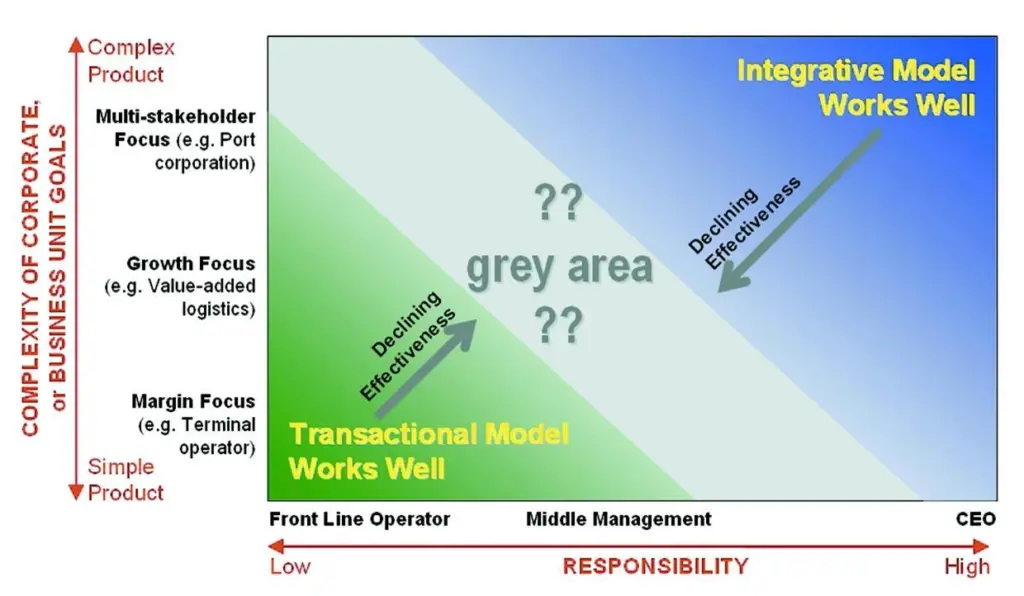
A recently completed Meyrick and Associates study, drawing on the experiences of several port corporations and stevedoring companies in Australia and New Zealand, has identified two basic models that reflect two quite different approaches to performance management: the ‘transactional model’ and the ‘integrative model’.
In the transactional model, there is no expectation that employee and corporate goals are aligned at any profound level. The model accepts that each party is differently motivated, and does not try to change this fundamentally. Rather, it frames the performance issue as a ‘transaction’ between the two: an exchange between two parties in which each gives the other what they want. The parties’ expectations of each other are very simple. Employers and their management representatives expect outputs to be maximised.
Employees expect the employer and its managers to ensure that appropriate conditions are in place to enable them to maximise a clearly defined output, and to reward them financially when they do so.
At the other end of the spectrum is the integrative model. This model is based on a fundamental hypothesis that business and personal goals can and should be aligned, and that business and personal success are interlinked. As a corollary, if the organisation takes care of the welfare and interests of its staff and deliberately links these to the achievement of its goals, then greater business success will be achieved.
In the transactional model the scope of performance is narrow and very clearly defined. Outputs can be precisely quantified, and can (at least in principle) be independently verified. Save for circumstances such as untoward weather or unavailable materials, the outputs that are being measured are virtually within the complete control of the employees. Performance is measured, and rewards are delivered, over a fairly short time span: a fortnight to a month. The rewards will be in the form of a bonus that is paid at frequent short intervals, and the bonus will comprise a large proportion of the total remuneration of the employee.
In the integrative model, the scope of performance is broad, and dimensions of individual performance may be explicitly aligned with statements of corporate objectives. Performance measurement encompasses not only measures of output but also a range of behavioural measures. These focus on behaviours that are considered to be consistent with corporate values and likely to contribute to the success of the organisation on a whole. Monetary rewards in the form of bonus payment tend to be very modest by comparison with those associated with the transactional model. Complementing the bonus payment, however, is a variety of other extrinsic rewards such as health and welfare supports, and the provision of or financial support for training and development, as well as intrinsic rewards such as job satisfaction, challenge and growth.
WHO USES WHAT Performance management systems close to a pure transactional model are being used by container terminal operators for operational staff.
In one such scheme, a worker is rewarded a bonus for the number of containers lifted by the gang in which he or she works. The scope of this scheme is very tightly defined and the outlook very immediate:
Performance is solely about the number of container movements per hour The focus of improvement is on the next fortnight The source of measurement and feedback is just a simple independently verifiable translation of container movements into each fortnight’s bonus payment By contrast with other schemes, issues such as quality, process improvement, or customer service do not figure in the range of performance elements that are considered. Nor is interpersonal discussion usually associated with personal and professional goal setting or review of performance either on a one to one basis or between a supervisor and the team captured by the scheme. In terms of business strategy, however, it connects to the fundamental purpose or core business of the stevedoring company.
Individual reward is based on gang or team performance, since each unit of output – that is container lift – can only be completed through the combined efforts of the gang. Effective teamwork is essential to achievement of a bonus, but no explicit endeavour is made to promote this aspect of behaviour: the premise is that a common interest in achieving the bonus will be sufficient to motivate each individual to behave cooperatively and positively influence peer behaviour and performance.
At the other end of the range are the systems in place in publicly owned port corporations, which provide the most comprehensive examples of the use of an integrative model. Each of the systems is consciously designed to achieve business success by aligning individual performance and divisional objectives with corporate goals.
They encourage personal as well as professional growth and success in individuals through ongoing coaching, mentoring and recognition. In addition, other developmental strategies such as financial support for study and the provision of free health checkups, complement the systems.
Managers and employees must submit a training and development plan as part of the performance management process, and feedback and discussion are integral to the system. The process, as well as the performance measures themselves, is seen as instrumental in improving performance.
AND WHICH ONE SHOULD YOU USE?
Users of both transactional and integrative models point to positive results. Very significant productivity benefits are being achieved for one terminal operator using an exceptionally pure version of a transactional model. It is inherently more difficult to assess the real impact of an integrative rather than a transactional performance management system. But each of the port corporations would cite improving performance ratings, a long history of industrial harmony, increased voluntary participation in continuous improvement initiatives, an increasing trend among staff to take deliberate steps to demonstrate the corporate values, and ultimately their significant financial success as indicators of the positive impact of their systems on corporate performance.
As so often happens in management, success depends on adopting an approach that is appropriate to the context. Appropriateness will demand answers to two sets of factors: the role of the individual in the corporation, and the complexity of the corporate objectives.
A transactional model will be most applicable in circumstances in which business success depends on the delivery of a narrow range of uncomplicated products and services, where corporate performance objectives are simple, and where the outcome required from a particular individual or small group can be clearly defined and measured.
The integrative paradigm is likely to be most applicable when the goals being achieved by the organisation are broad, complex and diffuse, and the orientation is towards long-term business growth and optimal profit. Profit will probably be targeted through the delivery of value-added services involving the development of diversely skilled and qualified staff capable of managing relationships with a diverse range of clients, suppliers and other stakeholders. And, the business may wish to achieve a range of environmental and social goals that meet the disparate needs of diverse stakeholders.
The greatest challenges are faced by those who occupy the middle ground. This problem of the middle ground exists at two levels:
for companies that are in the process of moving beyond the delivery of simple commodified outputs: for example, stevedoring operators making the transition to a more extensive role in logistics for middle management and administrative personnel, whose roles are too limited for individual performance to be clearly reflected in corporate or divisional success, but too broad to be captured adequately by a single, simple measure of performance.
Louise Meyrick is a director at Meyrick and Associates Pty Ltd. She can be reached at louise@meyrick. com. au
Related Articles
 CONCESSIONS & INVESTMENTS
 PORT & TERMINAL NEWS
 INSIGHT & OPINION