



MOL projects incorporated into government programme
Mitsui OSK Lines (MOL) has announced that a number of its joint research and development projects aimed at environmental improvements are to be incorporated into government industry initiatives, as part of a support programme sponsored by Japan’s Ministry of Land, Infrastructure, Transport and Tourism.
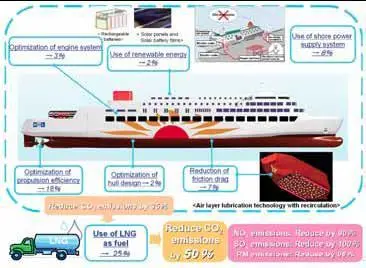
In the first case, a joint project is aimed at reducing CO2 emissions. MOL, Mitsubishi Heavy Industries, Ltd, and Sanyo Electric Group are jointly promoting R&D on a hybrid car carrier using renewable energy. This is part of MOL’s CO2 reduction technology R&D initiative. The company will develop a hybrid power supply system by combining solar power generation technology with lithium-ion batteries. The goal is zero emissions while the vessel is in berth by effective use of renewable energy. Electricity generated by solar panels while the vessel is under way is stored in the lithium-ion batteries. The batteries then supply power while the vessel is in berth, allowing the diesel generator to be shut down. MOL will also construct a hybrid car carrier equipped with this system (slated for launch in 2012), and validate and assess its CO2 reduction effect in actual operation. This project is aimed at establishing more effective CO2 reduction technology for future vessels. MOL has already adopted solar power generation systems on the Euphony Ace, constructed in November 2005, and on the Swift Ace, which joined the fleet in May 2008. The company will further advance this R&D with those vessels. In another project, MOL, Nippon Paint Co and Nippon Paint Marine Coatings Co are jointly promoting R&D on high-performance antifouling paints that improve vessels’ fuel efficiency. This is a key element of MOL’s CO2 reduction technology R&D initiative. MOL points out that ships consume most of their fuel in overcoming resistance when sailing. Reducing this resistance contributes directly to lower fuel consumption and reduced CO2 emissions. The drag of seawater over the vessel’s wetted surface accounts for 50 percent to 80 percent of all resistance, including wind and wave resistance. The R&D project aims to develop a super-slick antifouling paint for ship bottoms that will dramatically reduce fuel consumption. With the addition of a high-performance low ablation additive, the paint will significantly reduce drag. MOL will verify the paint’s effectiveness in CO2 reduction by applying it to its operated vessels and carefully analysing its performance during voyages. The paint used in the R&D project is expected to lower CO2 emissions 8 percent to 12 percent compared to conventional antifouling paints. MOL’s R&D projects are a step towards realisation of the group’s vision for the vessels of the future, announced as “ISHIN-I (car carrier)” in September 2009 and “ISHIN-II (ferry)” in December 2009. MOL continues to work aggressively on R&D to reduce the environmental burden of its vessel operations. Just before Christmas MOL announced the development of a carbon dioxide-reducing, efficiency-boosting fuel additive for merchant ships, in conjunction with Taihokohzai, Japan’s largest fuel additive manufacturer. MOL will use the new additive, called Taicrush HD, on its operated vessels to reduce the environmental impact of its operations. Taicrush HD improves the ignition performance and sludge (carbon and sediment) dispersion in heavy fuel oils. It reduces ignition delay and afterburning time by more than 30 percent. Compared to conventional fuel oil additives for large-scale vessels, Taicrush HD is claimed to promote improved combustion and reduced fuel consumption. This new product was used on 106 voyages of a large-scale Japanese coastal ferry which has a constant sailing schedule and is rarely affected by disturbance effects such as severe marine weather. MOL and Taihokohzai collected and analysed data, conducted engine tests on shore and at sea, and verified fuel efficiency improvements ranging from 1.12 percent to 1.46 percent.
Related Articles
 EQUIPMENT
 ALTERNATIVE FUELS GREENPORT