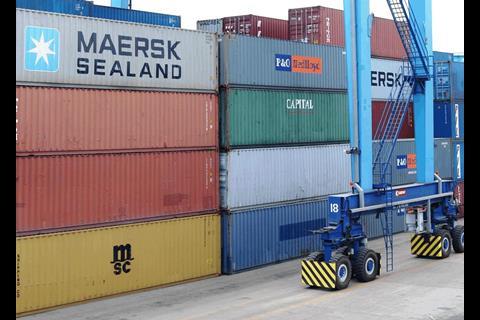
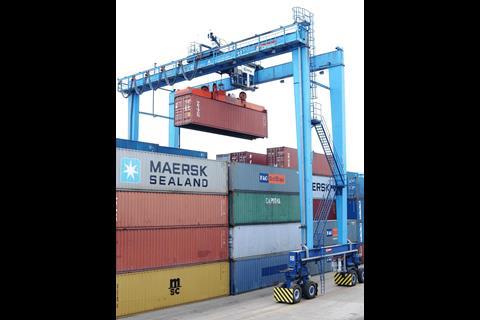
Late last year saw President Kibaki preside over the ground breaking ceremony for the Port of Mombasa’s second container terminal. While the event marked progress, it is very slow progress indeed.
The port’s existing container terminal was originally built with a rated annual capacity of 250,000 teu and while it has seen some expansion and a few rounds of new equipment it still struggles to handle the annual volume of around 800,000 teu now moving through the port.
In truth, the second container terminal project should have been launched much earlier but while the funding has been available – arranged through the Japan International Co-Operation Agency – the project has lacked political will to implement it. It has been something of a ‘hot potato’ politically: on the one hand cargo shippers and shipping lines have been crying out for new capacity and on the other Kenya’s coastal MPs in particular have dragged their feet or been openly hostile to the idea of a second new container terminal.
A substantial number of votes flow from the port’s public sector workforce and as such there has been a reluctance on behalf of the coastal MPs to back a change which may, in turn, trigger other structural changes such as the introduction of a private sector workforce if the terminal is offered for operation by an international terminal operator. There have been other influences at work, namely the operators of the many bonded container storage areas/CFS facilities that now function to act as overflow units to the container terminal. They recognise a modern new container terminal will effectively take their business away. There is also a plan for a private sector-backed deepwater container terminal.
All these different interest groups have played a part in slowing down the second container terminal development. The tendency of government to reach inside and tinker with the KPA has also been another major influential factor.
Frustration
This latter factor has seen some frustration on the part of aid agencies which are not without influence in Kenya and who recognise the fundamental importance of establishing efficiently operated port facilities. They continue to exert pressure on government and to implement work programmes aimed at delivering an international standard port, not one where vessels regularly face major delays and cargo congestion is manifest.
Trademark East Africa (TMEA) is prominent among these organisations and has recently announced that it is investing Sh4.5bn ($53.05m) over the next 5 years (2012 -2016) on improving the efficiency of the Mombasa port.
TMEA is proposing specific technical and grant support that would target both capacity and efficiency at the port. Targeted areas of support include a port-wide productivity improvement study, improving rail linkages and space rationalisation within existing port land, upgrading yard facilities and stacking areas at berths and improving port access.
TMEA estimates that by 2015 the Mombasa Port will need 40% more ship-to-shore equipment, 230% more quay space, and as much as 400% more yard space. TMEA has also committed Sh1.7bn ($21.3m) to the Tanzania Port Authority for work at Dar es Salaam Port. This represents over 29% of TMEA’s current Tanzania programme budget of $73.5m. Analysis of cargo statistics shows that Dar is taking business from Mombasa in key areas and notably in conjunction with transit trade to landlocked countries such as Uganda and Burundi.
The time has surely come for the port of Mombasa to press ahead with its new deepwater container terminal which, after two development phases, will offer a capacity of 1.2m teu per year. With, however, annual throughput forecast at two million containers a year by 2030 the KPA already needs to be thinking about what next?