



New Danish green feeder ship concept
Danish Naval Design and Marine Consultancy Knud E Hansen has developed a design for a fuel efficient 2,000 teu container feeder vessel in cooperation with ABB.
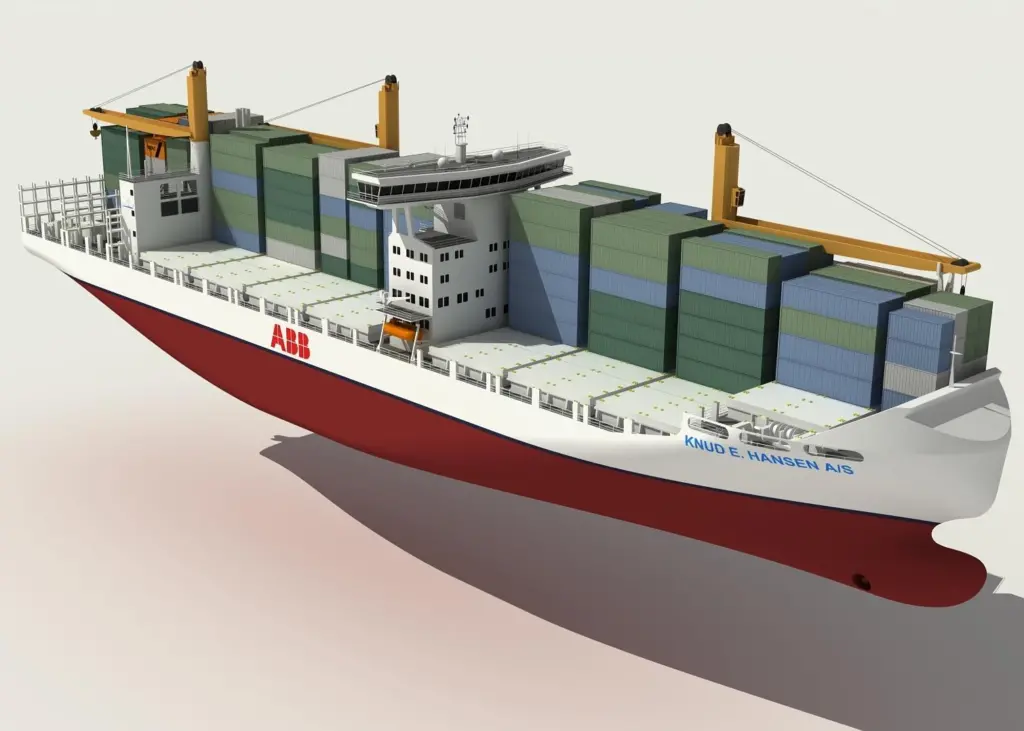
Although the vessel dimensions have been optimised for calling in Bangkok, the designers say that the vessel’s features offer operators efficiency benefits on any route.
The hull design and propulsion configuration together are claimed to offer fuel economy some 15%-25% per teu better than equivalent existing vessels, with reduced environmental impact, less water ballast, slow-steaming potential, flexible transit speeds, loading flexibility and a high container capacity for its size, including higher than usual reefer capacity.
“If you can reduce the fuel consumption per transported container by 10 to 25 percent compared to existing feeder vessels that will certainly have an impact on the total CO2 emission and air pollution from ships”, Jesper Kanstrup, senior naval architect at Knud E. Hansen A/S said to GreenPort.
He added: “We believe that feeder vessels of this size (2000 teu) in combination with ultra large containers liners (+ 18000 teu), which are also extremely fuel efficient, will be the green solution for the future.”
The vessel’s increased propulsion efficiency is down to the use of an electrically driven counter rotating ABB Azipod unit, which also enhances manoeuvrability.
The ABB onboard DC grid system enables the engines to run at optimal load at any cruising speed, enhancing fuel economy and providing the option of highly flexible transit speeds, including slow steaming, which is not the case for the majority of feeder vessels of today.
Importantly, space in the engine casing will allow fitting of scrubbers or a SCR system so that the vessel can be adapted for navigating in ECAs, while provision for containers holding batteries on the aft deck, which can be connected to the DC grid, means the ship can operate in zero-emission port mode if needed.
The vessel features new and advanced technology, so it will be somewhat more expensive to build than a conventional vessel, but with fuel prices sky rocketing and the increased focus on environmental issues, the designers believe that ship owners who are prepared to invest in return for a fuel saving, should see a pay back on the investment within a limited number of years.
Maersk Broker was also involved in the design and has confirmed that it will be exclusive broker for the containership design.
Related Articles
 EQUIPMENT
 ALTERNATIVE FUELS GREENPORT