![PortStrategy[GreenPort]](https://www.portstrategy.com/wp-content/uploads/2026/09/PortStrategyGreenPort.svg)



Chinese funding issues on railroad to nowhere?
In emerging African countries numerous projects have been advanced without sufficientplanning and cost/benefit analysis, as Iain MacIntyre reports
Kenya now has a brand new US$3.6 billion rail infrastructure network in place. However, the “railroad to nowhere” is not operating as part of a vital cost-reducing trade link to landlocked Uganda, as originally intended.
Following completion of the 470-kilometre section from Mombasa on the Indian Ocean coast to the Kenyan capital of Nairobi, the Chinese source of funds abruptly ceased.
The project had been heralded under Chinese President Xi Jinping’s “Belt and Road” (BRI) initiative. Yet China, which is understood to now be the single-largest financial of infrastructure projects in Africa, has had an apparent change of focus and is withholding the US$4.9 billion required to complete the second half of the connection into Uganda.
It is understood the Chinese Government has concerns over the financial viability of both the completed section and, especially, the unfinished section. Moreover, on a larger scale, there appears to be doubt as to whether Kenya and other poorer African nations can successfully service such huge loans.
A March 2018 report published by the Washington-based Center for Global Development stated: “China’s BRI hopes to deliver trillions of dollars in infrastructure financing to Asia, Europe and Africa.
If the initiative follows Chinese practices to date for infrastructure financing, which often entail lending to sovereign borrowers, then BRI raises the risk of debt distress in some borrower countries.
We conclude that eight countries are at particular risk of debt distress based on an identified pipeline of project lending associated with BRI.” With the railroad currently ending about 120 kilometres west of Nairobi, the Governments of Kenya and Uganda are reportedly now planning to forge a completion, of sorts, through reinstating an old Colonial-era rail line.
Meanwhile, in a directly-related development, the completed Mombasa-Nairobi railway is understood to have created considerable congestion at the Nairobi Inland Container Depot.
This Kenya Ports Authority-operated facility is regarded as a major hub for serving the Nairobi market, so issues with respect to congestion and inefficiencies show the need for thorough planning in advance to ensure that connecting developments can ensure there are no bottlenecks in the overall system.
Neighbouring Tanzania is another African country that has ambitions to capitalise on international cargo movement opportunities to and from Uganda and other land-locked nations in the Continent, through its Port of Dar es Salaam. In pursuit of this goal, a significant standardisation project was recently completed between the national rail operators of Tanzania, Zambia and the Democratic Republic of the Congo.
Among other developments, Africa’s first bullet train is to be developed between the western Tanzanian town of Isaka to the Rwandan capital of Kigali. Expected to cost US$1.3 billion for Tanzania and $1.2 billion for Rwanda, the rail line is expected to be completed in 2022.
However, although the country’s railway development plans appear to be advancing positively, it remains to be seen how these will successfully link with the half-completed expansion of capacity at the Port of Dar es Salaam.
This US$420 million project, which is due to be finished at the end of next year, was urgently required to handle burgeoning cargo volumes – and railway upgrades will only add further traffic to the equation.
Such pressures have not been alleviated by the recent stop/start nature of overall Tanzanian port development plans – notably the suspended US$10 billion Bagamoyo Port project.
When halting development of what would have been the largest gateway in East Africa in June, Tanzania President John Magufuli reportedly accused the project’s Chinese backers of “exploitative and awkward” terms that would “only be accepted by mad people”.
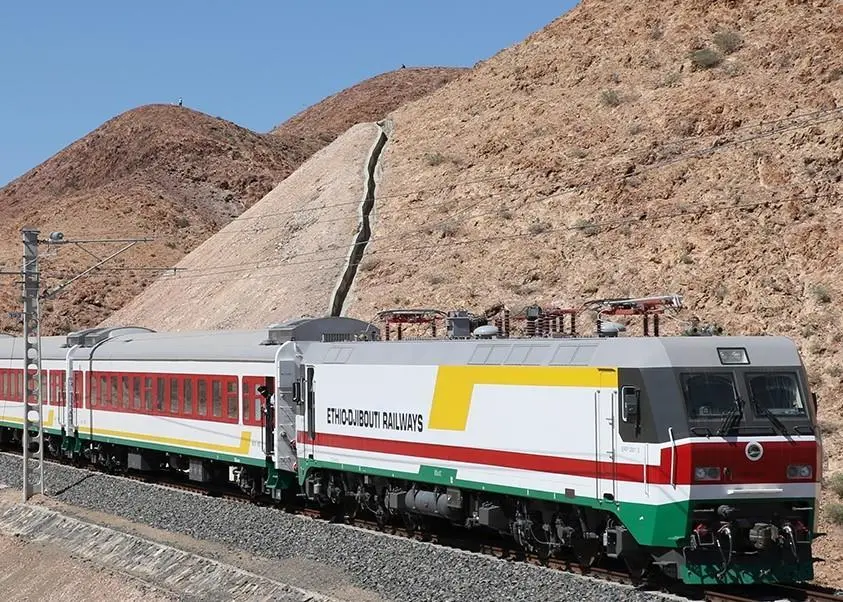
Meanwhile, the 750-kilometre railway between the port in Djibouti and the Ethiopian capital of Addis Ababa – reported to have cost between US$2.5 billion and US$4 billion – has succeeded in significantly reducing this journey time from three days down to just 12 hours.
However, serious issues surfaced in development of the completed project in early 2018, with media describing it as “poorly executed” and rampant with expensive planning mistakes.
To date, it appears the railway is not yet operating at a cost that is sufficient to enable land-locked Ethiopia to gain competitiveness in international trade. The position no doubt being exacerbated by the fact that, as a major source of revenue for Djibouti, the port is arguably highly priced.
Highlighting the point, it is understood that transporting a 20- foot container of garments from Ethiopia to Germany costs 247% more than it would from Vietnam and 72% more than from Bangladesh.
No doubt Ethiopia will be seeking to streamline its internal logistics systems and eyeing other potential external port gateways as a means of developing more competitive trading opportunities.
Ultimately, fellow Africa countries are advised to look carefully into, and learn from, the experiences to date with these and other multimodal developments throughout the Continent.
It would appear success is dependent on detailed and co-ordinated planning, with patient consideration of full financial implications and the cost to a country versus the potential benefits
Related Articles
 EXPANSION & DEVELOPMENT
 CONTAINER & CARGO HANDLING
 EQUIPMENT