![PortStrategy[GreenPort]](https://www.portstrategy.com/wp-content/uploads/2026/09/PortStrategyGreenPort.svg)


From famine to feast
Port Strategy explores the growing container handling capacity of West African ports
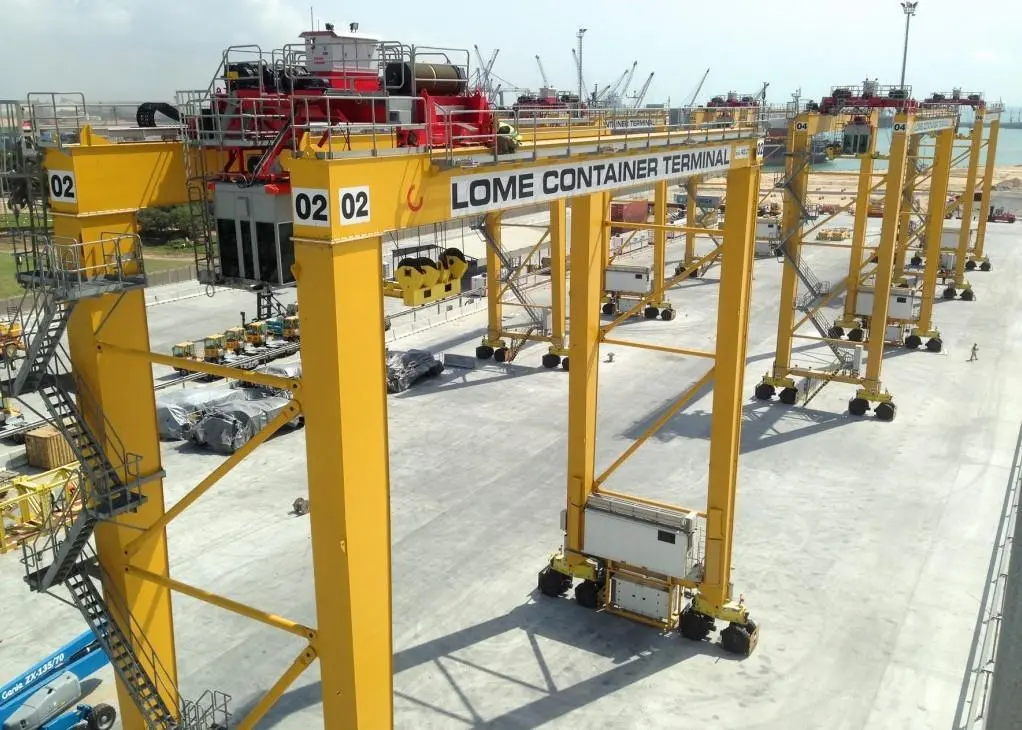
The short-term future will see a major change in the west coast of Africa’s container handling status. November 2014 marked the beginning of this change with the Lome Container Terminal, Togo, opening for business and being nominated as the main hub to be used by Mediterranean Shipping Company (MSC) when serving West African ports in conjunction with its China/Singapore services.
The exclusive focus on the Lome hub as a main port call replaces a direct service calling at three west African ports: Lagos, San Pedro and Abidjan and effectively signals the beginning of the region’s ability to offer modern deep water container handling facilities which facilitate not only gateway operations but extensive transhipment services.
Ten feeder vessels will operate in conjunction with the first phase development of the Lome Container Terminal connecting to nine ports – Abidjan, Cotonou, Douala, Freetown, Lagos (Tin Can), Libreville, Monrovia, Takoradi and Tema – and thereby basically offering a hub and spoke service to deep-sea west Africa liner services.
And it won’t be long before similar deepwater capacity comes on stream in other key ports along the west African coast. In four years the west African coast will see the addition of at least 3.54m teu of new deep water container terminal capacity, all of which is designed to offer both gateway and transhipment container terminal capacity.
In turn, this promises to bring about a revolution in how the coast is served by liner operators in terms of opening up the potential for the deployment of a greater number of direct services and larger vessels of up to 10,000 teu as well as prompting the relocation of many West Coast of Africa linked transhipment operations. MSC is deploying 6,000 teu vessels in its new China/Singapore Lome service, a significant jump up from the 4,100 teu units deployed in its earlier service covering the China/Singapore-West African coast.
Growth spurt
The Lome Container Terminal will also be able to accommodate larger vessel sizes when the time comes, up to as high as 14,000 teu. Similarly, the new Bollore deep water container terminal development in Lome will initially be able to handle vessels with capacities of up to 8,000 teu. The other ports referenced in the accompanying table will also be able to do at least this, with several committed to building in the ability to handle larger ship sizes even in this first phase development.
The overall development plans for each of these facilities also provide for the straightforward implementation of phase 2 expansion works. The hard work involving aspects such as breakwater construction, improving port access and berth line development is invariably undertaken at the phase one stage. Even conservative estimates indicate that Phase 2 works will involve more than a doubling of the estimated phase one capacity delivery.
With regard to transhipment activity this will increasingly be able to be undertaken ‘on the doorstep’ rather than a remote location such as Las Palmas or Algeciras. There are clear location factors in favour of this but equally, if not more, cost factors promote this idea, especially in the central area of the west African coast.
Transhipment traffic owes no allegiance to any specific location especially when a lower cost scenario beckons that can be sustained over the long term. This reality combined with the impact of larger consortia promises to see significant changes with regard to the location of West African transhipment operations.
The sheer scale of planned new capacity has also made it a priority for new hubs to go in pursuit of anchor cargo. MSC through its port investment arm, Terminal Investments limited (TIL), has an equity stake in the Lome Container Terminal. The numerous new terminals in West Africa that APM Terminals has an involvement in – Pointe Noire, Badagry, Bollore Lome terminal, Tema terminal and Abidjan – can all reasonably expect to be given priority where traffic volumes from sister companies Maersk Line and Safmarine are concerned. Certainly, this is already the case with the existing Apapa Container Terminal, Onne Terminal and Douala International Container Terminal facilities.
International Container Terminal Services Inc (ICTSI) has also struck an agreement with CMA-CGM to acquire 25% of its Lekki container terminal sub-concession. This also brings into the frame the prospect of Delmas traffic, the CMA-CGM subsidiary company.
It is likely that moves to lock-in container volume will become more elaborate along the coastline as those international terminal committed to transhipment activity consider in greater detail the potential supply-demand balance. When it comes to dealing with ship owners to build security, however, this is a double-edged sword with their priority being to continually reduce costs while terminal operators pursue healthy margins.
Pricing concerns
There is also a general issue with pricing in certain locations such as Lome, Togo and Nigeria which promise an influx of significant new capacity within a very short timeframe. Will this bring about a significant downturn in stevedoring rates? This is the experience in other locations which have suffered from the ‘too much, too soon’ scenario.
There are undoubtedly challenges associated with West Africa’s coming of age in delivering modern, deep water, container handling capacity – balancing supply and demand along a coastline populated by a large number of countries is undoubtedly one of these. Where gateway cargo is concerned there is also the traditional reality that ports do not function effectively unless they are served by good interfacing road and/or rail infrastructure. This is a concern with a number of the projects highlighted above and an area worthy of ongoing attention.
Secondary port development momentum builds
Secondary port upgrades are also now an area of some activity along the west African coastline. Good examples of this can be seen in the ports of Douala, Cameroon; Cotonou, Benin and at the Conakry Terminal, Guinea.
In response to congestion in the port of Douala and as part of an upgrade programme, Bollore has recently installed four new RTGs at its Douala International Container Terminal and two new heavy duty mobile cranes. An order has also been placed for a new ship-to-shore gantry.
Cotonou is another port that has traditionally suffered from congestion problems but with the recent opening of a brand new container terminal these problems are progressively being eliminated. Ship-to-shore cranes are in place supported by heavy duty mobiles and RTGs operate as the main handling equipment on the landside.
Meanwhile in Guinea, in November last year, Bollore Group inaugurated a new 340m quay at its Conakry Terminal, with a 13m draught alongside, raising the overall container quay length to around 600m. The new quay, built at a cost of €47m over 22 months, enables container vessels upwards of 5,000 teu to be served.
Overall, development activity in what can loosely be termed secondary ports comprises an expanding portfolio of entirely new facility development, existing terminal upgrades and general port improvements including a strong focus on port access arrangements.
Related Articles
 EXPANSION & DEVELOPMENT
 CONTAINER & CARGO HANDLING
 EQUIPMENT