![PortStrategy[GreenPort]](https://www.portstrategy.com/wp-content/uploads/2026/09/PortStrategyGreenPort.svg)


North Africa: Breaking down the barriers to trade
The contrasting fortunes of North Africa’s states are reflected in their port and tradeoperations, as Felicity Landon reports.
The removal of barriers, increased connectivity between nations and further infrastructure development are key to Africa’s economic emergence, said DP World’s group chairman and CEO, Sultan Ahmed Bin Sulayem, earlier this year.
Speaking at the Africa Emergence Conference in Dakar, Senegal, he said: “We do believe in the viability of Africa and we believe in investing in the continent; during our investment in Senegal, we improved efficiency and volumes 135% in ten years.”
Mr Bin Sulayem described the removal of trade barriers as being particularly important. “In Africa, tariffs are 50% higher than in Latin America and Asia. Intra-regional trade in Africa is only 12%, while in Europe, Asia and Latin America it is over 50%.”
The African Continental Free Trade Area could be a vital step. As well as boosting intra-Africa trade substantially, it is expected to set the scene for a customs union within a few years. The AfCFTA entered into force in May 2019 and its operational phase was launched in July this year.
It will be governed by five operational instruments: rules of origin; an online negotiating forum; monitoring and elimination of non-tariff barriers; a digital payments system; and the African Trade Observatory.
The FTA has been described by African Union chairman Moussa Faki Mahamat as one of the instruments for continental integration in line with the objectives of the Abuja Treaty and the aspirations of Agenda 2063. “The speedy entry into force of the AfCFTA is a source of pride for all of us,” he stated.
It is worthwhile to put this massive free trade area into perspective. It could establish a market of more than 1.2 billion people, with combined gross product of more than $3 trillion. The agreement commits countries to removing tariffs on 90% of goods, with more sensitive items to follow and economic trade experts say it could increase intra-African trade by 52% by 2022.
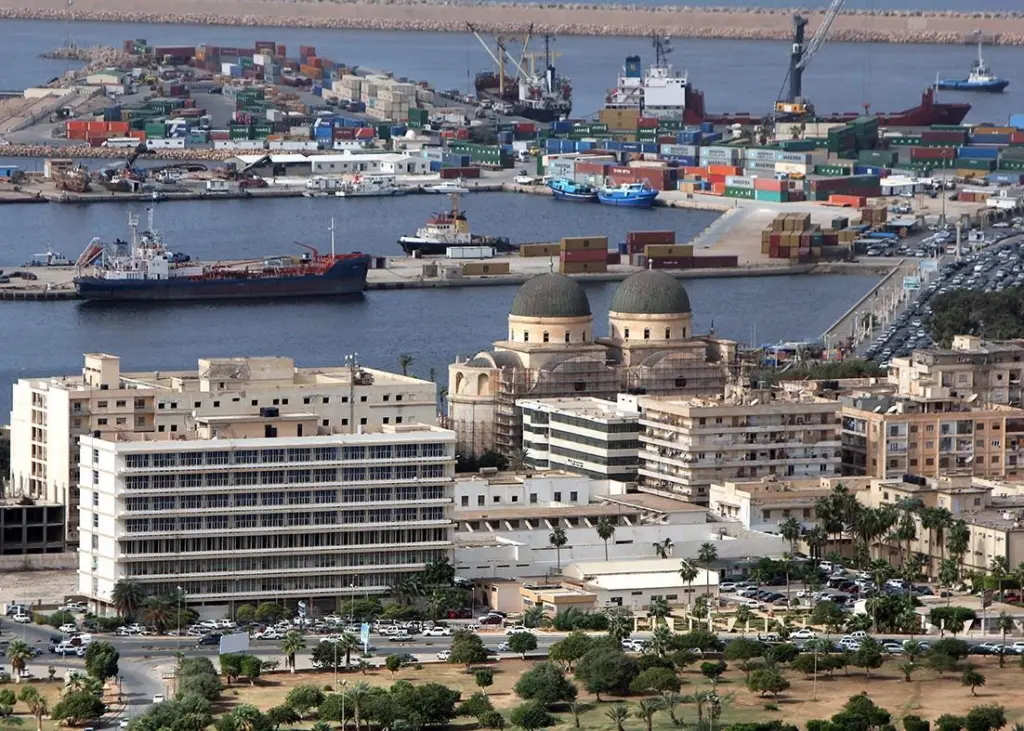
North Africa, of course, is a region of huge contrasts when it comes to trade aspirations and trade realities – ranging from Morocco, home to the vast Tanger Med complex and the sophisticated PortNet Single Window/port community system, to Libya, where continuing civil war means that safety and security advice to port users can change dramatically on a daily basis.
At the end of July 2019, the Libyan ports of Sirte and Derna both remained closed, but others – including Tripoli, Ras Lanuf, Benghazi and Zawiya – are open for business. “The situation in Libya remains extremely volatile and vessel operators should contact local ship’s agents and P&I correspondents for the most up-to-date information on Libyan ports,” North P&I Club reported. “Our local correspondent reports that the violence in Tripoli remains on the outskirts of the city and that the port remains open.”
It advised that vessels calling at Tripoli should make arrangements with agents well in advance, due to the unrest.
Meanwhile, there have been reports of Turkish nationals being detained by the Libyan army in the east of the country. “Correspondents recommend that Turkish flagged vessels or vessels with Turkish crew do not call at eastern Libyan ports without advising the local agent of the situation prior to arrival.”
Gard P&I Club also advised ships that ‘as the security situation is unstable’, they should stay in close contact with their local agent to obtain the most up to date and reliable information. “According to the correspondent, all working ports are currently considered safe for ships and crew. The situation is, however, subject to change and ship operators are advised to warn their ships’ crew of the volatility of the situation and to carry out an assessment of the risks involved prior to entering or transiting Libyan waters.”
Gard also warned ships to avoid navigating in the coastal waters of the closed ports and to declare the intended voyage and type of cargo to be discharged or loaded to the local agent well in advance of arrival at any Libyan port.
The US Coast Guard has determined that ports in Libya are not maintaining effective anti-terrorism measures and has advised ships to “proceed with extreme caution when approaching all Libyan oil terminals, particularly in eastern Libya, due to potential violent and criminal activity based upon recent attempts by armed, non-state actors to engage in illicit export of oil.”
Also at the end of July 2019, Libya’s National Oil Corporation declared force majeure on crude loadings at the Port of Zawiya, due to a ‘valve closure halting crude oil supply’ from the Sharara oilfield to the port. This was the second outage at the field in ten days, reported oilprice.com – staff from NOC subsidiary Akakus Oil Corporation had ‘attempted to reopen the valve but were prevented from doing so by a local armed group’.
The contrast between the chaotic situation in Libya and the trade facilitation systems in Morocco could not be greater. PortNet is a sophisticated National Single Window/port community system which has transformed Morocco’s import/ export activities and continues to expand its influence.
First deployed at Casablanca by the National Ports Agency eight years ago, PortNet has more than 31,000 customers and provides paperless services to around 36,000 users throughout Morocco. In January this year, the NPA and PortNet launched a series of new services designed to ‘make the import/export supply chain practical, integrated and digital’.
They include paperless heavy packages declarations, waste declarations, berthing requests and import/export manifests. Meanwhile, there have been updates to position assignment requests, and to dangerous goods, special goods and export manifest declarations.
“These practical services are part of the digital transformation of the ports’ approach piloted by the National Ports Agency in partnership with PortNet and the port community serving exporters and importers,” says PortNet general manager Jalal Benhayoun. “In doing so, every effort will be made to support economic operators in the adoption of these new paperless services,” he concluded.
In Algeria, recent weeks have seen port congestion at the Port of Bejaia, resulting in CMA CGM giving notice of a port congestion surcharge of US$200 per TEU, effective from August 1st, 2019, to cover extra operational costs incurred from service disruptions.
Elsewhere, Bejaia Mediterranean Terminal is operated by Portek, which holds the concession in a joint-venture with the Port Company of Bejaia and the Algerian Port Authority.
The terminal has maximum capacity of 300,000 TEU per annum and has 500 metres of quay with 12 metres depth, equipped with two quay cranes. It also has a dedicated installation for refrigerated containers, with electrical supply and monitoring services for up to 500 reefer boxes.
In early July 2019, BMT issued a statement saying that in order to cope with ‘the exceptional situation of the extension of the waiting stays in the harbour’ for container ships, it had proceeded jointly with the port company to implement an action plan comprising ‘a series of urgent and operational measures’ to reduce the number of ships waiting.
Just over a week later ‘as part of the continuous improvement of the quality of service at the container terminal’ and to cope with the long waiting periods, it announced: “We would like to inform our valued customers and partners of our commitment to ensure full container removal operations on Fridays starting Friday, July 19, 2019.”
Melilla’s expansion hope
The Spanish autonomous city of Melilla, on Africa’s north coast, is pinning its economic hopes on a massive expansion of its port.
Central government funding is confirmed for the €300 million development, which involves a 25-hectare reclamation project and will effectively create a whole new harbour, but the port authority is awaiting some very specific environmental approvals.
This is because the port area provides a home to thousands of Mediterranean ribbed limpets (Patella ferruginea), a species in danger of extinction and specifically named in the EU’s Habitats Directive.
The limpet population is mainly on the port’s present outer breakwater and this habitat would be destroyed if the breakwater was simply absorbed into the new area that would be reclaimed from the sea.
The solution is to create the extension as a standalone ‘island’, separated from the present port by a wide channel, with old and new ports connected by a bridge.
The new berths will provide 18 metres depth alongside. As well as cargo handling operations, the new space will accommodate industrial, logistics and added-value activities, all of which can benefit from Melilla’s unique tax status.
Melilla’s authorities predict that the development will provide a significant boost to the economy and create more than 3,000 direct and indirect jobs.
Related Articles
 EXPANSION & DEVELOPMENT
 CONTAINER & CARGO HANDLING
 EQUIPMENT