![PortStrategy[GreenPort]](https://www.portstrategy.com/wp-content/uploads/2026/09/PortStrategyGreenPort.svg)


Smart thinking
Kerry Dimmer examines the impact of South Africa’s pioneering spirit on the rest of the world
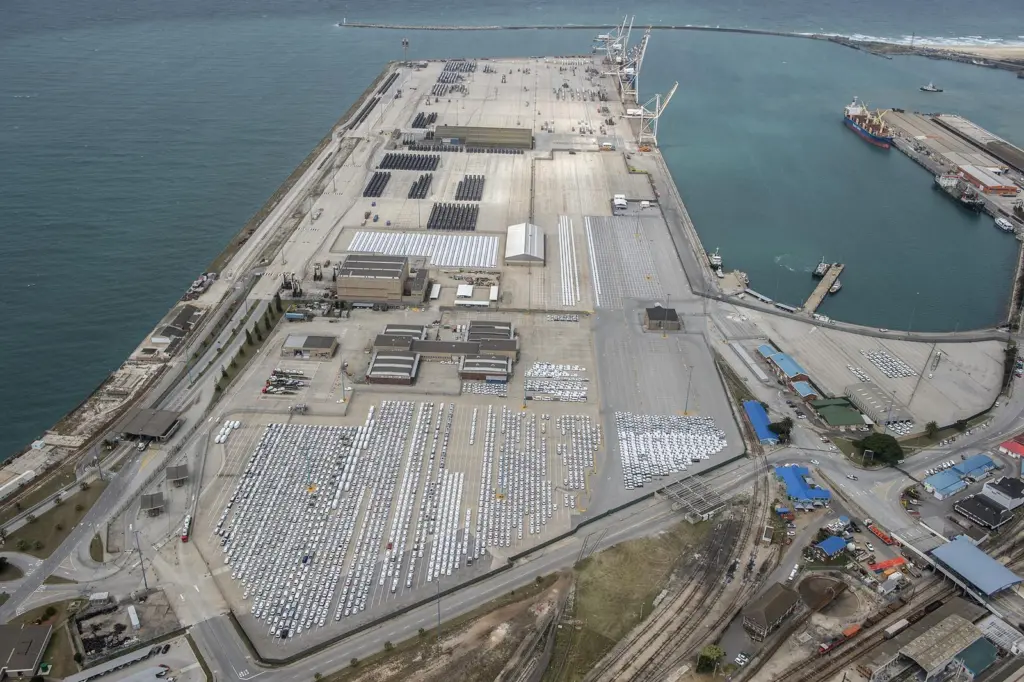
Fast-forward to early 2018 and the final of nine newly constructed tugs is about to be delivered to Transnet National Ports Authority (TNPA). The budget of R1.4bn ($110m) has been met, and well within the timeframe.
Newly qualified chief marine engineering officers are efficiently maintaining the mechanical integrity of the South African ports’ tug fleet, and along with new dredging vessels and marine aviation helicopters, a wider fleet replacement programme is proving that the adoption of South Africa’s state-owned Transnet’s Market Demand Strategy (MDS), is working; that the nation more than has the capability to deliver world-class services at its ports.
Backtrack to 2012 and the announcement of that seven-year R300bn ($24bn) capital MDS investment programme: key objectives included expanding infrastructure, productivity and operational efficiency, economic growth and job creation. Overall, the aim was to ensure the nation’s status as the leading logistics hub for sub-Saharan Africa, and become a globally recognised benchmark for container and heavy haul operations.
How far down the road the MDS has taken Transnet is best answered by Karl Socikwa, chief executive of Transnet Port Terminals (TPT), owner of 20 of the approximately 100 operating licences in South Afric, and hailed by TNPA as one of the best performing in the country, albeit a state-run operation. “Over the past five years we have consolidated our shipping lines to reduce per unit cargo costs. As a result, ships are getting larger, requiring deeper berths and more expansive cranes and landside resources to handle the increased parcel sizes.
“Our investment programme is keeping pace with global shipping industry trends and needs so our ports remain relevant and adequately capacitated to play a meaningful role in global shipping.”
Moving up the ranks
Evidence of this comes in the form of the World Bank’s 2016 Logistics Performance Index. Now classified in ‘The Movers’ category, South Africa ranks 20th in the world out of 7,000 country assessments, a considerable jump from its 34th position in 2014, and taking it into the leadership position of the top-performing upper-middle-income economies, ahead of China.
Mr Socikwa says that the elevation in status can be attributed to satisfying six key criteria including: efficiency of clearance processes (speed, simplicity and predictability of formalities); the quality of trade and transport related infrastructure such as the ports; the ease of arranging competitively priced shipments; the competence and quality of logistics services, such as customs brokers, and the ability to track and trace consignments; and the timeliness of shipments in reaching destinations.
“In targeting ports as a key engine of the government’s economic growth strategy, building freight capacity is paramount,” says Mr Socikwa. “We have therefore had to look at the entire continent’s trending commodities, of which the minerals manganese and magnetite are in high demand.
“We have been catering for this through alternate channels, for instance by using different handling methods and using multi-purpose terminals as well as bulk channels. We have also relocated the Manganese terminal from Port Elizabeth to Ngqura, developed Richards Bay coal facilities for emerging miners, and increased our stevedoring capabilities and efficiencies.”
Growth culture
It’s not an easy climate in which to develop the South African logistics sector, which makes any efforts to elevate the status quo somewhat heroic. The recorded 2016 economic growth for the country was its slowest since 2009 and although modest growth is expected in 2017, it has not delayed the self-funded Transnet’s evolution plans.
What does appear to be stagnating is the seemingly elusive privatisation dream of the enterprise, which Mr Socikwa admits is progressing slowly and therefore justifies giving precedence to TPT’s plans to optimise its existing capital investment portfolio and pursuit of increasing its public sector partnerships.
While the crystal ball remains misty due to some political and legislative uncertainties – particularly that of the mining industry – TPT continues to respond to pockets of growth, such as that of automotive exports and imports. Transnet’s response has been to overhaul its terminals’ outsourcing of driving abilities and Mr Socikwa confirms that berth-deepening projects for Africa’s largest container port, Durban, are in the pipeline.
Despite the uncertain climate, South Africa has continued to maintain its world class container loading and uploading rates at Cape Town and Ngqura Container Terminals. And, with iron ore loadings exceeding 7,000 tonnes per hour for the bulk market, the pressure is on for Durban and Richard Bay Container Ports to follow suit.
Big data revolution
Although the use of big data is relatively new in the port and terminal environment globally, it has the potential to revolutionise the industry. Remarkably, South Africa, is one of few countries that has seized the opportunity that big data presents for the industry, according to the World Bank’s 2016 Logistics Performance Index.
Durban Port is becoming ‘smart’: it uses 18 touch points so that information can be shared across the supply chain, connecting port assets, employees and terminal operators in combination with port communities, inclusive of road and rail.
Durban is also using drones for surveying, sampling and message sending, which Richard Valihu, the chief executive of SATNP, says improves terminal times: “During the testing phase, both aerial and underwater drones proved that track-and-trace technology can be used effectively for inspection of infrastructure and sea bed conditions as well as for the collection of information on port traffic … all of which can be actioned without interruption to usual operational activities.”
Incorporating digital technology to optimise port assets and improve customer interaction includes the introduction of the Spotlight App. “Introduced last July, Spotlight allows transporters to track and trace trucks and containers in the port system,” says Mr Socikwa. “We are also enhancing the fleet management systems to improve maintenance cycles of our assets in the short term.”
Other introductions include the installation of smart meters that convert analogue information to digital data for electricity and water metering. 3D printing is also being explored to ensure ease of port and precinct modelling when planning port development projects.
A smarter way
At any given day, with some 10,000 vessels off Africa’s coasts and 130,000 of those passing through and/or docking at South Africa’s waters annually, taking the country’s ports and terminals to the next level is a no-brainer.
By embracing smart technology, the ports will be able to enhance their customer centric attitude, which continues to be a key focus of all South African ports. With a fully integrated e-commerce platform, expected to go live in the first half of this year, a new ‘Order to Cash’ initiative will be replacing the current PortsOnline system, which customers use for online submission of cargo documentation.
Reports indicate that nine-year-old PortsOnline did significantly reduce the manual capturing process and time taken to conclude online order processing cycles, but that Order to Cash, through its single in-memory computing platform, will enable customers to deepen their interaction with TNPA across a myriad of channels; one such being the organisation’s call centre. Further, it will make visible port processes and improve integrated planning.
Another smart app is the introduction of Transport’s Intelliport, which looks at security. At the Port of Durban, 2,100 high definition cameras operated from a newly renovated control room, aid in detecting security threats ensuring early prevention against incidents that may affect ships or port facilities. This plan is to be rolled out in eight of South Africa’s commercial ports including the TNPA’s head office in Johannesburg.
TAKING TRAINING ACROSS BORDERS
A huge continental impact is also being motivated by the Transnet School of Ports, which has become the Holy Grail of maritime skills excellence. Over the past couple of years, it has trained students from Malawi, Botswana, Mozambique, Namibia, Zambia and Zimbabwe. Graduates completing internationally recognised qualifications include marine pilots, tug masters, engineers, and lifting equipment operators.
These crucial roles are intended to advance capabilities and efficiencies so that African ports can work synergistically to capture new, and sustain existing, investment opportunities entering the continent.
In many respects, this concept mimics how Transnet operates, given that under one umbrella it is not just the ports controller but also has rail and engineering capacity, enabling it to link its logistics provision expansively.
Related Articles
 EXPANSION & DEVELOPMENT
 CONTAINER & CARGO HANDLING
 EQUIPMENT