![PortStrategy[GreenPort]](https://www.portstrategy.com/wp-content/uploads/2026/09/PortStrategyGreenPort.svg)


Transnet pushes ahead with expansion
South Africas port regulator is pushing ahead with expansion plans across the board. Stuart Pearcey reports
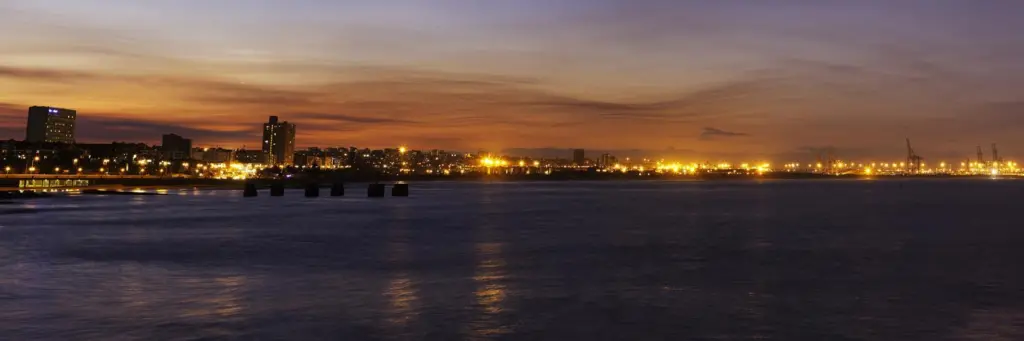
Economic downturn or not, expansion of Transnet’s state-owned ports continues apace.
With the huge Coega Development Zone at its back, and its face to the rest of the world looking out over the Indian Ocean, the new port of Ngqura is set to start business in earnest this month.
Billed as having the potential to be a major container hub for sub-Saharan Africa, and as such South Africa’s flagship port, its location is seven kilometres from Port Elizabeth.
Served by a channel with an 18m draft, and with 16.5m available at its four container berths, the port and its rubber-tyred gantry cranes have the capacity to service post-panamax vessels, and dry and liquid bulkers.
Operators expect the 60,000 square-metre terminal to ramp up to an annual capacity beyond 2m teu.
A landmark in the port project was the arrival of the Zhen Hua Number 21 earlier this year, bearing cargo worth more than Rand72m ($9.2m) in the form of two fully-erected rail-mounted gantry cranes weighing a total of 660 tons, as well as a further 60 tons of small assembly parts, tools, consumables and breakbulk cargo.
Hector Danisa of the Ngqura Container Terminal says special clearance had to be sought to bring the cranes in through the port. “The immense size of the cranes, which were delivered virtually assembled, made it physically impossible to land at the neighbouring Port Elizabeth harbour and deliver them overland. With equipment of this nature, it can only be landed at the terminal at which it will be installed and used,” he said.
The cranes will be used for the movement of containers on and off rail wagons, and will be pivotal in helping the port deliver on turnaround time promises, according to Mr Danisa. “The cranes will certainly assist us in meeting the Ngqura Container Terminal’s promised port-rail turnaround of under six hours. They offer double the handling rate of reachstackers, which are used in some of our port terminals. Pier 1 in Durban recently received similar cranes and is expecting huge results,” he says.
In a massive logistical effort involving Transnet and a team of experts from Covec, the Chinese Overseas Engineering Company, the cranes were brought ashore using rails and jacks, with the ship’s gear used for landing the consignment’s other items.
Ngqura is connected to its hinterland by the N2 highway and a railway line, with a second line linking to the existing rail network currently under construction.
Road and rail links pass through the Coega Development Zone, the 11,000-hectare leviathan that’s promised to be a purpose-built industrial and commercial park. But winning tenants for it is proving a trying task in the current economic climate. “We work harder to convince companies to make investment decisions,” says Development Zone chief executive Pepi Silinga.
Work harder they must; about one in three of the companies the CDC had been talking to are said to have postponed making a commitment as they feel the financial squeeze.
That’s why the promise of the plan by General Motors South Africa to build a Rand250m ($32m) pan-African parts distribution centre there is such a coup, and so important as a ‘sales tool’. Mr Silinga sees the motor manufacturer’s decision as a ‘brilliant signal’ in the face of a downturn posing a challenge to development of the export processing zone.
“Not only are we open for business, but our value proposition remains a compelling one even in these tough economic circumstances,” he says. “The decision by GMSA to invest in Coega is further proof of the value and competitive advantage it and the industrial development zone can provide to investors.
“Not only do we offer fantastic infrastructure and close proximity to a world-class port, but we also ensure our investors receive all the support they need,” he adds.
Further underlining his confidence is this summer’s commitment to build a Rand31m ($4m) power station with a capacity of 3200MW to support activities in both port and development zone. But that’s a way ahead; construction isn’t expected to start until the middle of 2012, with the first 500MW coming on stream 18 months after that.
And further along the coast expansion of the port of Durban to meet predicted increased demand is being planned. Looking beyond the economic downturn the chief executive of Transnet Port Terminals (TPT) Tau Morwe says he expects container traffic growth of about 3% a year until 2014; already there are suggestions of an increase in volumes. Although that’s less than a third of the growth experienced before the financial turmoil, it would still put pressure on the existing facilities.
Over the next few years the annual capacity of the Pier One Terminal, the first of TPT’s facilities to use rubber-tyred gantry cranes, is to be doubled to 720,000.
The slightly smaller Pier Two Terminal could have its capacity increased by 26%, driving up its daily throughput to 950 boxes daily.
To get the boxes away a three-rail terminal already replaces the old two-rail one, and there’s a new truck staging area, up to 2,000 reefer points and automatic gates to speed the flow on traffic into and out of the port, further supporting ship turnaround times by restricting congestion.
Mr Morwe says lack of investment over two decades had caught Transnet Port Terminals in a situation where the terminals hadn’t had the capacity to meet container throughput.
He is convinced that a more capable inland transport network is key to successful developments in the ports, and he sees the future in increased rail capacity. The frequency of container trains between Durban and Johannesburg has been ramped up to eight trains a day leaving the port, with a combined capacity of 800 teu – that’s more than twice as many as had previously been the case.
“Transnet has spent about Rand240m to build a facility at Pier One to ensure that if there is an overflow of trucks, the company can divert these trucks from the terminals. But it is not just the expansion of the terminals that is important. In addition, Transnet’s rail capacity needs to increase so that there are fewer trucks and, as a result, less congestion.”
He’s supported in that by the South African government’s Deputy Director-General for Transport Logistics Clement Manyungwana, who is urging the rail and road sectors to work together to increase rail capacity, so that commodities such as iron ore and coal are not transported by road.
And surely anything which smoothes the passage of cargoes to and from ports must be welcomed wholeheartedly.
Related Articles
 EXPANSION & DEVELOPMENT
 CONTAINER & CARGO HANDLING
 EQUIPMENT