![PortStrategy[GreenPort]](https://www.portstrategy.com/wp-content/uploads/2026/09/PortStrategyGreenPort.svg)


Two axes of connection and capacity
There are plenty of lessons to be learned from West African development, but not everyone is listening, writes Stevie Knight.
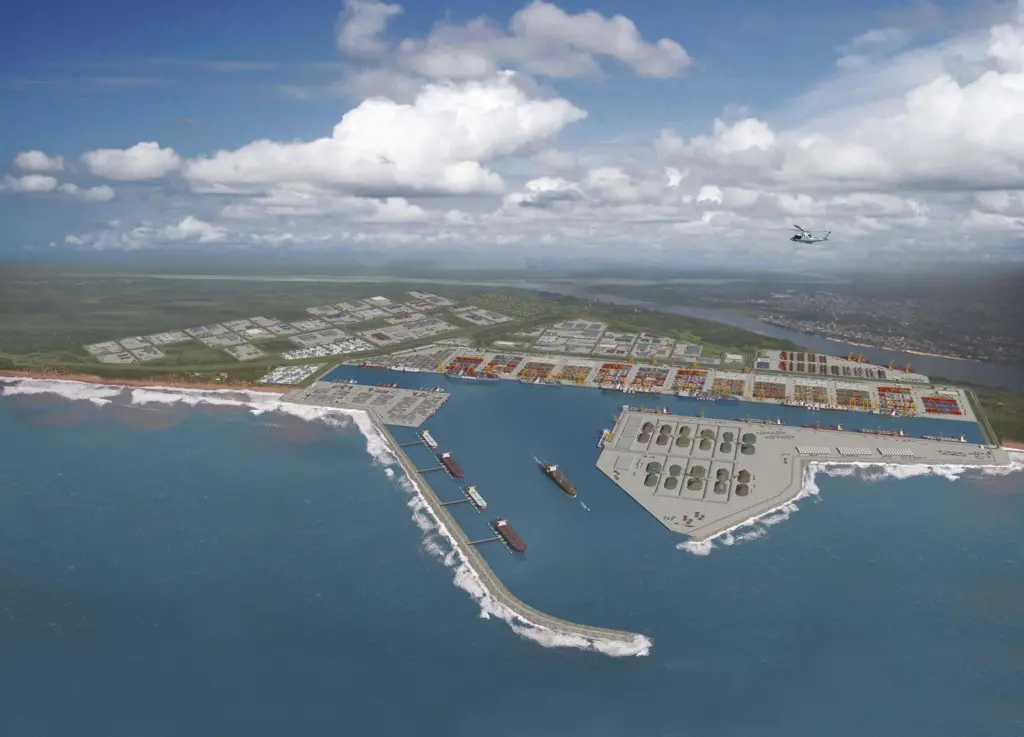
Over a third of the population of West Africa is in Nigeria, and that means Lagos is in the limelight. Not, unfortunately, for the right reasons.
“There’s evidence to suggest that Nigeria is steadily losing its cargo to other country’s ports,” says Darron Wadey of Dynamar. “It was only in 2016 that the Tin Can terminal in Lagos announced, with much fanfare, the largest-ever containership to call in Nigeria. But that vessel was only 4,650 teu. Lome (Togo) has been handling 13,500 teu ships.”
The almost permanent gridlock doesn’t help. “It takes four days to pick up a container from Lagos; there are literally thousands of trucks lining the roads. The price of transport in the Lagos area has tripled, around $500 extra on each load — that’s an enormous cost for both import and export,” said Thomas Westergaard-Kabelmann, of Quantifying Business Impacts on Society (Qbis).
“There’s the congestion, and there are now big port projects to the east and west. If I were Lagos, I’d be very, very concerned,” adds Mr Wadey.
The pointing finger of blame has swung around and around with APM Terminals and DP World both being accused of various infractions, then exonerated. However, there are now plans, some good, some possibly not so great, to relieve the congestion issues.
These range from ditching container deposits (which might add piles of dumped boxes to the issue), to introducing waterway alternatives. It’s a nice concept: a joint venture involving both local operators and Chinese players is looking at switching both box and non-box cargo onto barges. However, a lot does depend on how and where it will be executed, or it will hit the same congestion: both Mr Wadey and Mr Westergaard-Kabelmann point out that it hinges on a quick, efficient shift at the quayside.
Modal connections
It might be tempting to see the issues as simply a characteristic of Lagos, but the problems cinching the port city should be a lesson for others.
Take Lekki, for example. Originally it was dropped by International Container Terminal Services (ICTSI) as when the volumes collapsed, so did demand and the terminal operator exited. However, it’s back on again, this time with an $87m investment from China Harbour Engineering Company (CHEC) picking up where ICTSI left off.
The megaproject aims to be the beating heart of modern Nigeria as it embraces a vast free trade zone which has, according to local media, captured the attention of around 70 companies and should create over 170,000 jobs. Further, it will be home to a massive, 650,000 barrels per day refinery, righting the anomaly of a world-class crude exporter that’s completely reliant on diesel and jet fuel imports.
However, there are no trains and only one viable road connection. Moreover, the Lekki-Epe Expressway, originally built to take 30,000 vehicles, now sees 50,000 a day. Understandably, the lack of infrastructure gave rise to concerns that this ‘beating heart’ would also suffer the same catastrophic arterial failure as Lagos, prompting Ports Authority managing director Hadiza Bala-Usman to call for road, rail and pipeline links or risk Lekki becoming “unmanageable” in five to ten years.
West Africa’s reliance on hydrocarbons dragged many economies down during the oil-price collapse. According to Mr Wadey’s estimates the region’s containerised imports plunged 8.6% from 2.9m teu in 2014 to 2.65m teu in 2016 — although some areas felt it more sharply. Total port handling in Angola’s Luanda, for example, plummeted from over 1m teu to 540,000 in just two years. However, the recovering oil price means imports, now at 2.7m teu (2017), are once again flowing and carrying ports’ ambitions along with them.
Mass of projects
There is a plethora of projects clamouring for attention: among the largest is the aforementioned Lekki, Nigeria, which is adding 2.7m teu. Tema port in Ghana is bringing on another 3.7m teu, while Kribi, in Cameroon, has just added 650,000 teu of capacity and wants to double that for phase two. Then there’s Abidjan on the Ivory Coast with an additional 1.2m teu and the Badagry MegaPort says it wants to kick off with 1.8m teu.
As Mr Wadey explains, even taking only those currently underway, their combined capacity equals his estimate for the region’s total volume last year of 7.6m teu. “If all of it comes online by the end of 2028, West Africa port handlings will have to grow at 5.7% CAGR each year for the next decade to absorb just 80% of the extra capacity.”
Given this, it’s evident that not all will make it. So, what plans are most likely to take root and blossom?
Firstly, there’s Tema. “Ghana is unique because it’s one of the few countries in Africa that exports more than it imports. According to the United Nations International Trade Statistics Database, Ghana’s export was around $14.3bn in 2017, while its import was around $12.7bn,” says Mr Westergaard-Kabelmann.
However, Qbis’ studies showed that Ghana’s biggest port would pretty soon reach capacity. Enter a big new 3.5m teu multipurpose facility right next door which aims to double Tema’s moves per hour and treble the scale of container ships able to call to 13,000 teu. “The rise in productivity will mean port time should drop by 50% per vessel,” he concludes.
The project, which is looking at a ‘soft opening’ next year and a full launch in 2020, has at least some plans to stop it following Lagos into the nightmare: according to Maersk, inside the investment pot is an additional $200 to $300m earmarked for upgrading the road network connecting Accra with Tema port.
Lagos links
While we know there’s a sure link between cargo, investment and economy, the mechanism isn’t easy to define. However, Mr Westergaard-Kabelmann has attempted to do just that for the Lagos project: “We’ve looked at how much this project should improve Tema’s cargo and the investment has the potential to increase Ghana’s exports by between 14% and 17%.” There will also be something of a rise in imports, but to pin that down “requires further analysis”.
He explains it’s a gradual process: “improved terminal capacity and productivity induces shipping lines to respond with more services, more port calls per service, bigger vessels, which in turn — together with more competition — increases Ghana’s competitiveness through lower transport and logistics costs”.
There may also be winners — and losers — in the Democratic Republic of Congo. First came ICTSI’s 175,000-teu Metadi, located upriver and presently engaged in an expensive $40m dredging project to level the draft bottlenecks along its 150-km approach, giving it an initial 9.1-m depth with plans for 11 m in the future. The problem is that DP World has recently unveiled a plan to develop the port of Banana into a 350,000 teu capacity coastal port, which could cut Matadi’s custom off at the knees, points out Mr Wadey.
Then there are those that have a solid customer. “Lome, which is now receiving 13,500 teu vessels, has gone from handling 380,800 teu to 1.94m teu in five years, all on the back of having a substantial patron in MSC who used it to redefine West African trade, turning it into their regional hub,” says Mr Wadey.
Network plans
Given that MSC has retained a singular focus on Lome, its planned 14,000-teu-size upgrade at San Pedro on the Ivory Coast is slightly puzzling.
The answer may be down to the way the West traffic streams are constructed. Despite the increase in Far East cargo routed south around the Cape, his calculations show there’s still a shortfall in dedicated, direct shipping capacity: “I estimate that close to a quarter of all West Africa cargo, including some from the Far East, is routed via relay services from the Mediterranean.” Given this, it’s possible that San Pedro is being tailored for a hub role serving the western part of the Gulf of Guinea and countries further to the north, welcoming in larger ships.
Mr Wadey also includes Kribi, Cameroon in the list of probable successes despite a few hiccups. The original operator ran into trouble so it’s now being run by Bollore, CMA CGM, and CHEC. “Kribi didn’t appear until earlier this year, but it has already got three deepsea direct calls a week and an increasing number of feeder connections from CMA CGM,” says Mr Wadey, although he adds “gains might well be at the expense of nearby Douala”.
However, he has a word of warning for ports aiming principally for hub status: even those that have a current anchor customer “may be building on sand” if they believe they can make it without catering for gateway traffic: “You can adapt a darts adage here: ‘Transhipment for show, gateway for dough’,” he concludes.
Related Articles
 EXPANSION & DEVELOPMENT
 CONTAINER & CARGO HANDLING
 EQUIPMENT